Building a Marble Machine. Have motor, voltage drop 0.2 volts

Thread Starter

Tonyr1084

Joined Sep 24, 2015
9,744
I'm building a marble machine for my grandchildren. It has batteries and a motor that runs marbles up to the top and they drop back down via tracks and such. I have a clamp meter designed to measure AC Amps - NOT DC. I'm trying to figure out how much current the motor draws. I have a 5.1 volt supply running it. Across the motor is 4.99 volts, so there's a 0.2 volt drop. Is there any way I can figure the current from this information?

My goal is to power it by batteries with a push to start button. When the button is pushed a cap charges up and then holds high the gate of an N channel MOSFET. When the voltage bleeds off (via a resistor) the machine stops. Which means the kids can't turn it on, lose interest in it and then run the batteries dead. If they want to run it for 5 minutes (or thereabouts) they push the button. If they're not done with it they can push the button again. It's likely I'll power it from either 4 C cell or 4 D cell batteries.

What I need to know (or why I need to know) the current so I can select a MOSFET that will suit the purpose without any overkill. I'm convinced there's a way to figure the current on the motor. Can use your help.

Gotta go, the cat wants my attention. She's insisting, making it difficult to type.
 

Thread Starter

Tonyr1084

Joined Sep 24, 2015
9,744
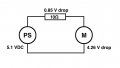
Tried the following: Put a 10Ω resistor in series with the motor. Resistor is just a little warm (1/8 watt maybe, could be 1/4 watt, pretty small). Measuring 0.85 volts dropping across the resistor and 4.26 volts across the motor. I'm certain there's a way to figure this BASIC stuff, but as I've said many a post before this - I'm not good with the numbers. Even if you don't want to give me a fish, at least teach me how to fish and I'll be happy enough with that.

Motor Current.jpg
 

ronv

Joined Nov 12, 2008
3,770
Tried the following: Put a 10Ω resistor in series with the motor. Resistor is just a little warm (1/8 watt maybe, could be 1/4 watt, pretty small). Measuring 0.85 volts dropping across the resistor and 4.26 volts across the motor. I'm certain there's a way to figure this BASIC stuff, but as I've said many a post before this - I'm not good with the numbers. Even if you don't want to give me a fish, at least teach me how to fish and I'll be happy enough with that.

View attachment 133791
If you remember your ohms law you can figure it out. You know the size of the resistor and the voltage drop across it.
I=E/R
 

Thread Starter

Tonyr1084

Joined Sep 24, 2015
9,744
Thanks @ronv I was drawing a blank. Of course I know homes law. Don't know why I blanked out like that.

0.85 ÷ 10 = 0.085 amps. So I can use a 2N7000 N Channel MOSFET for the controlling circuit. Simple RC circuit to hold the gate high with a bleeder resistor do drain the cap voltage until the FET drops out. Push a button and charge the cap again.

[edit] now there's something else I don't understand: I have probably a 1/4 watt resistor (0.250 watt) and calculations suggest 0.4335 watts, almost a half watt. Yet my resistor is not getting too hot to hold.
 

MaxHeadRoom

Joined Jul 18, 2013
30,557
To find the resistance of the motor, which is only relevant on zero rpm BTW, all the rest of the time it depends on load.
Lock the rotor and feed with a small DC voltage and measure the current.
Any other time you will have to measure when loaded.
Max.
 

Thread Starter

Tonyr1084

Joined Sep 24, 2015
9,744
@MaxHeadRoom Measuring current at the moment; I'm limited to an AC amp meter.

[edit] AH - WAIT A MINUTE, I GOT MY DC METER WORKING. Reading 62.8 mA running and 146 mA stalled.

OK, moot point now that I know. Still, don't know why my numbers were coming out so wrong. But now it explains why a 1/4 watt resistor didn't get hot. No where near its limit.
 
Last edited:

ebeowulf17

Joined Aug 12, 2014
3,307
[edit] now there's something else I don't understand: I have probably a 1/4 watt resistor (0.250 watt) and calculations suggest 0.4335 watts, almost a half watt. Yet my resistor is not getting too hot to hold.
How did you calculate that wattage?

W = I * E

You've already calculated the current, so you're halfway there.

(edited because I used inconsistent abbreviations the first time.)
 

MaxHeadRoom

Joined Jul 18, 2013
30,557
@MaxHeadRoom
[edit] AH - WAIT A MINUTE, I GOT MY DC METER WORKING. Reading 62.8 mA running and 146 mA stalled.

OK, moot point now that I know. Still, don't know why my numbers were coming out so wrong. But now it explains why a 1/4 watt resistor didn't get hot. No where near its limit.
The current readings are going to be lower when running, which depends on load, the minimum is full voltage, no load.
Max.
 

Thread Starter

Tonyr1084

Joined Sep 24, 2015
9,744
OK @MaxHeadRoom but I still can't figure out how I came up with 434 mW calculating 5.1 volts times 85 mA. 5.1 x 0.085 = 0.4335 watts (with the 10Ω resistor in series). When I dead stalled my motor with the amp meter in series I read only 146 mA. And the calculated value was done with the motor running.

According to calculated values, running, the motor was working on 434 watts (no load). Didn't calculate it with the motor dead stalled. The measured readings - well, wouldn't they be suspect? No sense in building something and blowing it up because of a faulty meter reading. And I don't have another meter I can use for amp measurements (except the AC Clamp Meter).
 

RichardO

Joined May 4, 2013
2,270
Be aware that your 10 ohm resistor is causing some errors in your readings. When you stall the motor the voltage across the resistor increases and the voltage across the motor decreases. This means that the motor is not running on anywhere near the 5 volts that it will be actually powered by.

Try a lower value resistor and see if your readings change. I would use less than 1 ohm for the resistor. Even 0.1 ohms is not unreasonable if you have one.

By the way...

As to your original intent. I would use a logic level MOS-FET in a TO-220 package and not worry about fine tuning the circuit. You might call that overkill but I wouldn't. This is especially true in your example since the FET will be in the linear operating range for a fair amount of time as the capacitor slowly discharges. You may even need a heat sink.

At the cost of increased complexity you can make sure that the FET is either all the way on or all the way off so it never dissipates any significant amount of power.
A CMOS gate with hysteresis is what I would probably use.
 

Thread Starter

Tonyr1084

Joined Sep 24, 2015
9,744
@MrChips: OK, 0.085 (amps) x 0.85 (volts) = 0.07225 W. 73 mW (unless I got that wrong too)

This is why I never went further than the basics. Math has always been hard for me. Give me a tape measure and a piece of wood and I can build some nice stuff. I LOVE electronics but I hate the math.

When I took physical measurements with my DC amp meter I got 62 mW, but that was without the 10Ω resistor in series. I'd think with it in I should get even lower
 

Thread Starter

Tonyr1084

Joined Sep 24, 2015
9,744
@RichardO 10Ω is the smallest I have in stock. I'd have to scalp something off of a SMD board and I don't feel like putting that much effort into it. Yeah, I know. Lazy sometimes.
 

Thread Starter

Tonyr1084

Joined Sep 24, 2015
9,744
As to your original intent. I would use a logic level MOS-FET in a TO-220 package and not worry about fine tuning the circuit. You might call that overkill but I wouldn't. This is especially true in your example since the FET will be in the linear operating range for a fair amount of time as the capacitor slowly discharges. You may even need a heat sink.
Good point. Hadn't considered that. What'cha think? Maybe use a comparator to switch the FET? I'm not cheap. Lazy maybe, but not cheap.
 

ebeowulf17

Joined Aug 12, 2014
3,307
When I took physical measurements with my DC amp meter I got 62 mW, but that was without the 10Ω resistor in series. I'd think with it in I should get even lower
I don't know if this is what happened here, but there are situations where reducing the supply voltage to a motor will result in the motor drawing more current.

When you add the 10 ohm resistor in series with the motor, you're dropping some voltage across the resistor, leaving less for the motor, so that might explain the lower current draw with no resistor and higher current draw with resistor.

It's not intuitive at all, but motors don't act as "ohmic" loads with consistent resistance. They generate back-emf (voltage in opposition to the supply voltage) when they're spinning and so their apparent effective resistance in operation varies with motor speed.

http://www.ecmweb.com/design/highs-and-lows-motor-voltage

http://www.studyelectrical.com/2015/02/back-emf-and-significance-in-dc-motor.html?m=0

Of course, it's also possible that it was just measurement error. Between resistor tolerances and switching meters, you could get some variation in readings. I wouldn't expect such a large difference just from that, but you never know. If you want to know for sure, use the DC amp measurement function on the motor with and without the 10 ohm resistor in the circuit. That will eliminate any potential error between the direct current measurement method and the voltage measurement method. I'm guessing you'll still see the same increase in current with the resistor added, but I also wouldn't be terribly surprised if I'm wrong on that.
 
Last edited:

Thread Starter

Tonyr1084

Joined Sep 24, 2015
9,744
Thanks @ebeowulf17 that might explain it. For now I'm happy enough that my measurements without the extra resistance suggests an operating amperage between 63 mA and 146 mA. I don't expect it to run anywhere near the max as my gearing is 22:1, so there's a lot of torque with a nice slow motion of marbles toward the top. So with AA batteries I should get a pretty long run out of things. And given that this is for children to play with (everything behind plexiglass) and a timed "Run period" batteries shouldn't become an issue. And I think I'm going to stick with using a FET as a switch and a charged capacitor to hold it on for some as yet to be defined period of time. And timing accuracy is not an issue. If it runs for 3 to 5 minutes at a time I'm sure the kids will enjoy playing with it for that short period of time. The good thing is they don't have to remember to shut it off. So when their short attention span takes them off to something else, the marble machine won't spend all day entertaining itself.
 

shortbus

Joined Sep 30, 2009
10,050
This is why I never went further than the basics. Math has always been hard for me. Give me a tape measure and a piece of wood and I can build some nice stuff. I LOVE electronics but I hate the math.
I'm exactly the same way. Give me something to make in wood or metal and it's done, and done correctly. But math and all bets are off. Back in middle and high school most of the class got it easily, so the teachers moved on not caring about the few of us that were struggling.
 
I suggest usiing a simple momentary switch on the motor. The operator would hold the switch closed and watch the marble go up to the top. Then the operator would let go of the switch and watch the marble decend. I would suggest a bat handle switch large enough for the hand of the operator but sturdy. Though it has been decades since I had anything to do with children under voting age, I would guess having the operator pull the bat handle forward toward herself would increase the sense of power of control over the game.
 
A good way to overcome math fears is to use approximation--that is, round everything up or down so it is 0,1,2,5,10 with any number of leading or trailing digits.

Thus, in your measurement of the current in the resistor you read 85 ma--think .1 amp; You have a 5.1 voltage source--think 5 volts. What is the voltage across the resistor? Think E=IR =.1/10 = .01--If you want, convert that to 10 ma.

How much power does the whole circuit take? Think P=IE = .01 times 5 = .05 watts--if you want convert that to 50 milliwatts.

This is definatly not exact, but it is close enough so that you don't need to worry about burning out the meter or shocking the user.
 
Top