They are kind of the same thing. Beta is the measure of gain and that is how much the current flows... I would think though that power transistors probably don't have that high of a gain but that is just my gut reaction. Voltage and current are physical limitations which to increase would require a larger physical size whereas Beta is the measurement of gain and high gain can be found in small XSTRs which physically are current limited to milliamps. That said, I would say current is easier to increase than Beta.
Anything with greater current beyond a pass XSTR would have to be a relay providing current directly from the supply rail or an outside source. Either SCR or electromechanical.
Anything with greater current beyond a pass XSTR would have to be a relay providing current directly from the supply rail or an outside source. Either SCR or electromechanical.
Yup, forgot about that one. Which is what the TIPs are. Or any multistage transistor amp. And didn't think about resistors on the output which doesn't have any. Which brings up... Are resistors used on the outputs to limit current as is typical for diodes and such?
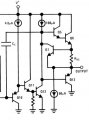
The output stage of most opamps have a current limiting circuit which uses a resistor to bias a shunt transistor if it get beyond a set current usually around 20 mA. The over current can happen regardless of supply voltage... think output short to ground.
The biggest would be my lack of experience with PNP and Darlington Pairs. In the limited BJT study I've done with XSTRs, PNP is explained but all of the analysis is done with NPNs. I'm still coming to grips with negative DC voltage and it is confusing still. The only time I worked with a Darlington Pair it was already in the transistor package and was treated the same as any individual XSTR would be so I don't see it as being at a disadvantage... I need to spend some time on PNP circuits so I can get a better feel for them and dispell some of my confusion. The only real drawback would be too high of a gain from a 2 stage amplifier. This circuit does not need much of a gain if any.
It's the same as NPN except the junction polarities are reversed. To turn on a PNP, you still need to forward bias the base emitter junction. The collector-base junction is reverse biased unless you're operating in saturation mode.
I don't use negative voltages much and have to keep reminding myself which direction current goes. The arrow on the transistor makes it easier to remember.
Saturation voltage and the additional diode drop from the second base emitter could become an issue at the lowest negative output. More so if you used an opamp like uA741 where the output voltage would be limited to 3V from the negative rail.
This is why I'm working on Malvino's Electronic Principles. Grob and Floyd's books were a good overview of DC and AC theory and devices but short on details. I really need a better grounding in XSTRs and opamps. Plus, while doing the bookwork, I am also trying to get some hands-on experience building and testing circuits.
Did you get yours as a kit? I bought both of mine on eBay.
I finally got around to doing something about the ripple I had in mine. In the one I used most, the ripple increased with voltage, so I put a probe on the 10uF caps that were across both zeners and decided they were both bad. I didn't have any axials that size, so I tacked some 470uF radials across the pot terminals. Ripple dropped to less than 5mV, so I decided to check the other one.
Ripple on the second one wasn't nearly as bad, but I tacked some caps across the pots anyway.
It could have been the filter caps on the rectifiers, but I didn't have anything close. Putting caps across the zeners would fix any problems with the oscillator too because it takes its power from the zeners.
I spent most of the repair time cleaning flux residue from when they were assembled. There was some pretty sad soldering too, so I reflowed some of the joints while I was at it. Had several wires from the line voltage stuff break. Users must have had to strip wire because only nicks in the wire would make them break off like that.
Mine came with their "Semiconductor Devices" course back in the 80s. It is the blue one. I looked on fleabay and there were several different models and colors but we have the same model ET-3100. I had been a fan of Heathkit for many years and built several of their Ham Radio gear. My first Ham rig was their HW-101 which I ran for many years and still have. Didn't build it but did many an alignment and repairs on it over the years. Still have it and another one that an old Radio-TV repairman gave me when he was closing up his shop. Sitting on the shelf waiting for me to get around to resurrecting them although the cost of retubing them is daunting. HeathKit was getting out of the kit business and partnered with Zenith and some others and started trying to get into the continuing education business (which was also dying) and I bought several of their courses.
I had been trying to get a Heathkit curve tracer on eBay for years. Finally had to settle for a B&K Precision Model 501A that was sold as not working. All it took was a 7432 to fix it.
Recently picked up a Jud Williams Model A curve tracer on eBay for $45 in a buy it now. Finally, someone on eBay selling used equipment for a reasonable price. Most want $200-300 for a curve tracer now. For that price, it'd be worth building one from scratch.

 Facebook
 Google
 GitHub
 Linkedin