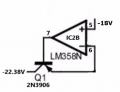
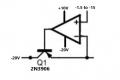
Set this up with both the 731 & 358 w/ 10/-20Vs and both work. However, I was only able to provide -1.5 to -15V to the noninverting pins and used the -20Vs also on the PNP collector.
Other than the 358 is a space saver, I don't see any real difference between them. I read the PDFs and there are some nuances but either one would do the job.
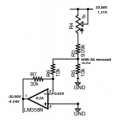
This part gets a bit tricky. I understand the voltage divider and the inverting amp and know it has to do with keeping the signal following and within the rails. When the voltage divider is coupled with R6 it not only divided by half but then by 1/3 so the amp had to be 3X in addition to inverting the voltage. That part of the circuit analysis I am a bit fuzzy on. I measured it dropping to 1/3 when coupled but not quite sure why it happened.
The 1/3 happens because R6 is parallel with ground... this is one of the “magic” with opamps and there are some beautiful things opamps do. Since the NI (non inverting) input is at ground, it equalizes the INV input and puts that at ground (0.03V in this case).
Set this up with both the 731 & 358 w/ 10/-20Vs and both work. However, I was only able to provide -1.5 to -15V to the noninverting pins and used the -20Vs also on the PNP collector.
Other than the 358 is a space saver, I don't see any real difference between them. I read the PDFs and there are some nuances but either one would do the job.
For starters, you should start using schematic fragments when discussing circuits because there will be less assuming and guessing. When you say "used the -20Vs", give specific voltages. Volts and fractions of volts are significant when you operate near the limits.
What were the power supply voltages used for the opamps? The same 9.09V and -21.56V?
I think you're saying that the 741 didn't have as much range as the LM358. Look at the input range (common mode input range) and output voltage swing specs for the two.
NatSemi LM741:
NatSemi LM358:
EDIT: added output voltage swing info.
Do you see any significant differences here?
When you post a schematic of your test circuit, with supply voltages, I can suggest some experiments to help you understand why one opamp might be better than the other for this circuit.
This part gets a bit tricky. I understand the voltage divider and the inverting amp and know it has to do with keeping the signal following and within the rails. When the voltage divider is coupled with R6 it not only divided by half but then by 1/3 so the amp had to be 3X in addition to inverting the voltage. That part of the circuit analysis I am a bit fuzzy on. I measured it dropping to 1/3 when coupled but not quite sure why it happened.
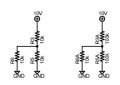
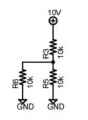
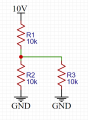
Set up these circuits:
The divider on the left is about what you had in the tracking supply. I removed R4 and changed the value of R3 to make a simpler example.
In the divider on the left, without R6, it's a 2:1 divider. When you add R6, it becomes a 3:1 divider. The reason is that since the non-inverting terminal of IC2A was at ground, the inverting terminal is treated as a virtual ground. I showed it as an explicit ground above.
When I had mentioned in post #196 that any pair of same value resistors could be used to make a 2:1 divider, I mentioned that there could be other considerations.
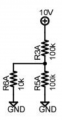
In the circuit on the right, I changed two resistors to 100k. Without R6A, it's clearly a 2:1 divider. When R6A is added, what is the ratio now? Do you see how the magnitude of R3A and R5A interacts with R6A? The impedances between the voltage divider and the inverting amplifier have to be matched to get the correct division.
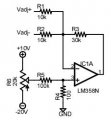
After measuring tracking on two different versions of the tracking supply, I finally got around to doing something about making measuring tracking performance less tedious.
The opamp is using the same +10/-20V supplies as the others.
I should make the multiplication 5X or 10X to make the mental arithmetic easier, but I didn't have any other 1% values handy to test the proof of concept.
LM741C: Vs +/-13V TYP, Vs +/-15 MAX, Vo +/-14V
LM358: Vs +30V -1.5V MAX this is not clear to me appears only 3.5V greater than the 741MAX? Vo 28V so the same as the +/-14V 741?
The LM741 has a larger supply differential than LM358. LM358 typically specifies V+ only because the opamp is designed to operate from a single supply.
When we specify opamp parameters, we usually use worst case numbers because we can't guarantee that we got a typical part. The maximum LM358 output voltage is 3V from the positive supply, the minimum is 20mV
Comparing that to LM741 which is only guaranteed to swing to within 3V of either supply.
After measuring tracking on two different versions of the tracking supply, I finally got around to doing something about making measuring tracking performance less tedious.
When I started seeing up to 30mV of difference between the supplies, I had to dig out the manual for my HP3438A. On the 20V range, it is only accurate to +/-0.1% + 1 digit. So when measuring 18V, the reading could be off about +/- 20mV. The opamp circuit was telling me I had a 30mV difference for +/- 18V outputs; even though the meter showed they were tracking within 10mV.
Not that that small of a difference is more than cosmetic. One of my Heathkit experimenters has 150mV of ripple on the supplies and it has only caused a circuit to malfunction once.
Your using it surprised me at first as one PDF I read lead me to believe it was single supply.
On a different tangent. What are you using to sketch your schematics? After a few cut and pastes, they get pretty hard to read and I keep going back to an earlier version to do so for clarity.
Yep, I understood this. Simple series/parallel circuit.
This fooled me a bit until I took the time to do the math. I calculate a 1.1X amp.
You can use any single supply opamp with dual supplies or any dual supply opamp with a single supply. In the case of LM358, you have to be concerned about crossover distortion because it was designed for single supply operation and the output stage took that into consideration.
On a different tangent. What are you using to sketch your schematics? After a few cut and pastes, they get pretty hard to read and I keep going back to an earlier version to do so for clarity.
Since we're using this as a learning exercise, this is a voltage divider, not an amplifier. The output is 0.083 times the input voltage, so it's more appropriately called an attenuator.
If you used this divider to feed R6 in the tracking supply, the voltage wouldn't be what you wanted with a gain of -3.
When you're designing a circuit, you have a lot of flexibility in component values, but you still have to consider other important parameters.
I have 2 of those and the one I use is the one with 150mV of ripple on the supply. I keep thinking about improving the voltage regulation, but am torn with a desire to keep it stock.
As I have learned. I did an exercise with using diodes to remove crossover distortion and heard that the LM358 is prone to it but have never encountered it using one.
I downloaded the latest Eagle some time back and looked at it but haven't really tried using it. Mostly using LTSpice now but I am interested in a more straight forward (to me) graphics program for schematics.
As I have learned. I did an exercise with using diodes to remove crossover distortion and heard that the LM358 is prone to it but have never encountered it using one.
I downloaded the latest Eagle some time back and looked at it but haven't really tried using it. Mostly using LTSpice now but I am interested in a more straight forward (to me) graphics program for schematics.
LTspice isn't known for making aesthetically pleasing schematics. When I've really needed it to work on some designs, it didn't. So I breadboarded the circuits and they worked pretty much as I expected them to. Now I mainly use LTspice to do operating point calculations when I'm too lazy. For virtually all of what I design, the simulator between my ears is sufficient.
I think the latest free versions of Eagle needed an account. The old version lacks some bells and whistles, but is more than adequate for what I use it for. I don't think it would violate any licensing agreements if gave you a copy of 4.13r1 to use as freeware if you wanted it.
I do use logic simulators because I've gotten lazy or don't want to buy parts. I found a free one that's easy to use and create components for.
Wow those Heathkits would be awesome for the online labs people are doing today because of Covid. I was discussing with my professor about something like that. Coupled with a small scope and DMM and you can do quite a bit of labs.
EasyEDA does have a print to pdf and I've had to print them to troubleshoot. You can print B/W or color, that's a print option. They have just now launched an offline version. You still need to go online to get non standard parts and footprints but the community shared footprints make life easy... you have to check them to make sure they didn't make mistakes. I usually make my own. They have started adding spice sim but haven't bothered. Wow, just noticed they've updated it to 32 layers.
They make some "lab boards" similar to the old Heathkit but they are pricey. I didn't really know what I had back then but yeah they were/are pretty sweet. That was back in the days when HeathKit was dying and they were getting into the Continuing Education partnered with Zenith. I did their entire semiconductor course in the 80s but never kept up with it and forgot it all. Did a few of their micrologic courses as well. By the 90's they were pretty much history.
I have the LM386s but even better I have some NE5532P, OPA134PA, and LM301s. My first real foray into Music amplification didn't go so well and I'll hold off on that for a bit. Mostly just amplifying a sig gen signal so far.
Far too many bell and whistles (typical AutoCAD) and finding basic components very difficult to use. Much more so than EasyEDA was. All I did was just a simple sketch and screen snip. I'm sure it can do much more.
Yep, I use it mostly for simulation and to lay out an exercise circuit to check my calculations against to be sure I'm doing it correctly. Makes a pretty good electronics calculator.
The math and a working circuit can be first then going from simulation to breadboard, nice to dial in voltage.
Each node in the simulation will either match or not to the bread board frequency, voltage, current and scope view.
When your resistor value is off you can change the simulation in turn adjust what ever to accomplish the end result.
A 10 turn 20k voltage divider can fix things when the data sheet and simulator is different from your component.
The simulator can tell you how a particular model likes to run for a particular effect and you can choose which op amp.
In some cases component tolerance errors here and there can cause math to be 20% or more from perfection. The Eco tank color printer.
I will print out the circuit, make notes when I adjust the wrong direction. Before plucking all the parts out, take a picture.
Keep a folder with the goals, math, data sheets, the schematic, picture, bill of materials, the gerbers, notes. then start the tear down.
If you are building various 741 or whatever, all that is valuable for later if it is well organised.

 Facebook
 Google
 GitHub
 Linkedin