Building a +15 -0- -15 DC PSU

sparky 1

Joined Nov 3, 2018
1,218
About the lower cost power supply. Not to bad. The LM317 warm up about 10 minets the internal Vref voltage will change as it warms. You can replace LM317 with a LT1083 some improvement. I use low dropout (100 mA rated) fixed regulators after. The supply is used as a pre-regulator the best ripple rejection for LT1083 is about 16V and under 150 mA.

Fake parts are common place now so keeping a close eye on quality control of your parts inventory is unfortunately necessary.
I use a lot of small zip lock plastic bags I got at craft store and place a paper inside bag with notation.
 

Thread Starter

SamR

Joined Mar 19, 2019
5,497
I was using them because the one I "designed" and built did not work turned down to +/-5V so I still need to do some work on it. The cheapo ones from eBay are not center-tapped secondaries so I link them in series to use as +/gnd/- by center-tapping the series connection so there is no need for a negative regulator. Both use the LM317 positive regulators.

EDIT I was getting some noise on a 10mV input using the 2 PSUs to supply +/-15V so I added another op amp to the board to use as a voltage follower/buffer to remove the noise. Noise not coming from the PSUs but from nearby 3 phase power lines. Uh-oh... They can't power 2 op amps @ +/-15V. could have done 14V but I went and turned them down to 10V. The tiny cheap XFMRs on those kits just don't have much oomph in em. 1N4007 diodes so no problem there but the electrolytics are 25V so +/-15V is about the limit even with a better transformer unless you also swap out the electrolytics. But hey, I got what I paid for, a cheap power supply!
 
Last edited:

dl324

Joined Mar 30, 2015
18,370
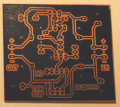
I did a layout for the circuit I posted. The board is 2.25" x 2":
1604451350323.png

Need to get out the ferric chloride in the next few days to etch... Think I'll have to use a couple 4.7V or 5.1V zeners in series because I don't think I have 10V in my stock.
 

Thread Starter

SamR

Joined Mar 19, 2019
5,497
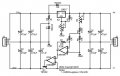
@dl324 Looking over your design, planning to breadboard it, and have a few questions. First the R3 9.09kΩ resistor. Odd value especially with the R4 1kΩ pot next to it? I assume this is to balance the follower to an exact match? The 9.09kΩ value is to set the trim to the exact center of the 1kΩ pot? The R2 2kΩ sets the voltage and the LM358 follows.
 

dl324

Joined Mar 30, 2015
18,370
First the R3 9.09kΩ resistor. Odd value especially with the R4 1kΩ pot next to it? I assume this is to balance the follower to an exact match? The 9.09kΩ value is to set the trim to the exact center of the 1kΩ pot?
The total resistance for R3+R4 needs to be about 10k to give a 3:1 divider. If R5||R6 is a little more than 5k, R3+R4 needs to be more than 10k. If R5||R6 is a little less than 5k, R3+R4 needs to be less than 10k.

If you consider the tolerance of R3, R5, and R6 (for which I used 1% resistors) and the input offset voltage of IC2A, the 1k pot gives you a little room to compensate for the tolerance. Using a 9.1k 5% resistor could leave you with too little resistance for R3+R4 because the 9.1k could be as low as 8.65k. That would only work if R5||R6 was less than 5k.

You could cherry pick resistors for R3, R5, and R6, but that isn't how conservative design is done. I just used some 1% resistors without measuring values. In my case, the 10k resistors were adjacent on a reel and resistors that are next to each other generally have pretty good matching.

I don't know the actual values of R3, R5, and R6 in my prototype. I just know that the 1k pot gave me enough adjustment range to make the absolute value of the voltages track within 0.01V.
The R2 2kΩ sets the voltage and the LM358 follows.
R2 sets the voltage for the regulator. How well IC2B tracks is determined by R3-R7.

R4 will let you account for mismatches between R6 and R7 and any input offset voltage for IC1A.

It goes without saying that the voltage ratings on caps on the input and output need to be sufficiently high. If the input is greater than +/-20V, the positive supply for the opamp needs to be adjusted accordingly. I specified 10V, but the input can get as high as 1.5V below V+ (7.5V with the 10V zener). That gives you a maximum potential V- of about -22.5V. But the LM317 is only guaranteed to give 17V wth a 20V input.

The LM358 inputs and outputs can go to the negative rail, so that isn't a limiter for the negative voltage.
 

dl324

Joined Mar 30, 2015
18,370
tolerance of R3, R5, and R6 (for which I used 1% resistors)
I also used a 1% tolerance resistor for R7. The voltage divider is 3:1, so the inverting amplifier gain needs to be 3.

Now that I've explained how all of the functional blocks work (which hadn't been my intention), all that's left is for you to determine why certain values were selected, why I used a 3:1 divider and 3x amplifier, and why I used LM358. Among other considerations...
 

Thread Starter

SamR

Joined Mar 19, 2019
5,497
Working on it and got a pretty good idea of why the LM358 although trying to get my head around it using negative voltage. Negative voltage and PNP transistors still hard for me to get used to thinking that way. Almost all of my resistor stock is 1% but I had to order the 9.09kΩ and got a couple of 358s instead of relying on my chinesium stock. I really should put the circuit together in LTS to study it. Another something to add to my already somewhat full plate of things to do.
 

dl324

Joined Mar 30, 2015
18,370
Negative voltage and PNP transistors still hard for me to get used to thinking that way.
I have to give it some thought too.
Almost all of my resistor stock is 1% but I had to order the 9.09kΩ
You can use parallel/series combinations to get something close while you're waiting for the parts.
EDIT: 10k||100k = 9.09k
I really should put the circuit together in LTS to study it.
I find it more stimulating to use the simulator between my ears. I use LTspice when I'm too lazy to do the thinking. I'm not proficient with LTspice and it has told me that several of my circuits wouldn't work; when I knew they should (and did).
 
Last edited:

Thread Starter

SamR

Joined Mar 19, 2019
5,497
I haven't done hardly any modeling on LTS with ICs or transistors and not even sure it has the 358 model. Mostly used it for reactive LCR circuits to check my solution to a circuit exercise.
 

dl324

Joined Mar 30, 2015
18,370
not even sure it has the 358 model
Not there by default. I think I downloaded the model from somewhere, but haven't gotten around to installing it.

My usual method is to design it in my head, enter the schematic, and then breadboard. I'll use paper and pen if it requires more thought.
 

Thread Starter

SamR

Joined Mar 19, 2019
5,497
I downloaded and installed the Bordodynov library which includes a ton of Russian transistors and such that I'll never use but it is supposed to be one of the most complete libraries out there. Just haven't used it for more than a couple of transistor circuits.

EDIT: nope, it's not there. only a couple of LM op amps in it.
 

Thread Starter

SamR

Joined Mar 19, 2019
5,497
@dl324 I assume the LM358N in your design is supplied by the +/-20VDC which in this case is more like ~+/-22.4VDC coming out of a DB207 rectifier w/ 1000uF caps on each leg to GND for smoothing.

Ummm... The PDF gives max +/-16V OR 32V max so it is single supplied by the positive rail then? That works!
 
Last edited:

dl324

Joined Mar 30, 2015
18,370
@dl324 I assume the LM358N in your design is supplied by the +/-20VDC which in this case is more like ~+/-22.4VDC coming out of a DB207 rectifier w/ 1000uF caps on each leg to GND for smoothing.
I mentioned in the note that the LM358 supplies were +10V/-20V. In my prototype, I used a zener diode to make the 10V supply and you'll have to do the same. The maximum supply differential is 32V so you may need a zener diode for the negative supply.

clipimage.jpg
I don't know if I'll install all of the electrolytic caps, but I'll have a place to add them if they're needed.

Once you understand how all of the blocks work, the circuit can be simplified.
 

Thread Starter

SamR

Joined Mar 19, 2019
5,497
OK, You switched things up a bit but I got it. Got the zeners put in and getting -19.39V on pin 4 and 9.2V on pin 7. You switched op amp pins but I straightened it out as I assume it doesn't matter which you connect to first so I swapped back to the original I had? And you swapped the 2N3906 for a TIP30C which I don't have. I'm not getting any variable output from the LM358 on pin 7 to the base of the 2N3906. Pretty hard to tell anything from the picture with the breadboard so crowded. Yes I tested the LM358. And I have TIP30Cs on order.

IMG_0803[1].JPG
 

dl324

Joined Mar 30, 2015
18,370
you swapped the 2N3906 for a TIP30C which I don't have.
I mentioned that a power transistor should be used because it could dissipate significant power. Use whatever works for your supply.
I'm not getting any variable output from the LM358 on pin 7 to the base of the 2N3906.
What are the voltages on the opamp pins? What did you use for opamp supply voltages?
 

Thread Starter

SamR

Joined Mar 19, 2019
5,497
With 15.00V on the + rail I am getting +7.36V on pin 2 coming from the R4 pot through R3&R6.
Continuing through R7 I have +6.85V on pin 1. Which jumpers to pin 5.
Pin 3 GND
Pin 4 -19.20 from the zener which provides -19.55.
Pin 6 connected to -rail @-14.45V
Pin 7 -14.85V to base of 2N3906.
Pin 8 +8.03 which is down from the +9.31V supplied by the zener.

So the voltage from the zeners is dropping a bit and not getting any voltage change from the pot adjustment.
 

dl324

Joined Mar 30, 2015
18,370
With 15.00V on the + rail I am getting +7.36V on pin 2 coming from the R4 pot through R3&R6.
Continuing through R7 I have +6.85V on pin 1. Which jumpers to pin 5.
Pin 3 GND
Pin 4 -19.20 from the zener which provides -19.55.
Pin 6 connected to -rail @-14.45V
Pin 7 -14.85V to base of 2N3906.
Pin 8 +8.03 which is down from the +9.31V supplied by the zener.
Are you using the schematic in post #153? Or the one in post #137?
 

Thread Starter

SamR

Joined Mar 19, 2019
5,497
153 except I kept the pinout from 137 on the 358. You swapped the op amps on the #153 schematic.
 

dl324

Joined Mar 30, 2015
18,370
153 except I kept the pinout from 137 on the 358. You swapped the op amps on the #153 schematic.
clipimage.jpg
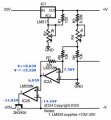
If this is correct, check the wiring on IC2A. With 7.36V on the non-inverting input, the output should be at -19.2 because the input is too high. Is the LM317 output set for around 14.72V?

EDIT: corrected text.

The way I calibrated my prototype was I set the LM317 for the maximum output the circuit could provide and adjusted R4 to get the negative voltage to be the same. When the positive voltage is reduced, the negative output should track (within 0.01V in my prototype).

What is the maximum negative voltage from your rectifier?
 
Last edited:
Top