Buck's PID compensation network poles positioning

Thread Starter

tekkor

Joined Oct 5, 2017
6
Hello folks,

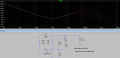
I'm simulating the buck's PID compensation network with ltspice, and found out that in the bode magnitude response both poles move forward when I try to move only the first, by changing C10 in the schema attached. According to the formulas, C10 impacts only on one pole, but in the bode plot both poles seem to be affected. Could anyone explain that? Thanks a lot
 

Attachments

Thread Starter

tekkor

Joined Oct 5, 2017
6
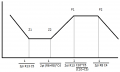
Yes rigth, around 100kHz is where the response changes, because of the poles P1(R13,C5,C10) and P2(R8,C4).
Changing C10 should move only P1 frequency as I undestand, not P2. But in the plot, P2 frequency seems shifted too; that I don't understand, I'm sure I'm missing something...
 

crutschow

Joined Mar 14, 2008
38,355
The R13,C5 corner is 796Hz so is unrelated to the response @ 100kHz.
The R8,C4 is at 70.7kHz so it is combined with the integrator rolloff proved by C10 to provide the rise and fall in response at 100kHz.
So when you are changing C10 you are changing the frequency where the rise in response from R8, C4 intersects with the fall in response from C10.
So changing C10 changes this intersection frequency as would be expected.
You need more separation between the two poles if you want to see the flat area between them.
 
Last edited:

crutschow

Joined Mar 14, 2008
38,355
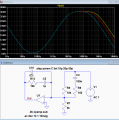
Here's the simulation for the poles arbitrarily separated to see each one separately.
As you can see, only pole P2 changes with a change in C10.
Thus it would seem that the pole equations are in error.
For example, for the values I used, the P2 equation gives a pole at 10.6kHz, which would seem to be P1 not P2

upload_2017-10-5_14-15-57.png
 

Thread Starter

tekkor

Joined Oct 5, 2017
6
If we change components values it can well happen that P1 swap with P2 in frequency, that's ok; but still only one pole I would expect to move, not both. In your plot I can see only one pole is moving according to my expectation; in my plot both move...why is it so?
 
Top