Buck + LDO or not?

Thread Starter

STech2106

Joined Jul 8, 2023
43
I have an board with several chips that operate at 5V (MAX98357A, logic gates (LVC family)) and others at 3.3V, such as the MPU, and two different power sources.

The primary power source: 12V from a switching power supply that is converted from 12V to 5V by a buck converter.

The secondary power source: 5V from USB-C.

The two power sources connect to TPS2116DRL power mux.

The mux output goes to two 3.3V LDO converters for the logic where the maximum input voltage is 5.5V.

The design is intended to have the lowest possible quiescent current.

I have some serious doubts:

1. The voltage applicable to the MUX input is 5.5V (6V max). I am concerned that the buck converter may produce high-frequency spikes and damage the MUX and the two downstream LDOs. Is this realistic?

2. If I insert an LDO with high voltage inputs downstream of the buck converter and increase the output voltage (by how much to be safe?), I would have a dissipation problem and lose a lot of efficiency considering that the currents on the 5V are in the order of 2/3 amps, BUT the good thing about this architecture is that if I insert a TVS diode between the buck and LDO, I would save the 5V LDO and everything downstream from any spikes!

Can someone with more experience than me help me, please?
 

crutschow

Joined Mar 14, 2008
38,506
1. The voltage applicable to the MUX input is 5.5V (6V max). I am concerned that the buck converter may produce high-frequency spikes and damage the MUX and the two downstream LDOs. Is this realistic?
I think you are overly concerned.
Typically, for a well designed buck converter, the output spikes are small and would not do any damage to downstream circuits.
Adding 100nF ceramic decoupling caps from the supply voltage to ground close to those circuits, will help minimize any spikes further.

So I see no reason to add the LDO in your second question.
 

Thread Starter

STech2106

Joined Jul 8, 2023
43
Hi @crutschow

As always, your advice is super helpful.

Maybe, like you said, I'm overthinking it since the voltage limits of the components I'm using are really close to 5V. My concern was based on theory; I don't know if it's a real problem in practice! Thanks for helping me out.

So I can power the logic at 5V and the MAX98357A. This will greatly increase the efficiency of my circuit! That's great!

Do you have any other advice for protecting the components after the buck regulator from slight overvoltage, or will adequate decoupling with capacitors be sufficient?
 

Ian0

Joined Aug 7, 2020
13,131
I use a buck from 24V to 5V and an LDO from 5V to 3.3V. My choice of LDO is the LP2951, which will withstand 30V on its input, so it would need a BIG spike from the buck to cause a problem.
I didn't choose the LP2951 because of its input voltage range, I chose it because of the accuracy of its output voltage. It's a tough little thing!
 

crutschow

Joined Mar 14, 2008
38,506
Do you have any other advice for protecting the components after the buck regulator from slight overvoltage, or will adequate decoupling with capacitors be sufficient?
The capacitors should suppress any spikes, but if you are really concerned about overvoltage from a buck regulator failure, then you could add an overvoltage protect circuit to limit the voltage, or an overvoltage crowbar circuit.

The limit can be done with an TL431 voltage reference IC and a couple transistors.
The crowbar circuit can be done with a TL431 reference, a transistor, and an SCR.

I can post a circuit, if interested.
 

Thread Starter

STech2106

Joined Jul 8, 2023
43
The capacitors should suppress any spikes, but if you are really concerned about overvoltage from a buck regulator failure, then you could add an overvoltage protect circuit to limit the voltage, or an overvoltage crowbar circuit.

The limit can be done with an TL431 voltage reference IC and a couple transistors.
The crowbar circuit can be done with a TL431 reference, a transistor, and an SCR.

I can post a circuit, if interested.
@crutschow
Thank you, something like a crowbar would be appreciated.
 

dendad

Joined Feb 20, 2016
4,637
In my designs for industrial control equipment. I tend to add lots of bypass caps. They are one thing that overdoing it seems to pay off. Quite a lot of our gear has been in operation for 25 years.
I don't think we have had spike problems on the power supplies.
 

Ian0

Joined Aug 7, 2020
13,131
In my designs for industrial control equipment. I tend to add lots of bypass caps. They are one thing that overdoing it seems to pay off. Quite a lot of our gear has been in operation for 25 years.
I don't think we have had spike problems on the power supplies.
My design philosophy as well, but it came unstuck when I got a batch of 1uF 50V Multilayer ceramics that had a tendency to fail short circuit at random when connected across the 5V supply. A short circuit 1206 capacitor is the last thing you look for when faultfinding! (Quite literally, as the 5V rail remained shorted to ground when I had desoldered all the ICs)
 

crutschow

Joined Mar 14, 2008
38,506
something like a crowbar would be appreciated.
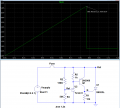
Below is the LTspice sim of an example crowbar circuit:
It uses a TLV431 adjustable voltage reference as a comparator to turn on Q1 and trigger the SCR, which shorts the output, when its Ref voltage, as determine by R2 and R4, reaches 1.24V (Vout ≈ 5.l6V).
You can tweak the value of R2 or R4 to change the trigger voltage.

The fuse is needed to disconnect the supply from the short-circuit current.


1754225736612.png
 
Last edited:

crutschow

Joined Mar 14, 2008
38,506
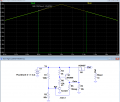
Here's an alternate circuit, using a TLV431, a BJT, and a P-MOSFET, that turns off the MOSFET and disconnects the output, rather than shorting it to ground, when an overvoltage occurs:
It has the advantage of not requiring a fuse.
Similar to the crowbar circuit, the cutoff occurs when the Ref voltage reaches 1.24V.

1754231961537.png
 
Last edited:

Ian0

Joined Aug 7, 2020
13,131
You could use a TVS diode instead of the crowbar. For most of its life the TVS will deal with any spikes that come along.
If the buck fails and puts full supply across the TVS, the TVS will fail short-circuit and act as a crowbar. OK, so you have to desolder it, but at that point you are also having to desolder the failed buck regulator. Not a pretty solution but effective - buck regulators don't fail very often.
Add the resettable fuse, so it can't do too much damage when it happens!
 

crutschow

Joined Mar 14, 2008
38,506
You could use a TVS diode instead of the crowbar.
I doubt that a TVS diode can limit the voltage of a 5V supply to 5.5V if there's a short-circuit failure of the buck-converter switching MOSFET, causing a direct connection from the input voltage to output.
 

Thread Starter

STech2106

Joined Jul 8, 2023
43
@crutschow

I think this is very much what I need, so as not to stress the upstream components, as in the circuit with SCR.
I will try to simulate the circuit with LTspice to understand the response time of the MOSFET. Thank you very much.

My experience: No one TVS diode clamps the voltage to the nominal voltage. TI supplies parts with “flat clamp” technology, but when the working voltage and the clamp voltage are close, a TVS diode is ineffective.

Here's an alternate circuit, using a TLV431, a BJT, and a P-MOSFET, that turns off the MOSFET and disconnects the output, rather than shorting it to ground, when an overvoltage occurs:
It has the advantage of not requiring a fuse.
Similar to the crowbar circuit, the cutoff occurs when the Ref voltage reaches 1.24V.

View attachment 353544
 

crutschow

Joined Mar 14, 2008
38,506
I will try to simulate the circuit with LTspice
Attached is the .asc sim file, along with the model files for the TLV431.

The TLV431 model seems to be difficult to simulate, often giving a "time-step too small" convergence error when doing the transient sim, so be aware of that.
That's the purpose of Csim, for example, which is just to help achieve convergence.

The TL431 will also work (with a Ref trigger of 2.5V), and doesn't have a convergence problem, but it requires higher Vref input current, so R1 and R2 resistors must be about 10 times lower in value.
This may be a problem if you are concerned about achieving minimum quiescent current from the circuit.
 

Attachments

Last edited:

Ian0

Joined Aug 7, 2020
13,131
I doubt that a TVS diode can limit the voltage of a 5V supply to 5.5V if there's a short-circuit failure of the buck-converter switching MOSFET, causing a direct connection from the input voltage to output.
It's always a compromise - a TVS diode is several orders of magnitude faster than a crowbar, especially if there is a filter to prevent nuisance tripping. The choice depends on whether a tall narrow pulse would be more destructive than a wider one which is has less over-voltage.
 
Top