Facebook
 Google
 GitHub
 Linkedin

Well, that's going to be a tough one to accomplish, because with higher power arrays, the Vf can easily exceed what the max Vr is.Yeah, I want to protect against LEDs being put in reverse. I've done this with signal LED's too much to not really worry about it - but a more expensive LED array wouldn't be on my list to blow up.
You can only do so much to protect against facepalms. Connecting an expensive high-power array backwards is something one would do just once, unless they are slow learners, gluttons for punishment, or just like seeing smoke.
re: play with it:
It's mainly the cap across the LED, because it couples the surge to the current sense resistor. This is basically a variation of the same theme I was talking about earlier in the thread; soft-start problems.Thanks. The problem with the smaller caps are the LED gets hit my a high current on startup. But, I found with a 2.2μF cap across the LED and a 220nF to ground works very well, and prevents the high current surge. You can get 2.2µF 16V caps in 0603.
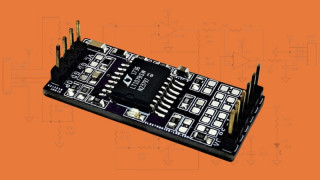
Good catch; I'd just looked at the test fixture that Linear Technology supplied, and they specify 5V for Vlogic and Vcc inputs, which is in contradiction to the datasheet!Also, I noticed you dropped the supply to 5V. This isn't going to work, or if it does, the efficiency will be poor. The synch. driver is only rated 6V - 9.5V on the Vcc and Vlogic lines. I'm replacing the supply with 7.5V...
You should write them a note, indicating the discrepancy, and ask them which is correct.
Why not start with an LM111/LM311, and see how that does/doesn't work?... and am probably going to find some high voltage high speed comparator to run off this same line (any suggestions?)
Remember, the LMx11 has an open-collector output; you'll need to use a pull-up resistor.


 I'm going to use this very same MOSFET in one of my projects, but it is for slow-speed on/off control. LTspice has a similar fet but not the exact same one.