Buck-Boost Converter for High Voltage

Thread Starter

yoshua habibnur q

Joined Apr 16, 2017
8
i got a project with spec :
  1. Vin = 300-340 Vdc
  2. Vout= aprox. 312 Vdc
  3. with load at least 500 Watt
so i use parts my buck-boost with this value
Fsw = 15kHZ - 25 kHZ (using optoisolator TLP250 so cannot above 25kHZ)
L= 3mH
C= 1mF
diode = MUR1560
Mosfet = IRFP460

But, the inductor current goes too high even with input 40 Vdc (duty 50%), the inductor current can reach 6 A with no load(voltage signal is good though like a pure DC). Any solution for this problem? or is there any other suitable topologies for spec above?
 

DickCappels

Joined Aug 21, 2008
10,661
Increase primary inductance and/or increase the frequency.

We would like to see your circuit. Can you get rid of the opto coupled driver and use a faster one?
 

Thread Starter

yoshua habibnur q

Joined Apr 16, 2017
8
Increase primary inductance and/or increase the frequency.

We would like to see your circuit. Can you get rid of the opto coupled driver and use a faster one?
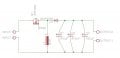
this is my circuit below with with control circuit PWM (arduino UNO and TLP250), if i use higher frequency, what driver and/or optoisolator should i use? lets say above 100khz

Capture.JPG

moderators note : shown image full size
 
Last edited by a moderator:

ian field

Joined Oct 27, 2012
6,536
this is my circuit below with with control circuit PWM (arduino UNO and TLP250), if i use higher frequency, what driver and/or optoisolator should i use? lets say above 100khz
Your circuit is actually an inverter. TI published a book on SMPSU topologies - I think you can download the PDF. Try archive.org first, but it must be around somewhere.

Bush Rank Murphy used this topology in one of their early solid state TVs, but it didn't eliminate the live chassis.

Buck/boost is harder to do (costs more) so most commercial manufacturers use the flyback topology driving a transformer. You can arrange for the output voltage to be within the adjustment range you need, and you can have output isolation if you use an opto coupler in the feedback loop.
 

ian field

Joined Oct 27, 2012
6,536
Hello,

Here is a PDF from TI about buck-boost converters.

Bertus
The circuit posted by the TS wasn't buck/boost - I'd start with a book that at least outlines the different topologies.

Can't remember if the book I'm thinking of includes buck/boost - but the TS has to start somewhere.

In any case, I think the job can be done without so much complexity.
 

bertus

Joined Apr 5, 2008
22,899
Hello,

@ian field , The TS is showing an inverting buck-boost converter.
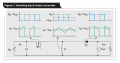
From the posted PDF:

Inverting buck-boost converter TI.png

In the schematic of the TS the capacitors are the wrong way around.

Bertus
 

Thread Starter

yoshua habibnur q

Joined Apr 16, 2017
8
The circuit posted by the TS wasn't buck/boost - I'd start with a book that at least outlines the different topologies.

Can't remember if the book I'm thinking of includes buck/boost - but the TS has to start somewhere.

In any case, I think the job can be done without so much complexity.
i choose this topology because the simplest one for step up and down dc-dc converter comparing with other topologies that i know (cuk, SEPIC ETC)

Hello,

@ian field , The TS is showing an inverting buck-boost converter.
From the posted PDF:

View attachment 124840

In the schematic of the TS the capacitors are the wrong way around.

Bertus
right, but no matter i switch capacitor polarity,i see no different in simulation. does it really affect the works of buck-boost?
 

DickCappels

Joined Aug 21, 2008
10,661
I was surprised to see that Wikipedia calls the present circuit a buck-boost.
Buck–boost converter

One drawback of making the polarity of the output opposite to the input is that the voltage swing on the MOSFET and rectifier is almost double what it would be if the circuit had an output the same polarity as the input. Nothing wrong with 700 VP-P on the drain, but it makes driving the MOSFET harder and makes things a little warmer and more expensive.

If the output polarity were to be the same as the input then another inductor (or another winding on the same core) would be needed to be able to buck or boost depending upon the input voltage.

Yoshua, do you want the output to be the same polarity as the input or opposite polarity?
 
Last edited:

Thread Starter

yoshua habibnur q

Joined Apr 16, 2017
8
I was surprised to see that Wikipedia calls the present circuit a buck-boost.
Buck–boost converter

One drawback of making the polarity of the output opposite to the input is that the voltage swing on the MOSFET and rectifier is almost double what it would be if the circuit had an output the same polarity as the input. Nothing wrong with 700 VP-P on the drain, but it makes driving the MOSFET harder and makes things a little warmer and more expensive.

If the output polarity were to be the same as the input then another inductor (or another winding on the same core) would be needed to be able to buck or boost depending upon the input voltage.

Yoshua, do you want the output to be the same polarity as the input or opposite polarity?
i want same output as input, thus positive output.
 

DickCappels

Joined Aug 21, 2008
10,661
This topology won't do what you specified.
Vin = 300-340 Vdc
Vout= aprox. 312 Vdc

If you want the power supply to be able to accept voltages higher and lower than the output you might want to have another look at the Cük converter.
 

ian field

Joined Oct 27, 2012
6,536
This topology won't do what you specified.
Vin = 300-340 Vdc
Vout= aprox. 312 Vdc

If you want the power supply to be able to accept voltages higher and lower than the output you might want to have another look at the Cük converter.
What most people understand to be buck/boost topology, are more complex and can be a bit challenging.

The cheats way out is to keep the buck and boost stages separate - perhaps boost it to slightly above the required voltage and then buck it down to that.

Most mains SMPSUs with PFC use 2 stage conversion - The PFC stage is actually a flyback boost converter with no mains reservoir electrolytic. Most are followed by a second flyback stage with transformer output - it gives isolation and more or less fails safe. If the transistor in a buck regulator fails short circuit - it stuffs the input voltage straight through to the load.
 
Top