Buck boost converter design

Thread Starter

Devasakayam

Joined Sep 30, 2014
6
I am working on designing a buck boost regulator for charging a 12 volt battery using a solar panel as source.
voltage output of solar panel varies from 19 volt to 21 volts.
Specifications are:
V input = 19 to 21 volts
V output = 12 v dc
Current output = 5.5 A

How to calculate the inductor and capacitor values for a particular frequency say 100khz?
What must be the current and power ratings of the components?
Plz help me with this. I have surfed through a lot of sites but none mentioned about how to get the required current output?
 

Alec_t

Joined Sep 17, 2013
15,117
Current output = 5.5 A
Is that the short-circuit current of the panel in full sunlight, or the current you are hoping to get from the 12V output?
To charge a 12V battery you will need more than 12V.
 

MrChips

Joined Oct 2, 2009
34,807
I am working on designing a buck boost regulator for charging a 12 volt battery using a solar panel as source.
voltage output of solar panel varies from 19 volt to 21 volts.
Specifications are:
V input = 19 to 21 volts
V output = 12 v dc
Current output = 5.5 A

How to calculate the inductor and capacitor values for a particular frequency say 100khz?
What must be the current and power ratings of the components?
Plz help me with this. I have surfed through a lot of sites but none mentioned about how to get the required current output?
You need to reconsider your specifications.

For a solar panel you can expect your Vinput to be 0-21V, not 19-21V
To charge a lead acid battery you will need Voutput = 14.5V
You cannot have constant voltage and constant current both at the same time.
If your max Current output = 5.5A @ 21V, is your solar panel capable of producing in excess of 115W?
 

ronv

Joined Nov 12, 2008
3,770
Yes, MrChips is right.
You might post the specs for your panel and the amp hour rating of the battery. Often a panel made to charge 12 volt batteries will have an open circuit voltage of 19 to 21 volts, but is almost a perfect match for charging a 12 volt battery.
 

SgtWookie

Joined Jul 17, 2007
22,230
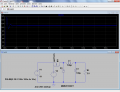
I've modified your file a bit.
1) Your design is not buck-boost; it's only a buck. The output voltage can never exceed the input voltage.
2) I reoriented the N-ch MOSFET so that the gate is on the left and the source is down; I've also selected a MOSFET with Vdss=30v and a low Rds(on). The default MOSFET has very poor characteristics; you really must select one from the list or add the model of the MOSFET you wish to use.
3) You had the gate voltage referenced to GND - in the real world, this will result in sudden death of the MOSFET, as Vgs may exceed the maximum limit due to transient voltages aka "spikes". Most MOSFETs have a ±20 Vgs limit, and a goodly number of them have a limit significantly lower (I've seen as low as ±12v.)
4) I increased the times of the gate drive.
5) Added provisions to start the voltage on the output higher than zero.
6) Added a current source I1 that acts as a load.

The circuit has very significant overshoot and "ringing", and there is no control of the output voltage nor current. Your challenge is to add these.
 

Attachments

Thread Starter

Devasakayam

Joined Sep 30, 2014
6
I've modified your file a bit.
1) Your design is not buck-boost; it's only a buck. The output voltage can never exceed the input voltage.
2) I reoriented the N-ch MOSFET so that the gate is on the left and the source is down; I've also selected a MOSFET with Vdss=30v and a low Rds(on). The default MOSFET has very poor characteristics; you really must select one from the list or add the model of the MOSFET you wish to use.
3) You had the gate voltage referenced to GND - in the real world, this will result in sudden death of the MOSFET, as Vgs may exceed the maximum limit due to transient voltages aka "spikes". Most MOSFETs have a ±20 Vgs limit, and a goodly number of them have a limit significantly lower (I've seen as low as ±12v.)
4) I increased the times of the gate drive.
5) Added provisions to start the voltage on the output higher than zero.
6) Added a current source I1 that acts as a load.

The circuit has very significant overshoot and "ringing", and there is no control of the output voltage nor current. Your challenge is to add these.
Thanks for your help sir...!! :)
But what if i have to boost the input value so that I can charge two 12 V batteries connected in series??
 
Top