Can the word 'breakdown' as 'breakdown voltage' and others alike be replaced by the word 'destruction' in data sheets / technical specifications and mean the same ?
Can the word 'breakdown' as 'breakdown voltage' and others alike be replaced by the word 'destruction' in data sheets / technical specifications and mean the same ?
Can the word 'breakdown' as 'breakdown voltage' and others alike be replaced by the word 'destruction' in data sheets / technical specifications and mean the same ?
“A lot of native speakers are happy that English has become the world’s global language. They feel they don’t have to spend time learning another language,” says Chong. “But… often you have a boardroom full of people from different countries communicating in English and all understanding each other and then suddenly the American or Brit walks into the room and nobody can understand them.”
Can the word 'breakdown' as 'breakdown voltage' and others alike be replaced by the word 'destruction' in data sheets / technical specifications and mean the same ?
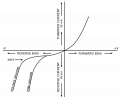
No. Breakdown, in this context, basically means a point at which the behavior drastically changes due to the limits of some mechanism being reached. In some devices, such as Zener diodes, that change in behavior is what we are relying on for the desired operation in the circuit. In most cases, the breakdown itself is not destructive, but the change in behavior can permit moving into a region of operation, usually by allowing large current to flow, that quickly causes the destruction of the device. If the circuit prevents these destructive events from occurring, there is a good chance that the device will be undamaged, although, depending on the specifics, the breakdown itself may also cause permanent damage that may be sufficiently minor that the device appears to recover and work normally (possibly with somewhat different characteristics and perhaps with shortened lifetime), if multiple breakdown events happen, may result in cumulative damage that, at some point, causes premature device failure.
Hi. Do not add to the headache, please. 'native' means born in. Being born-in does not mean speaking the 'globish' language.
And America is a continent. Born in Cuba is as american as from any other american country. Be it Colombia or the United States. Both are in America.
Now I earned myself some spanking... be gentle.
From the etymonline link, seems breakdown means something not functioning any more even if not destroyed.
Hi. Do not add to the headache, please. 'native' means born in. Being born-in does not mean speaking the 'globish' language.
And America is a continent. Born in Cuba is as american as from any other american country. Be it Colombia or the United States. Both are in America.
Now I earned myself some spanking... be gentle.
From the etymonline link, seems breakdown means something not functioning any more even if not destroyed.
Ordinary diodes, Zener diodes, neon lamps, etc. exhibit exponential increase of charge carriers at certain voltages. "Breakdown" is the wrong word to use but unfortunately that is the word often used.
Diodes exhibit rapid increase of current when forward biased but we don't call that "breakdown".
CMOS structures exhibit SCR-type latchup under certain circumstances. Total destruction can be avoided if the "breakdown" current is limited. Thus, destructive breakdown usually occurs when the current through the device exceeds the maximum current carrying capacity of the structure.
If device datasheet has a "breakdown" specification, you would be wise to avoid coming anywhere near that condition. That is simply sound engineering practice.
Hi. Do not add to the headache, please. 'native' means born in. Being born-in does not mean speaking the 'globish' language.
And America is a continent. Born in Cuba is as american as from any other american country. Be it Colombia or the United States. Both are in America.
Now I earned myself some spanking... be gentle.
From the etymonline link, seems breakdown means something not functioning any more even if not destroyed.
As has been pointed out a few times, most zener diodes rely on operating in reverse breakdown. Below 5.6 V, the Zener effect dominates and is due to quantum tunneling. This effect has a negative temperature coefficient. Above 5.6 V, avalanche breakdown dominates and exhibits a positive temperature coefficient.
Just avalanche breakdown and zener effect (often called zener breakdown, but that's probably a misnomer). Knee voltage merely refers to the (appoximate) voltage at which the characteristic bends over when reverse biased. Reverse breakdown is a generic term. All diodes have a reverse breakdown voltage. You can use a normal diode just like it's a Zener diode, it's just that it is manufactured to that its knee voltage is above some minimum value and how far above that minimum value is neither documented nor is any effort made to control it.
Just like a Zener diode being used as a Zener diode, it is the responsibility of the person designing the circuit to limit the reverse current to a level that will not damage the device. This is much harder to do with normal diodes because their breakdown voltages tend to be so large that it takes correspondingly less current to generate the damaging heat.
Data sheets do not show two kinds of 'breakdown' parameters : terminal and temporary, right ?

 Facebook
 Google
 GitHub
 Linkedin