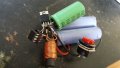
I got it to work! 12v output at .9 amps. The problem was circuit resistance which has been mentioned a couple of times. Previously I had soldered my components to a prototype board placing components as close together as possible. This didn't make too much of a difference. This time I soldered my components directly to each other with no board and using as few wires as possible.
I had to experiment with with frequency a bit since I don't know the exact value of the inductor, but it seemed to like a frequency of about 10k and a 75% duty cycle. Now that I know I can reach the output I want I can design the feedback portion of the circuit and program the controller to limit voltage.
Thank you to everyone who joined the conversation.
I have the same problem as you, I was able to get 20wats power from 3.65v 30amp lipo batteries, note; lipo's have lower resistance than lithium 18650's. but I'm still in pursuit to create a boost converter that can boost 3-4.2v to 5v with 100watts power alteast. and yes I did have 200watt from power source.
#1 Biggest problem is wires, wires need to be able get 5amps in, by making the wire thick as possible on PCB trace, depositing thick solder on joints, and traces. this is because 3.65*5amps=18.25watts = on ouput 12*2amps=24watts? thats not possible, its not evening including the efficiency drop.
#2 mosfet,--> I used stm8s that has 20mA output drive for mosfet so I used transistor npn,pnp for output drive 1amp drive for high frequency. most 555 timers are good drivers for mosfet but can't run lower than 5v.
also, vgs threshold needs to be as LOW as possible. 1.3-2v ideal. Note: if mosfet gets hot, then you need lower Rds on mosfet, parrelling helps but also adds gate capacitance lowering the high frequency gate drive.
#3 Next is Toroid --> toroid come with different materials, it hard to notice visually if the toroid is actually high power. You can buy toroid meter that can display all sorts of values uH, low resistance ESR, etc, or you can experiment with them and choose which one is best.
Test: by placing toroid inbetween 12v 100amp car battery and 2 car light bulb 10amps. If the troroid heats up then it cannot handle 12v*10amps=120watts.
#4 the other is diode, you can test this again with above setup, efficiency can be improved by removing this schottky diode with P mosfet. as Synchronous boost converter. but this will only improve efficiency not total output power.
#5 larger caps with low esr. its hard to notice how much power is dissipated in caps because they rarely get hot. one time, I had one explode on me... then i realized it was low esr value cap. in AC wrong value cap size can become resistors.

 Facebook
 Google
 GitHub
 Linkedin