Boost converters, how do I get more current?

ronv

Joined Nov 12, 2008
3,770
Yes, and if the load demands more current than can be provided at that duty cycle then the controller would compensate by increasing the duty cycle. Correct? So what I'm saying is I'm already running at 90% duty cycle. Whether its fixed or not there isn't much more room to go up from there. That's why I don't think that feedback is my current problem. I could be wrong. I don't think that if I added a feedback and then programmed the controller to vary duty cycle as needed, that it will be any different than just setting a fixed duty cycle for testing. When I know that the circuit can provide the necessary current then I will add feedback and write the rest of the program.
Give this a read.
https://www.ecnmag.com/article/2011...l-limit-boost-factor-dc-dc-voltage-conversion
 

Thread Starter

esgeroth

Joined Nov 28, 2012
20
You believe what you want to believe. I'm done for now.
I think were probably miscommunicating. I never said that I don't need any feedback. Just that it isn't important to the current discussion which is to find out what the max is. If the circuit isn't providing enough output power at 90% duty cycle, then adding feedback isn't going to get it any higher either. Once the circuit works, I know that I will need to add feedback so that the controller can regulate voltage as needed.

You might need a larger inductor. There are equations for switching converters to determine the proper inductor size. I don't have them in front of me at the moment.
I've been using this calculator: https://learn.adafruit.com/diy-boost-calc/the-calculator
Once I get a better switching mosfet, I'll try with a larger inductor and lower frequency.

I gave it a read. While it does imply practical limits for output voltage, it doesn't really say anything about how much current to expect. We'll see what I get with a larger inductor and better switch.
 

ronv

Joined Nov 12, 2008
3,770
I don't believe anything. That's why I came here to ask a question. If I'm wrong about something, or don't understand, you haven't really pointed out where i'm not understanding. I'm not sure what the attitude is for.
I was just looking at your simulation.
You need a higher frequency and a larger inductor. Here is a handy calculator for switch mode supplies. Try 30Khz and 470Uh. You need to be very careful that the inductor does not saturate at the current you want. So in your case if your looking for 15 volts I would look for 1 good for at least 5 amps. You will be happier with a FET, but make sure it is a logic level FET since you only have 4 volts to drive it.
http://www.daycounter.com/Calculators/Switching-Converter-Calculator2.phtml
 
I am going to say again what I said before....
If you have a known good recipe and your parts match what it suggests then all you need to check is the soldered joints and your supply charactoristics...
For everything else, which is happening thousands if not tens of thousands of times a second you need a scope.

Look I get the whole budget and learning thing, I am no expert now and I spent years, actually tens of years, mucking about with salvaged bits, I even built some working cool stuff but I didnt actually understand most if the many and crucial newances untill I had an isctrument to see them with...
Now I am learning all over again, just properly now.
There is nothing so humbling as seeing exactly how a sound looking concept fails in a real environment, proper learning.

I applaud your spirit and tenacity, but respectfully suggest you will progress much faster with a little investment in your own education.

Scopes, especially pure digital ones are getting much cheaper, why dont you ask the folks here that know this stuff what can be bought on a budget that will help you. You may have to compromise on speed and resolution a little but frankly even a handheld single trace unit with 20K of bandwidth would be several orders of magnitude better than the best multi-meter on the planet from the point of view of overall functionality.

I am not the man to ask, as I am still learning, actually trying to forget what I thought I knew. I can say with confidence that a scope will enable you.

Have fun,
Al
 

Thread Starter

esgeroth

Joined Nov 28, 2012
20
I've got some new mosfets to test in my circuit. I've got some lru024n. They are logic level with an Rds on value of 0.065Ohms. This has made quite a difference but current is still quite low. I have my multimeter in series with the led panel to measure the current draw. It is now measuring a current flow of about 300mA where it was measuring about 200mA before.

I should probably look at my inductor next. I have multiple inductors of different shapes and sizes. While most of the scavenged inductors are working fine for smaller loads, I think I'll probably need to buy one with the right specs to get the desired output current I need. I've been using the boost converter calculator found here: https://learn.adafruit.com/diy-boost-calc/the-calculator. It shows that I need an inductor of at least 16uH and 6 Amp current rating. I found this inductor on digikey and I'm wondering if it's right for the job. https://www.digikey.com/product-detail/en/eaton/HC9-220-R/513-1349-2-ND/1130368
What determines the current rating of the inductor? Is it just the size/resistance of the wire? I'm not sure I'm running into the current limit of the inductor as its not getting hot during operation. I have a 22uH inductor that might not meet the current requirement, I would think it would be getting hot if it was reaching its current limit.
 

Motanache

Joined Mar 2, 2015
652
Is there anything I should try to increase current that this circuit can provide? Or is pulling almost 1 amp too much?
My suggestions:
- Use MOSFET.
Just like a capacitor It tends to keeps constant voltage at its terminals, a coil "wants" to keep the current constant. The current passing through that transistor at the end of the ON cycle must be as high as possible
- use feedback

I used this schematic and worked very well. Try this first and then go back to the microcontroller.

- At boost there is an optimal Duty Cycle(DT). A lower DT, and a higher DT than this value, lower the output power. In the first case, the coil is not charged with enough energy. In the second case It does not have time to discharge the energy from the coil.

- In post #11 you notice that the coils have different colors. It's not a rule, but the producers code through it the material they're made of.
 

Motanache

Joined Mar 2, 2015
652
In post #11, looks like coils for filter. They are good only for not very good results. The coil is characterized by an inductance, but that's not all. Its inductance does not say about the energy it can store:
Faraday U=-dfi/dt
U=-Ldi/dt
....L-=d fi/di
In other words the coil must be of a particular material (Use E + E ferrite from transformers, not toroids for filters),the electric wire must be thickt (that if we neglected that at high frequencies The current flows at the conductor surface)
 

MrAl

Joined Jun 17, 2014
13,708
I certainly don't need 70v. I was just saying that that is what it will put out at about 80% - 90% duty cycle. But with a load, even with a 90% duty cycle, the highest voltage I get is about 9v. I havn't added a feedback to the attiny85 yet as I have been adjusting the duty cycle manually by uploading a new program to the microcontroller. I have added a schematic in the first post, as well as the ltspice circuit. It's just a very basic boost converter. I only need about a 30% duty cycle to get 12v but that will drop down to about 5v - 6v with a load attached.
Hello there,

I just skimmed over this thread so some of the stuff i will state here might have already been stated, but there are some key points that are of interest.

First, the boost converter is not your typical 'first' converter circuit. It's more complicated than many other circuits like the buck. If you've never done a switcher then you should really start with a buck.

If you choose to proceed, you should find out the key points of interest of a boost converter. There are some important points that have to be considered before the thing will work right.

For example, if you are experiencing low output voltage with load, that is probably because there is too much internal resistance. The internal resistance of the circuit has a direct effect on the maximum output current and if it is too high it will prevent the output from going up to the right voltage with full load. This resistance can come in many forms:
1. The battery.
2. The switch (transistor).
3. The inductor.
4. The wiring.
5. The diode.
6. The input cap ESR.

Starting with the battery, the internal resistance reflected to the output acts in series with the load., just like all the resistances in the circuit. That means this is one of the resistances that creates something like a voltage divider. If you had 12v in and tried to get 12v out, you may not be able to do it because of that voltage divider effect until you reduce the battery resistance. Cheaper batteries will have higher internal resistance, and the ones that can work at high current will state that in the data sheet and also be more expensive. I run a flashlight at nearly 70 watts (7 high power LEDs) but i use not one battery but at least 2 in parallel, and they are a special type that is made for high current drain, not the run of the mill type 18650. That brings up another point BTW, that you should not use run of the mill batteries in high drain applications or you could cause a fire as the battery over heats. Instead, buy high current drain types.

Next comes the switch, the transistor. The transistor has a certain 'on' resistance equivalent, and that also acts in series with the load, after it is transformed into a different value. That value may be greater than the actual transistor resistance too, so we see a reduction in max output voltage because of that too.

Next we have the inductor. Obviously this resistance is in series with the load, but it's also sometimes in series with the input, so the resistance gets transformed into a higher value equivalent in series with the load. This is one of the worst ones because it's easy to get an inductor with a high ESR and not be aware of it until something does not work right. In any case, to get high output voltages you need a good inductor, one with low ESR. It also has to be able to handle the current being fed via the input when the switch is on. There are formulas you can use to calculate this current.

The wiring is also important because it is in series with the load and there are AC and DC effects. This means it should be as short as possible.

The diode should be a type like a Schottkey for low voltage drop and fast speed. If you try to use a 1N4001 diode for example it will not work right because it is not fast enough. Any diode must be fast, and it should have low voltage drop in the forward mode.

The input cap ESR should be low. This acts to help the battery maintain the input voltage during surges when the transistor is 'on'. If the ESR is too high and the battery ESR is also too high, the input sags and that greatly limits the output voltage max.

The choice of operating frequency is not always straightforward. If you go too high you get bad effects from things you dont get bad effects from if you stay lower. If you stay too low you need a larger value inductor and capacitor. 20KHz to 50KHz is probably reasonable for a first boost converter.

What you should do first is measure the ESR of your inductor. You could state the value of the inductor in Henries and the ESR value in Ohms. If you also state the operating frequency we can start to calculate some things. If you dont know the ESR of your battery then try loading it down with some resistance and see how much the voltage drops at your typical load. Also, your input cap value and ESR, and your output cap value and ESR.

When it comes to the control circuit that's even more complicated. Buck converters are much more simple so they make a better 'first' converter.
 
Last edited:

Thread Starter

esgeroth

Joined Nov 28, 2012
20
My suggestions:
- Use MOSFET.
I am using a mosfet as the switch. I'll try the circuit using the TL494. I think I have one of those around.

In other words the coil must be of a particular material (Use E + E ferrite from transformers, not toroids for filters),the electric wire must be thickt (that if we neglected that at high frequencies The current flows at the conductor surface)
Aren't some of the toroids also made from from ferrite? Maybe most of what I have are not. I'll try an E core.

Hello there,


For example, if you are experiencing low output voltage with load, that is probably because there is too much internal resistance. The internal resistance of the circuit has a direct effect on the maximum output current and if it is too high it will prevent the output from going up to the right voltage with full load. This resistance can come in many forms:
1. The battery.
2. The switch (transistor).
3. The inductor.
4. The wiring.
5. The diode.
6. The input cap ESR.
I've tried adding a second battery in parallel in case its internal resistance was a problem. It did not seem to make any difference on the output. The ESR of the batteries measure about 50mOhms.

The switch is a lru024n and has an on resistance of 65mOhms.

Most of the inductors I have are unknown. Some have a value printed on them and some don't. I can't detect any resistance across any of them with my multimeter so they are all less than a tenth of an ohm. This is why I was looking to find an inductor with known values.

Wiring could be an issue. I initially had it all on a breadboard. I then soldered everything onto a prototype board. I didn't seem to make much difference on the output.

Diode is a 1n5819. Seems to be a popular choice for boost converters. It has a forward voltage drop of .6v.

I thought my capacitors were of the low ESR variety but you made me double check the datasheet and they are general purpose. I'll have to get some new capacitors.

Thanks for the info.
 

Motanache

Joined Mar 2, 2015
652
The best lesson about the SMPS is from Elliott. It's the project that I started with. It is explained in detail and very well. High power output. But is push-pull.
http://sound.whsites.net/project89.htm


The german site from I put the TL494 schematic
http://www.joretronik.de/Web_NT_Buch/Kap6_2/Kapitel6_2.html
Have boost with many drivers.


For SMPS I use toroids with very good results from Kaschke
http://www.kaschke.de/en/products/ferrites/ring-cores/

I'm not a chemist, but all of you presented are ferrite. But the ferrite are of several types, although it looks apparently the same
https://en.wikipedia.org/wiki/Ferrite_(magnet)

If you're looking for physics lessons about the coil, most will treat it in a simple manner - The coil will be studied without internal resistance and without ferrite.

https://en.wikipedia.org/wiki/Magnetization
Magnetization in ferrite is due to the orientation of microscopic magnetic moments of atoms in the direction of extrenal magnetic field applied. Not circulate current through a ferrite that has resistivity like the semiconductor.

When all dipoles are already oriented, the external magnetic field has nothing to chage in ferrite and saturation occurs. Mathematically decreases drastically the inductance L of the coil.
https://en.wikipedia.org/wiki/Saturation_(magnetic)

From Allaboutcircuit
https://www.allaboutcircuits.com/textbook/direct-current/chpt-14/permeability-and-saturation/

You may not be interested in all this. But you have to keep in mind that ferrites are different types.
 
Last edited by a moderator:

MrAl

Joined Jun 17, 2014
13,708
I am using a mosfet as the switch. I'll try the circuit using the TL494. I think I have one of those around.


Aren't some of the toroids also made from from ferrite? Maybe most of what I have are not. I'll try an E core.


I've tried adding a second battery in parallel in case its internal resistance was a problem. It did not seem to make any difference on the output. The ESR of the batteries measure about 50mOhms.

The switch is a lru024n and has an on resistance of 65mOhms.

Most of the inductors I have are unknown. Some have a value printed on them and some don't. I can't detect any resistance across any of them with my multimeter so they are all less than a tenth of an ohm. This is why I was looking to find an inductor with known values.

Wiring could be an issue. I initially had it all on a breadboard. I then soldered everything onto a prototype board. I didn't seem to make much difference on the output.

Diode is a 1n5819. Seems to be a popular choice for boost converters. It has a forward voltage drop of .6v.

I thought my capacitors were of the low ESR variety but you made me double check the datasheet and they are general purpose. I'll have to get some new capacitors.

Thanks for the info.

Hi,

It's starting to look like the inductor mostly.

Note that the diode you are using is only rated for 40v so you cant go up to 70v with that diode. If the diode blows out it wont work well at all. Maybe check it to make sure it is still working properly too.
 

Motanache

Joined Mar 2, 2015
652
I'm interested in how it worked.

And I want to make a boost either with TL494 or with microcontroller.

With TL494 I did, but the results were not very good.
At 30V output I get approximate 1A.with a 4 cm/ 2 inch coil.

I abandoned then.
But I want to resume the idea If you've had better results.
 

Thread Starter

esgeroth

Joined Nov 28, 2012
20
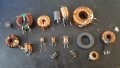
I've tried a number of different inductors as well as using the coil of an E core transformer and I'm not able to get more than about 300mA output. Also, as for the diode, I haven't turned it on without a load so the diode has never had more than 12v across it. Earlier it was pointed out that some of the inductors I had posted a picture of were for filtering. How can you tell the difference? I have several different types of inductors I can try to use. I'll post a picture of what I have below. Do any of these look like they would be suitable for my needs? I'm looking to get to 10 watts at 12v output from either a single or two 18650 cells.

20170601_194953.jpg

I would also buy an inductor but I'm not sure what to get. I found this one on digikey that looks like it should do what I need? https://www.digikey.com/product-detail/en/eaton/HC9-220-R/513-1349-2-ND/1130368
These look good but a bit expensive: http://www.ebay.com/itm/2-Vishay-IH...427164?hash=item568e4a631c:g:eXEAAOSwrklU5krA
How about these: https://www.amazon.com/Uxcell-a1307...TF8&qid=1496375402&sr=8-113&keywords=inductor

I can also get lots of scrap computer electronics, atx power supplies and battery backups. Is there a certain type/style inductor I should look for that would work better?
 

ronv

Joined Nov 12, 2008
3,770
I've tried a number of different inductors as well as using the coil of an E core transformer and I'm not able to get more than about 300mA output. Also, as for the diode, I haven't turned it on without a load so the diode has never had more than 12v across it. Earlier it was pointed out that some of the inductors I had posted a picture of were for filtering. How can you tell the difference? I have several different types of inductors I can try to use. I'll post a picture of what I have below. Do any of these look like they would be suitable for my needs? I'm looking to get to 10 watts at 12v output from either a single or two 18650 cells.

View attachment 128031

I would also buy an inductor but I'm not sure what to get. I found this one on digikey that looks like it should do what I need? https://www.digikey.com/product-detail/en/eaton/HC9-220-R/513-1349-2-ND/1130368
These look good but a bit expensive: http://www.ebay.com/itm/2-Vishay-IH...427164?hash=item568e4a631c:g:eXEAAOSwrklU5krA
How about these: https://www.amazon.com/Uxcell-a1307...TF8&qid=1496375402&sr=8-113&keywords=inductor

I can also get lots of scrap computer electronics, atx power supplies and battery backups. Is there a certain type/style inductor I should look for that would work better?
Look at this one at 150Uh. Set the duty cycle at 55% and the frequency at 30Khz. Add a filter cap of 200Ufd. Use 2 cells.
 

Thread Starter

esgeroth

Joined Nov 28, 2012
20
I've been looking at oscilliscopes on ebay but I don't have one yet.
I have experimented with different frequency ranges for each coil I have tested. There is usually a sweet spot where output power is greatest. Increasing or lowering the frequency from there will result in a lower output power.
 
Top