Board repair help, are all 555 times the same ???

Thread Starter

xtal_01

Joined May 1, 2016
227
OK ... way out of my league but trying something new. I build a simple switching device for a customer ... just a few a year ... reversed engineered one that they used for 30 years and was no longer available ... working great.

So, he sends me a board. It was sent to him for repair (the end user had tried a few places and I guess could not find anyone who wanted to repair it). For ????? reason, they won't say what it is off of, just that it "doesn't work". No idea what the board even does! Just know the device is obsolete and you can't get parts ... thus they need the board fixed.

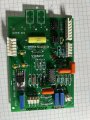
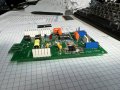
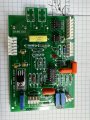
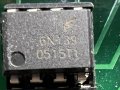
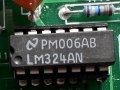
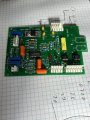
Relatively simple board. Three IC's that are on sockets (6N139, NE555N, LM324AN) ... caps (about 8) , resistors (about 20), a voltage regulator, one transistor, ...

Soooooo ... my thought process is that I will make a schematic (lucky it is only a two sided board) ... then start testing each part.

if this is anything like the old electronics I "play" with, probably a bad cap. If I can't find anything obvious, I was thinking I would replace all the caps ... replace the IC's, transistor and voltage regulator, and maybe the diodes.

I am sure I will have a number of questions but just one for the moment ....

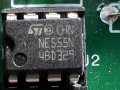
One chip is a NE555N. What does the N at the end of the part number mean? When I do a search, I keep coming up as obsolete. Are not all 555's the same?

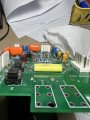
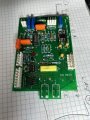
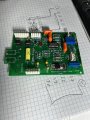
I have attached a picture of the board.

Thanks ....
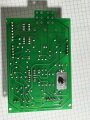
IMG_0252.JPEGIMG_0251.JPEG
 

MrChips

Joined Oct 2, 2009
34,628
The N is likely the temperature range or package style. It is not significant in this case.
What is more important is the replacement, NE555 or LM555. Do not substitute with LMC55 or TLC555 since these are low power CMOS chips.

Too bad that the customer would not reveal the application. Saying that the board "doesn't work" is not useful information.

I would not go about it by replacing components. I would determine what the board is supposed to do in the first place. How else are you supposed to determine that the repaired board is working?
 

crutschow

Joined Mar 14, 2008
38,316
Are not all 555's the same?
The are two basic types:

The original is built with a bipolar (BJT) process, and most of them are the built that way, and should act similarly.

Later on they came out with one built with a CMOS process, such as the LMC555 or TLC555.
They use less power, can use a higher value of timing resistors, have lower output drive current, and a lower max operating voltage.
 

MrChips

Joined Oct 2, 2009
34,628
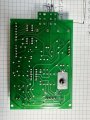
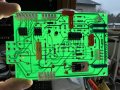
Please post some more pictures of the component side of the board, from 4 different angles and lighting so that we can see the writing and traces more clearly.

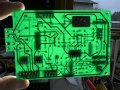
Post also a 5th photo taken from the component side with light shining from the solder side. This way we can see the copper traces on the solder side through the board.
 

Tonyr1084

Joined Sep 24, 2015
9,744
I would not go about it by replacing components. I would determine what the board is supposed to do in the first place. How else are you supposed to determine that the repaired board is working?
This is the same thing I say. Only in different wording.

"Fully diagnose the problem(s) before you start throwing parts at it." That is to say if you start throwing parts at it you'll end up with an entirely new board that probably doesn't work because you blew something out after replacing something. You'll never catch that ghost. It'll keep moving on you and you may have a pregnant ghost, one that gives birth to lots of little ghosts.

If you want our help, help us help you. More info. Simply editing your first post may lead us to misinterpret something. With each change, make a new comment. Unless you're correcting some spelling error.
 

Tonyr1084

Joined Sep 24, 2015
9,744
I now notice the chips are in sockets. Sockets can be problematic. LOOK to see if any legs may be bent. I also noticed a code: 1214. This could be a date code. If it is then the bare board was made the 12th week of 2014. Easily 10 years old. Also, there are no surface components on the board on either side. Not a very sophisticated board.
 

metermannd

Joined Oct 25, 2020
472
I would also start making a BOM as some of the part markings are not likely going to be visible in the pictures (part of why additional pictures were requested by another poster). Particularly the zener at CR1 and the diode at CR2, and the marking on the regulator is hard to make out.
 

Tonyr1084

Joined Sep 24, 2015
9,744
Another thing that can knock out a board is a bad solder joint. I didn't see any suspect joints but one would have to have the board in hand with plenty of light and at least 3X magnification. 7X to examine suspect joints. There COULD be nothing wrong with your board from a component standpoint. Those header plugs - they can be a weak spot. But if you don't know what it does (did) and don't have a schematic with values - it's not going to be an easy fix. No wonder nobody wants to fix it.
a voltage regulator,
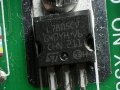
That's a 5 volt regulator. L7805
Further complicating the problem(s) is what input voltage does it take? And why are SW 1a & SW 1b missing? Perhaps that's a part of the circuit board that is not currently being used in this application. Someone took the necessary steps to drill out one of the switch pin through-holes.

That's all I got for now.
 

schmitt trigger

Joined Jul 12, 2010
2,027
Back in the days when the very first ICs were produced, the very first letters identified the vendor and probably a specific product line for that vendor.
For instance, LM was used by National Semiconductor to identify its linear monolithic ICs. TL was Texas Instruments’ prefix for texas linear. MC meant Motorola CMOS. RCA semiconductor used the CA and CD for its analog and digital ICs respectively.
For the NE prefix, it was Signetic’s commercial grade devices, which also used SE for its MIL or industrial grade devices.
STMicro simply licensed IC designs, and mostly kept original part numbers.
 

schmitt trigger

Joined Jul 12, 2010
2,027
However, to answer your original question, the 555 timers from different vendors strive to meet the original specifications and functionality, but the internal design details may vary, sometimes slightly, sometimes significantly.

If you would like to actually view different 555 dies, check this page. In German:

https://www.richis-lab.de/555.htm
 

sparky 1

Joined Nov 3, 2018
1,218
Depending on the application it can be important to distinguish characteristics within a type. Type stated above.
Within a Main type are characteristics found using the correct datasheet under electrical characteristics table 2 and 3.
show supply voltage and current compliance, threshold low and high compliance specs.

In your case it should not matter for an NE prefix because. Repair or maintenance would not normally redesign
unless a specific malfunction was reported or fails during your testing. There is good reason that 555 continue as reliable.

The STMICROELECTRONICS NE555N has a temperature range of 0 °C, +70 °C
The SA555N has a temperature range of -40 °C, +105 °C
The SE555N has a temperature range of -55 °C, + 125 °C

Since the choice of selecting NE555N means that an extended temperature range was not necessary.
The order code summary shows these markings. The suffix N denotes that these are sold in tubes.
As we know the Pdip 8 pins are easily bent and the reels were discontinued.

Under revisions Jan 2012 the equation for astable operation was modified.
The modification removed the sloppy typos on the older datasheet but the formula itself is the same.
The claim of Temperature stability of 0.005% per °C is the same, a few differences in characteristics listed for grade.

The formula will address whether or not the resistors and capacitors are in spec.

The vendor below is Mouser, they can carry a variety 555, the datasheet is STMICROELECTRONICS and the markings are ST
The 555 are so abundant that most vendors will carry enough quantity where manufacturers can rely on stability. The manufacturer could
use their quality control lab to decide on which Brand.
General-purpose single bipolar timers
 
Last edited:

Thread Starter

xtal_01

Joined May 1, 2016
227
WOW ... I was not expecting so much help ... THANKS!

I can sense the "end user" has little understanding of electronics. I am "guessing" this board has gone out before and that is why they know (or maybe I should say suspect) it is gone again.

I do know it came from a "chem lab" ... doesn't help much.

Also, they passed on the message ..."just replace all the parts on the board"

Not knowing what this board does, my thinking was to come up with a schematic ... test all the individual parts ... hope I find one that is not working.

Any help you guys can give would be great!

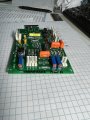
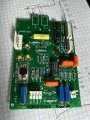
Here are a bunch of pictures you asked for.

Thanks again soooooooo much!!!!!!

Oops ..... just found out max 10 photos ... I will put the last 4 in the next postIMG_0311.JPEGIMG_0312.JPEGIMG_0313.JPEGIMG_0314.JPEGIMG_0315.JPEGIMG_0316.JPEGIMG_0317.JPEGIMG_0321.JPEGIMG_0323.JPEGIMG_0324.JPEG
 

MrChips

Joined Oct 2, 2009
34,628
Thanks for posting the photos.

Your angles are too steep. Usually, we need a view directly from above, and then two different views from the left and from the right, (or from top and bottom depending on how components are laid out), so the we get a different look at all the components, and still see all the components and markings (on a small sized PCB). A larger board would require photos in sections.

What I mean by a different angle, is to be able to see PCB markings that otherwise would be hidden. Besides a photo taken at 90° straight from above, two views from both sides at 80° would show it all. PCB labels are often hidden by other components.

Don't do it now unless I ask for it.
 

Thread Starter

xtal_01

Joined May 1, 2016
227
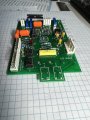
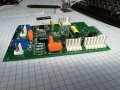
I know you I didn't need to but if this helps, here are 4 more pictures at less of an angle.

I really could not figure out why someone would want a phone with a camera .. now I seldom use my camera :)

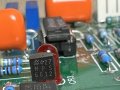
I was going to need to ask later how to read the values on some of these caps.IMG_0334.JPEGIMG_0333.JPEGIMG_0332.JPEGIMG_0331.JPEGIMG_0334.JPEGIMG_0333.JPEGIMG_0332.JPEGIMG_0331.JPEGIMG_0334.JPEGIMG_0333.JPEGIMG_0332.JPEGIMG_0331.JPEG

Thanks!
 

sagor

Joined Mar 10, 2019
1,046
The board seems to have a dual power supply feeding it (P5 pins 1,5,6) based on polarity of C1, with the +ve rail going to the 7805 regulator to provide +5V. Without knowing if the power supply is good, it may be hard to diagnose the board failure. You may need more information about the power that goes to the P5 connector.
By the looks of it, it is unlikely any of the passive components are blown. There are a couple of diodes (one is a Zener), but otherwise the most suspect component would be the 5V regulator and then the IC chips along with Q1. A bad power feed on connector P5 could also have damaged any of the ICs in a subtle way.
You need to verify the source power supply operation. Also, there is a small chance their external devices are faulty, like sensors, etc., not the board.
 

Thread Starter

xtal_01

Joined May 1, 2016
227
The board seems to have a dual power supply feeding it (P5 pins 1,5,6) based on polarity of C1, with the +ve rail going to the 7805 regulator to provide +5V. Without knowing if the power supply is good, it may be hard to diagnose the board failure. You may need more information about the power that goes to the P5 connector.
By the looks of it, it is unlikely any of the passive components are blown. There are a couple of diodes (one is a Zener), but otherwise the most suspect component would be the 5V regulator and then the IC chips along with Q1. A bad power feed on connector P5 could also have damaged any of the ICs in a subtle way.
You need to verify the source power supply operation. Also, there is a small chance their external devices are faulty, like sensors, etc., not the board.
Once I can come up with a schematic, I was going to feed power into the board and see if the regular is good or not. I

I keep asking and for some reason, just can't get any info out of the end user. I am not even sure why they think the board is dead. My best guess it it has failed a few times in the past and thus they think that is what is going on now. Like someone said, probably why no one else wanted to touch it.
 

schmitt trigger

Joined Jul 12, 2010
2,027
Another question; what sort of equipment did this board came from?

But as someone else mentioned previously, without knowing what constitutes a good or defective board, and what signals and/ir voltages are required for correct operation, it is essentially a blind guess.
Wish you the best.
 

MrChips

Joined Oct 2, 2009
34,628
Do not disassemble the board or remove any component. I have already drawn the circuit schematic. We should be able to apply voltage and check the functionality of the board.

We need to identify the resistor values but I cannot be certain of the color bands from the photographs.
Write out the color bands you see. You can use abbreviations shown. All the resistors have 5-band codes, ±1% tolerance. (The 5th band is Br). Sometimes it is difficult to determine the order of the bands, left to right, or right to left. A resistance measurement would help to decide which is the correct value.

0 Bk
1 Br
2 R
3 O
4 Y
5 G
6 BL
7 V
8 Gy
9 W

https://resistorcolorcodecalc.com/

Not all values are possible. Resistor color bands should match values from the E96 series.

https://www.logwell.com/tech/components/resistor_values.html

Measure the resistance while in-circuit to give some estimate of the value. This measurement is not 100% accurate since you are measuring the resistance of all components connected in parallel with this resistor.

I have started a list below with some examples.

R1 - 5 kΩ trimpot CAL
R2 - 1 kΩ trimpot ZERO
R3 - 5 kΩ trimpot MAX
R4 - Ω
R5 - Ω
R6 - Ω
R7 - R Y W R Br = 24.9 kΩ
R8 - 49900 Ω
R9 - Ω
R10 - Ω
R11 - Ω
R12 - Ω
R13 - Ω
R14 - Br Bk R Br Br = 1.05 kΩ
R15 - Br Bk R Br Br = 1.05 kΩ
R16 - Ω
R17 - Ω
R18 - Ω
R19 - Ω
R20 - Ω
R21 - Ω
R22 - R Y W R Br = 24.9 kΩ
R23 - BL Bk Y Bk Br = 604 Ω
R24 - Ω
R25 - Ω


There are some markings visible on CR1 and CR2. Write down what you can see.

Edit: Typo error on R2.
 

Tonyr1084

Joined Sep 24, 2015
9,744
Two things from my observations: First, U2, the NE555N chip, pin 4 - - - Is that solder on the pin and on the chip carrier? If so, it's possible flux has migrated down into the socket and could be causing issues - if any issues exist. Second, it has been recommended you don't remove any parts at all, and I tend to agree with that sentiment. However, if you can build a test bed for each chip that is socket mounted you should be able to remove them and test them for functionality.

STRONG ADVICE: Work at an ESD safe work station. If you're unfamiliar with ESD just ask. ESD stands for Electro Static Discharge, which can cause outright failure of a component OR can cause a latent failure (future failure) due to EOS (Electrical Over Stress) which is fancy for "weakened".

Once you have a schematic it should be easier to test the board. Personally, I'd have handed the board back and said "I don't have sufficient information to test and repair the board". You don't even know WHAT it does, let alone HOW it does whatever it does. What it controls. What it outputs.
 
Top