BJT resistor values

Thread Starter

darylsingh

Joined Jul 10, 2011
15
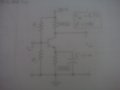
How do I find the values of R1 and R2 of this schematic? Along with VBE and Beta, I'm also given an ICQ value. All this is very new to me, is there any specific formulas for calculating this? Thanks in advance.
 

Attachments

Jony130

Joined Feb 17, 2009
5,599
The only think you need to do is to find the base voltage for a given ICQ (with a little help from Ohm's law) and then again using Ohms law design the voltage divider that provides that voltage to the base.
And the current that will flow through R1 and R2 should be greater than 10*Ib.
 

Adjuster

Joined Dec 26, 2010
2,148
If you put as much effort into solving the problem as you apparently have into finding four different ways to ask the question in separate posts on this forum, you would have solved it already!!!
 

Thread Starter

darylsingh

Joined Jul 10, 2011
15
Sorry Adjuster, I'm new to the site and wasn't sure where exactly to post my question at first, that's why it appears in two forums. This transistor analysis stuff is very new to me and the textbook that I'm using is only confusing me more than I already am. I have been working on this problem for the past 7 hours but it hasn't made any sense to me. If possible, can you kind of outline for me in step by step bases on what I should do. Thanks for your time
 

blah2222

Joined May 3, 2010
582
VBE = 0.7 V
B = 100

If Ic(Q) is known, then you can easily figure out what VB is.

VB = Ie*B + VBE ***\(Ie = \frac{(B+1)*Ic}{B}\) ~= Ic (B >> 1)

Therefore, VB ~= Ic*200 + VBE.

Now here comes the actual engineering in this design. Resistors R1 and R2 are used only for DC biasing purposes, and set the value of Vb. With this in mind, they can be large values and draw little power from the supply. Their relative ratios are the most important part.

From here you can use KCL and try out values that you think would make sense:

I2 = Ib + I1

\(\frac{VCC - VB}{R2} = Ib + \frac{VB}{R1}\)

\(\frac{VCC}{R2} - VB*(\frac{1}{R2} + \frac{1}{R1}) = Ib\)

\(***Ib = \frac{Ic}{B}\)

***VB ~= Ic*200 + VBE

***VCC = 20

\(\frac{20}{R2} - (Ic*200 + VBE)*(\frac{1}{R2} + \frac{1}{R1}) = \frac{Ic}{B}\)

If you want a simplified formula with all given values substituted:

\(R1 = \frac{100*R2*(200*Ic + 0.7)}{1930 - Ic*(R2 + 200)}\)

You are still going to have to chose a value for one of them to get the other.
 

Jony130

Joined Feb 17, 2009
5,599
But we can use ohms law directly to fond R1 and R2.
The voltage divider current must be greater than the base current.
In practice 5 to 30 times larger then Ib (typical 10 times larger).
So:
Vb = Icq*Re +Vbe

R1=Vb/(10*Ib)


R2=(Vcc-Vb)/(11*Ib)
 

stinky111

Joined Apr 7, 2011
39
darylsingh, I have just compleated this paper, (ANALOGUE) of which BJTs was a big part of.
The text book I found most useful (Other than the e-books on this site) was "Electronics For Electrical Trades" 4th ed, James F Lowe.
 
Top