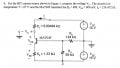
So think about your question. You are given two extraneous pieces of information and you have no problem ignoring one but seem to have a problem ignoring the other.
Just an observation. May well be reasonable that you are comfortable ignoring one and not the other.
I just think that it's interesting that you are so concerned about why they gave you Is when you aren't concerned at all about why they gave you the temperature?
I'd be more puzzled by why they gave Is and Rl to six sig figs while only giving other parameters to one or two sig figs.
And we can solve this nonlinear equation using numerical method. For example for Vt = 26mV my computer shows this solution:
Ic = 3.02283mA and Vbe = 0.607595V
And we can solve this nonlinear equation using numerical method. For example for Vt = 26mV my computer shows this solution:
Ic = 3.02283mA and Vbe = 0.607595V
I agree that this is a little unusual because they seem to give some spice data, yet they spec the Vbe voltage at the same time, and the gain given would be a typical actual Beta not BF in the spice model sense, which would probably be higher.
"Is" is often called the "saturation current", and it fits into the spice model equation for Vbe for example along with another constant "N" (variations on this). But since they already give the Vbe then there doesnt seem to be any good reason why they give this information. The temperature spec could be just to show that there is nothing too diverse about this problem that we might see at elevated or very low temperatures, but why they gave "Is" is a mystery.
In cases like this the only way to know for sure is to judge this based on the context of the course itself, or ask the instructor. In most courses there is usually a set of agreed upon assumptions and techniques, and that would tell us exactly how to proceed. If that doesnt dictate what to do then they only recourse is to ask the instructor. If there is no instructor then you might try to find the origin of the problem, what document it came from, and that document may give clues as to how they are doing things in general.
A real quick calculation does show the Vbe to be close to 600mv as per the data sheet, but they give the idealized model there.

 Facebook
 Google
 GitHub
 Linkedin