bjt amp phase shift

Thread Starter

Homebrew1964

Joined Nov 22, 2024
105
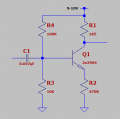
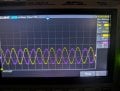
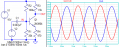
I don't know if i'm being too fussy here but i just built this simple amplifier circuit and i was expecting a 180 degree phase shift between the input and output, this phase shift appears to be slightly off, is this correct or can someone tell me why this is happening please/

my input is an AC coupled sinewave from my wienbridge oscillator at roughly 1Khz - 500mV
 

Attachments

WBahn

Joined Mar 31, 2012
32,702
I don't know if i'm being too fussy here but i just built this simple amplifier circuit and i was expecting a 180 degree phase shift between the input and output, this phase shift appears to be slightly off, is this correct or can someone tell me why this is happening please/

my input is an AC coupled sinewave from my wienbridge oscillator at roughly 1Khz - 500mV
The input circuit constitutes an RC high-pass filter network, so it will cause a bit of phase shift. But it looks like it's cutoff is around 3 Hz, so I wouldn't expect mush shift at 1 kHz (and note that it is "kHz", not "Khz" -- these things can matter and you need to develop an attention to detail).

The BJT is not perfect and has some internal capacitances, as well, which will cause some phase shift, but shouldn't be much.

How much phase shift are you seeing? I'm not going to make the effort to try to figure it out based on the screen grab when you can used the scope cursors and get a much better measurement in far less time.

The same for the gain. Are you seeing about the gain of just under three that you would expect? Looks like it'll be in the ballpark.
 

WBahn

Joined Mar 31, 2012
32,702
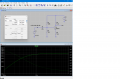
Did I screw up my estimate of the input filter's cutoff frequency? If so, that's what I get for trying to do it in my head. The plot looks like it's at around 300 Hz and I said 3 Hz. Which did seem low, but I did it twice and got the same thing.

Yep!

Actually writing it down it I see where I made my mistake and I get ~340 Hz. Doing it in my head made tracking units difficult for me -- I struggle keeping track of all but the simplest things in my head at the same time ever since my little stroke. I didn't have a pen/pencil handy, so I just did it in my head. Putting it on paper showed immediately how the units get screwed up.

So, with the signal being well under a decade higher than the cutoff frequency, I would expect a modest, but significant, phase shift to result.
 

WBahn

Joined Mar 31, 2012
32,702
Estimating that the input impedance is dominated by the 10 kΩ, I get an expected phase shift of about 19° due to the input filter, which compares pretty favorably with the sim result of about 21.5°.
 

Thread Starter

Homebrew1964

Joined Nov 22, 2024
105
How much phase shift are you seeing? I'm not going to make the effort to try to figure it out based on the screen grab when you can used the scope cursors and get a much better measurement in far less time.
I don't know how to use the cursors yet, i'm sort of new to electronics...if you don't want to make the effort then fine..........

suite yourself.

And Khz or kHz i don't care, people know what i mean however i spell it....why are you being so pendantic?
 
Last edited:

Danko

Joined Nov 22, 2017
2,136
I don't know if i'm being too fussy here but i just built this simple amplifier circuit and i was expecting a 180 degree phase shift between the input and output, this phase shift appears to be slightly off, is this correct or can someone tell me why this is happening please/
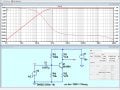
Phase shift is exactly 180°:
1777069081618.png
 

Danko

Joined Nov 22, 2017
2,136
The phase shift of the second part of a two-part signal processing chain.
But what really matters in any real-world situation? The phase shift of the input network can't simply be ignored. The signal at the base of the transistor is NOT the input signal of the amplifier.
Cool! But T.S. is not stupid too.
Therefore he, from post #9, understood than cause of additional phase shift is capacitor.
 
Last edited:

Thread Starter

Homebrew1964

Joined Nov 22, 2024
105
Phase shift is exactly 180°:
View attachment 366308
Just to let you know i tried this on my breadboard and changing the value of R1 doesn't affect the phase shift at all, i put a 30K pot in there and all that does is alter the DC level of the waveform as i would expect.

Raising the value of C1 from 0.047uF to 1uF fixed the issue, i now have 180 degree precisely.
 
Last edited:

LvW

Joined Jun 13, 2013
1,993
I don't know how to use the cursors yet, i'm sort of new to electronics...if you don't want to make the effort then fine..........

suite yourself.

And Khz or kHz i don't care, people know what i mean however i spell it....why are you being so pendantic?
I'm actually a bit surprised to see a newcomer responding to a post by an experienced expert with comments like that.
 

Thread Starter

Homebrew1964

Joined Nov 22, 2024
105
I'm actually a bit surprised to see a newcomer responding to a post by an experienced expert with comments like that.
There is no need for rudeness and belittlement regardless of how experienced someone is, we all have to start somewhere.

i'm here on this site to learn electronics, not to argue and fight with people.....
 

crutschow

Joined Mar 14, 2008
38,314
There is no need for rudeness and belittlement
I saw nothing of that in the posts that offended you.
You need a thicker skin.

And engineering is a discipline that requires exactness.
It is KHz, not khz or Khz, just as its I not i.
If you want to be sloppy in your writing that's your business, but it shows a lack of attention to detail that is normal in technical discussions.
 
Sincere advice, without the slightest attempt at offending the TS. You do require to learn how to fully operate your scope.
It takes some time and patience but once that you’ve mastered, you will wonder how much information you were previously missing.
BTW; modern DSOs nowadays have a full suite of automated measurements. No need to count small and large divisions, multiply by the timebase, etc.
 

Thread Starter

Homebrew1964

Joined Nov 22, 2024
105
Sincere advice, without the slightest attempt at offending the TS. You do require to learn how to fully operate your scope.
It takes some time and patience but once that you’ve mastered, you will wonder how much information you were previously missing.
BTW; modern DSOs nowadays have a full suite of automated measurements. No need to count small and large divisions, multiply by the timebase, etc.
Thank you Schmitt.
 
Top