Facebook
 Google
 GitHub
 Linkedin

Hi, all!
I came across this circuit that generates a 250 Hz sine wave. I would like to change it to 500 Hz. According to the formula of the phase shift oscillator, the frequency is:
f=1/(2πRC√6).
So, I'm guessing the 47n capacitor and the 4K7 capacitor are used to generate the 250 Hz frequency (actually about 290Hz). I have 22nF caps and 5K1 resistors, that will get me to 580 Hz which is close to what I want (I just want to generate a tone, so it's not crucial that it is exactly 500 Hz).
However, I'm not sure what RC pairs generate the frequency. Is it C1 and R3? C2 and R4? Both pairs? What about R4 and C3?
To add more context, this is for a toy morse code generator (so not a real one that would go into a transmitter), and the input will be a push button. I like the characteristic sound of morse code of a sine wave more than the sound of a square wave.
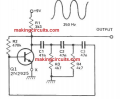
https://makingcircuits.com/blog/single-transistor-sinewave-generator-circuit/
Thanks for your help!
I came across this circuit that generates a 250 Hz sine wave. I would like to change it to 500 Hz. According to the formula of the phase shift oscillator, the frequency is:
f=1/(2πRC√6).
So, I'm guessing the 47n capacitor and the 4K7 capacitor are used to generate the 250 Hz frequency (actually about 290Hz). I have 22nF caps and 5K1 resistors, that will get me to 580 Hz which is close to what I want (I just want to generate a tone, so it's not crucial that it is exactly 500 Hz).
However, I'm not sure what RC pairs generate the frequency. Is it C1 and R3? C2 and R4? Both pairs? What about R4 and C3?
To add more context, this is for a toy morse code generator (so not a real one that would go into a transmitter), and the input will be a push button. I like the characteristic sound of morse code of a sine wave more than the sound of a square wave.
https://makingcircuits.com/blog/single-transistor-sinewave-generator-circuit/
Thanks for your help!
Last edited: