Big currents, small transducers

Ian0

Joined Aug 7, 2020
13,131
You've actually asked what's a controversial question around here. The answer apparently is "as accurately as possible". I've been handed a $150,000 DAQ, a lot of HBK CTs, and a requirement that the sensing apparatus fit in basically a large shoebox.

I can already always measure at sufficient accuracy except the transient. So if I could put two 600A CTs on a split line (actually a second line on the same ring terminal), that solves my problem.
Your initial idea should be good enough.
6 AWG is 16mm^2 (I need it in units I can understand).
Try a piece of 10mm^2 in parallel running as close as possible to the thicker cable to keep the inductances similar, and put that through your transducer.
That would read 38% of the total current. See if that saturates.
If not, try 6mm^2 in parallel.
You can compare the measured steady state current through the transducer to the measured steady state current in the cable to get an accurate ratio then scale up the pulse current.
 

Thread Starter

Edgewalker

Joined Nov 16, 2023
9
Your initial idea should be good enough.
6 AWG is 16mm^2 (I need it in units I can understand).
Try a piece of 10mm^2 in parallel running as close as possible to the thicker cable to keep the inductances similar, and put that through your transducer.
That would read 38% of the total current. See if that saturates.
If not, try 6mm^2 in parallel.
You can compare the measured steady state current through the transducer to the measured steady state current in the cable to get an accurate ratio then scale up the pulse current.
Thanks for the advice and sanity check. It sounds like this all works just the way I thought. And I also learned things I didn't expect from the other comments.
 

Ian0

Joined Aug 7, 2020
13,131
The Micro-Transformer part is rather smaller than the ones you are using, and that would measure the entire current albeit not as accurately.

I do wonder what benefits you will get from "accuracy". At a guess the magnitude of the pulse depends on things like the length of cable to the power source, the inductance etc. so every installation will be different.
 

Reloadron

Joined Jan 15, 2015
7,889
I can already always measure at sufficient accuracy except the transient. So if I could put two 600A CTs on a split line (actually a second line on the same ring terminal), that solves my problem.
Uh correct me if I am wrong but every CT (Current Transformer) I have worked with over the years was used for the measurement of AC current. I read you were looking at measuring DC current up to about 2,000 ADC?

Your budget allows plenty of possibilities.

Ron
 

Danko

Joined Nov 22, 2017
2,168
Yes, the current is a transient spike -- under 100 microseconds. But I need to measure it in real time. I already have current transducers with a 900A capacity and a 100Ms/s DAQ, but that CT is railed during about 50 of those microseconds.
Use cheep but accurate Rogowski coil:
https://www.alibaba.com/product-detail/Rogowski-Flexible-Ct-Split-Core-Current_62441311670.html?s=p

Specifications:
Current Range: 10A to 100kA
Rated output: 0.333Vac at rated current with Integrator,100mV/per 1000A @ 50Hz without integrator
Accuracy:±1% from 5% to 120% of rated current with integrator(45-65Hz)
Phase Angle: ≤±1°5% to 120% from 5% to 120% of rated current
Linear: 0.5%
Frequency: 1Hz-1MHz ,50/60 Hz nominal
Work Voltage: 600V
Power supply: 7-30VDC (9 Vdc,12 Vdc recommended )
Coil Diameter: 10.5mm,12mm or as customer order
Window size: 10mm,15mm or as per customer ordered
Wire lead: 1 meter sheath cable or as customers order
Withstand Voltage:3000V
Operating temperature: -25℃-+70℃
IP class : IP65
CE recognized. RoHS Compliant
 
Last edited:

Ian0

Joined Aug 7, 2020
13,131
Uh correct me if I am wrong but every CT (Current Transformer) I have worked with over the years was used for the measurement of AC current. I read you were looking at measuring DC current up to about 2,000 ADC?

Your budget allows plenty of possibilities.

Ron
The one he is using calls itself a "current transducer" and is specified for AC and DC, so presumably is Hall effect.
https://www.hbm.com/en/8880/current-transducers/?product_type_no=Current Transducers
 

Irving

Joined Jan 30, 2016
5,118
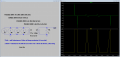
A current transformer will still give an output on a transient V = -L dI/dT. A few turns of wire would work, eg:

1703789453100.png

Agreed, the output would not be copy of the input, but the output describes the input well enough...
 

MisterBill2

Joined Jan 23, 2018
27,513
If there is already a scheme for measuring steady state current then it should work to measure the voltage drop over some length of the present conductor, and be able to accurately correlate the voltage drop as a function of current. The added requirement will be to add a sensor to know the temperature of that wire segment used, relative to the calibration temperature. With that data you will be able to compute the current within the limitations of your DAq HARDWARE.. The very critical thing will be the insulation on your voltage sense wires, as they will get hot if they short circuit to anything else. The second concern will be the common mode voltage limit on your DAQ analog input. THAT will be the biggest challenge.
 
Top