You need to lower the frequency. You also need a way to figure out way to measure or estimate the the actual frequency is.
If you are running at over 300 kHz you have a 3.3 us cycle. The transistor will be spending most of the time turning off and on rather than being fully on or off.
P.S. This similar circuit also runs just above 300 kHz but it utilizes fast semiconductors.
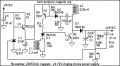
The base circuit for Q3 (R3, D1, R6, L1) creates a negative going pulse when the transistors switch off to help the 2N4401 switch off quickly. This greatly improves efficiency. If you want a transistor to turn off fast you need to give it some reverse base-emitter voltage.
D2 prevents the base-emitter junction of Q2 from avalanching and so improves efficiency.
The Q1 circuit is a voltage regulator that closes the loop around the output voltage.
The efficiency is directly related to the resistance of the inductor L2.
The output rectifier is an common PN junction switching diode for a 24 volt otuput but when using a lower output voltage a Schottky diode would improve efficiency a little bit.
With the components shown this is not capable of supplying high power, though there is no reason why the principles used to increase efficiency cannot be applied to scaled up versions of the circuit.
You need to lower the frequency. You also need a way to figure out way to measure or estimate the the actual frequency is.
If you are running at over 300 kHz you have a 3.3 us cycle. The transistor will be spending most of the time turning off and on rather than being fully on or off.
P.S. This similar circuit also runs just above 300 kHz but it utilizes fast semiconductors.
The base circuit for Q3 (R3, D1, R6, L1) creates a negative going pulse when the transistors switch off to help the 2N4401 switch off quickly. This greatly improves efficiency. If you want a transistor to turn off fast you need to give it some reverse base-emitter voltage.
D2 prevents the base-emitter junction of Q2 from avalanching and so improves efficiency.
The Q1 circuit is a voltage regulator that closes the loop around the output voltage.
The efficiency is directly related to the resistance of the inductor L2.
The output rectifier is an common PN junction switching diode for a 24 volt otuput but when using a lower output voltage a Schottky diode would improve efficiency a little bit.
View attachment 218340
With the components shown this is not capable of supplying high power, though there is no reason why the principles used to increase efficiency cannot be applied to scaled up versions of the circuit.
So I should reduce base drive current? Because if I increase the base drive current, The VCEsat Reduces according to calculations. So, I should still reduce it more?
I've been thinking of using something in a TO92 Package, But I don't know which transistor will work.
According to my experiments;
1. Low frequency: Heat dissipation is reduced, But voltage drop is increased.
2. The inductor is making a whining sound. Maybe its not tight???
3. Tried TIP41C, It got very hot, and voltage drop increased very well.
So, I'm thinking of using the TIP41C, But I'm not sure that it will work, Because of the voltage drop that I get. Can the transistor specs cause a voltage drop?
And also, Is 100KHZ too slow? Will voltage drop increase?
Use the datasheet provided below for the transistor and you will find plenty of curves from which you can see what's happening inside the transistor.
100 kHz is probably still too fast. Try something easier for an audio transistor, like 10 kHz or 20 kHz.
1. Good. It appears that the drive needs to be adjusted.
2. Had that problem in a studio camera design once. About 10 coats of varnish fixed it.
3. Probably not being driven right.
Ok, I reduced it more. Voltage drop is tooo high. I changed the transistor to D882, but the same thing happens, I added another in parallel, the heating reduced VERY WELL, Even at a high frequency. It looks like the voltage drop increases when the frequency lowers.
At 1A load, the voltage drops to 4.5V if I reduce the frequency, it causes an unstable voltage, and Mr Switch(Transistor if you will) will start getting of the warm(or warm).
Thank you for answering all my questions.
Hahahaha, I don't go to pharmacists, I go to doctors
I'm using a PNP transistor to drive the NPN's , But its still misbehaving, The signal is coming from the PNP transistor.
Welcome to learning how to _engineer_ and _design_ something. You have to take in all the constraints- input power, output power, thermal issues, choose parts accordingly, carefully design to satisfy all requirements.
If you want help- you MUST provide a schematic of what you've done. If you aren't willing to post a schematic, or sketch one that is a _reasonable_ facsimile, then perhaps this line of interest is not for you. Electronics is an engineering discipline. It becomes an Art only if you're good enough to go that far.
Looking at the circuit in post#23, there is no way that the base current in Q3 can be 200 milliamps. if R3 is 1000 ohms. So how did you arrive at that current value? AND, what circuit is actually being discussed at this point?
AND, this whole discussion is a perfect example of my claim that switching supplies are complicated to design.
I modified it to my own specifications, I said that already.
By the way, my inability to post schematics is NG....
Its not anybody's fault, I blame......(Well, let's leave it here).
By the way, Adding another transistor in parallel reduced dissipation and increased efficiency Very Much.
Welcome to learning how to _engineer_ and _design_ something. You have to take in all the constraints- input power, output power, thermal issues, choose parts accordingly, carefully design to satisfy all requirements.
If you want help- you MUST provide a schematic of what you've done. If you aren't willing to post a schematic, or sketch one that is a _reasonable_ facsimile, then perhaps this line of interest is not for you. Electronics is an engineering discipline. It becomes an Art only if you're good enough to go that far.
My phone doesn't allow me to draw anything because of bad camera (BB9930, Yep, I still use it). And no simulators, so, We have to imagine the circuit in our heads.
By the way, I just added another transistor to share the load- Problem solved.
So, Next time, I'll consider everything else.
On quite a few occasions I have described a circuit that I have come up with and other folks have drawn it correctly and posted it. So that is another option that just requires a bit of writing skill and the ability to read one's own sketch. And some visualization skills on the part of the ones who draw it.
There are drawing programs made for smart phones, so that would be another option. I refuse to own a big smart phone, it would not provide any functions that I desire a phone to provide that my small phone does not provide.
Online circuit simulator, works to make a quick circuit schematic as well. http://falstad.com/circuit/
You can draw there, save as an image. I wouldn't want to do anything very complex on there, but it's workable.
I've never been a fan of self-oscillating circuits, but I can see a real problem here. What turns off Q2? Without a pull-down of some sort, Q2 will take weeks to switch off, and take a fortnight or so hanging around half-on and half-off dissipating power. Perhaps I exaggerated the timing a little bit.

 Facebook
 Google
 GitHub
 Linkedin