Better AC sensing circuit for ADC conversion

Ian0

Joined Aug 7, 2020
13,157
One of friend said to go with this idea but not sure how I can aply,

*You can make it smaller and simpler, with a 30V change-transformer (2 x 15V), of much lower power, that then has one relay select Phase for ADD/SUBTRACT and another relay selects 15/30 via series or parallel. A bypass relay can remove the correction transformer entirely for correct mains.
That gives 5 steps with 3 relays and a smaller transformer and lower losses.
Most mains loads easily tolerate +/-5%, and it is rare to find an electronic load that is not able to manage 110-220
*
Take a 230:30V transformer, and wire the SECONDARY in series with your mains supply.
Supply the primary with 230V IN PHASE with your mains, and it will ADD 30V to your mains voltage.
Supply the primary with 230V OPPOSITE PHASE to your mains and it will SUBTRACT 30V from your mains voltage.
You don't need to disconnect it with a relay, if you want the mains to pass through, just short out the primary winding.
Obviously, if you connect other voltages to the primary it will add or subtract pro-rata.

If you want an advanced version, supply the primary from a chopper circuit, and you can vary the output to any voltage within 30V of your supply.

And a REALLY advanced version would enclose the whole thing in a feedback loop with a pure sinewave reference and remove any distortion from the output (but that would be a challenge to get it stable!)
 

drjohsmith

Joined Dec 13, 2021
1,613
@Reloadron, see on post 16, can they perform well besides RMS transducers ? Or they are somewhat same ?
@Hasan2019

why are you worrying about true RMS / peek when your output decision is very limited , up or down say 10 volts.
You don't care about the absolute value in, just how far form the expected,

You transformer is only going to work well for sine waves, so the examples you show for pulses are irrelevant, as the transformer cant process them.

The mains is imho , more than close enough to a perfect sine wave for your application,
the version you made using comparators assumes sine waves,
try some tests , spread sheet, with different waveforms, and algorithms ,
you will then decide what differences and tolerances you want

IMHO,KISS.
Its very easy to spend extra making a perfect XYZ, that then falls over because of ABC.
focus on what you want as a specification, and keep it simple and realistic
 

Thread Starter

Hasan2019

Joined Sep 5, 2019
199
Take a 230:30V transformer, and wire the SECONDARY in series with your mains supply.
Supply the primary with 230V IN PHASE with your mains, and it will ADD 30V to your mains voltage.
Supply the primary with 230V OPPOSITE PHASE to your mains and it will SUBTRACT 30V from your mains voltage.
You don't need to disconnect it with a relay, if you want the mains to pass through, just short out the primary winding.
Obviously, if you connect other voltages to the primary it will add or subtract pro-rata.

If you want an advanced version, supply the primary from a chopper circuit, and you can vary the output to any voltage within 30V of your supply.

And a REALLY advanced version would enclose the whole thing in a feedback loop with a pure sinewave reference and remove any distortion from the output (but that would be a challenge to get it stable!)
Take a paper and pencil and draw it. AI tool can give a functional diagram.
 

Ian0

Joined Aug 7, 2020
13,157
@Hasan2019

why are you worrying about true RMS / peek when your output decision is very limited , up or down say 10 volts.
You don't care about the absolute value in, just how far form the expected,

You transformer is only going to work well for sine waves, so the examples you show for pulses are irrelevant, as the transformer cant process them.

The mains is imho , more than close enough to a perfect sine wave for your application,
the version you made using comparators assumes sine waves,
try some tests , spread sheet, with different waveforms, and algorithms ,
you will then decide what differences and tolerances you want

IMHO,KISS.
Its very easy to spend extra making a perfect XYZ, that then falls over because of ABC.
focus on what you want as a specification, and keep it simple and realistic
I would also add that the greater the number of taps, the more often it will change taps. Changing taps will product a step change of voltage on the output, and that would be more likely to have a detrimental effect of connected equipment than a slightly low or slight high mains voltage, or the mains voltage drifting slowly up and down.
 

Thread Starter

Hasan2019

Joined Sep 5, 2019
199
I would also add that the greater the number of taps, the more often it will change taps. Changing taps will product a step change of voltage on the output, and that would be more likely to have a detrimental effect of connected equipment than a slightly low or slight high mains voltage, or the mains voltage drifting slowly up and down.
More and more you make number of taps, more and more it will be problematic.
 

Thread Starter

Hasan2019

Joined Sep 5, 2019
199
@Hasan2019

why are you worrying about true RMS / peek when your output decision is very limited , up or down say 10 volts.
You don't care about the absolute value in, just how far form the expected,

You transformer is only going to work well for sine waves, so the examples you show for pulses are irrelevant, as the transformer cant process them.

The mains is imho , more than close enough to a perfect sine wave for your application,
the version you made using comparators assumes sine waves,
try some tests , spread sheet, with different waveforms, and algorithms ,
you will then decide what differences and tolerances you want

IMHO,KISS.
Its very easy to spend extra making a perfect XYZ, that then falls over because of ABC.
focus on what you want as a specification, and keep it simple and realistic
Yes, I was avoiding the True RMS issues, but people in other forum suggested very seriously. Between Arduino and tap changer transformer all are digitally controlled. Take a look here, it's a easy design, https://iopscience.iop.org/article/10.1088/1742-6596/2629/1/012023/pdf
 

drjohsmith

Joined Dec 13, 2021
1,613
I would also add that the greater the number of taps, the more often it will change taps. Changing taps will product a step change of voltage on the output, and that would be more likely to have a detrimental effect of connected equipment than a slightly low or slight high mains voltage, or the mains voltage drifting slowly up and down.
Agree, The advantage of using the processor to directly drive the relays , is the algorithm can do things like jump taps, limit the number of changes per second, depending upon the input changes. i.e. if the input is changing up and down by say 10 V, and the steps out change is 10v, then dont change the taps till the new voltage has been presnt a few seconds, Its just software, you could even do things like Kaln filtering et all !

etc,

Why @Hasan2019 do you need 16 taps, what is the voltage change per tap ?
what is the condition of the ac in that you are designing for ?
 

Reloadron

Joined Jan 15, 2015
7,891
@Reloadron, see on post 16, can they perform well besides RMS transducers ? Or they are somewhat same ?
I looked at post 16 and no those circuits will not deliver true RMS. This sort of things goes two ways. When measuring an AC signal you have Average Responding RMS indicating which is fine for nice clean sine wave. However, you mentioned that your wave for may not always be a pretty sine wave as we see in post #16. You want what we call true RMS responding RMS indicating. This holds true for not only true RMS Voltage but also measuring True RMS current.

True RMS (Root Mean Square) voltage sensors work by mathematically recreating the fundamental RMS formula: they square the instantaneous voltage values of a waveform, average those squared values over time, and then take the square root of the average, providing the true heating power or equivalent DC value, regardless of the waveform's shape (sinusoidal, distorted, or noisy). Unlike basic meters that assume sine waves, True RMS sensors sample the entire waveform, making them highly accurate for modern electronics with non-linear loads like VFDs and computers.
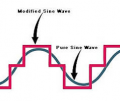
Years ago I I did a little experiment using an old 150 watt UPS (Uninterruptable Power Supply) . This unit used what we call a MSW (Modified Sine Wave) output when running on batters and gave a nice sine out when mains power was available. Albeit not a perfect comparison, here is a TSW verse a MSW.

MSW.png

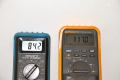
I used two meters to measure the two signals:

RMS MSW.png

Initially when the UPS was running on Mains read 117 VAC but when Mains was lost only the meter on the right was True RMS. When this happened the cheap meter could not measure the MSW . So while measuring nice pretty sine both meters do fine but when we went to the distorted sine wave, thw MSW wave the cheap meter displays 84.2 VAC and the reality is only the true True RMS meter reads correct.

This is why I suggested using transducers designed for your task.

Ron
 

Thread Starter

Hasan2019

Joined Sep 5, 2019
199
Agree, The advantage of using the processor to directly drive the relays , is the algorithm can do things like jump taps, limit the number of changes per second, depending upon the input changes. i.e. if the input is changing up and down by say 10 V, and the steps out change is 10v, then dont change the taps till the new voltage has been presnt a few seconds, Its just software, you could even do things like Kaln filtering et all !

etc,

Why @Hasan2019 do you need 16 taps, what is the voltage change per tap ?
what is the condition of the ac in that you are designing for ?
May be author of this publication wanted to make some difference with others then he suggests 16 relays, normally these are applicable to different AC output level due to rapid change of input AC, you can say for many slices of apple.
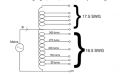
The autotransformer rating was 1kVA .The input voltage fluctuation from 180V to 260V AC is considered as a reference parameter and the output voltage is anticipated to be 220V, 50Hz. Single phase core type transformer has been considered for designing with atotal number of 333 turns. The current in primary winding is calculated to be 4.545 Amps and in secondary windings is calculated to be 3.753 Amps. The primary winding coil diameter is calculated to be 1.521mm (16.5 SWG) while the secondary windings coil diameter is calculated to be 1.38mm (17.5 GWG).

1kVA_AUTOTRANSFORMER.png
 
Last edited:

Thread Starter

Hasan2019

Joined Sep 5, 2019
199
I looked at post 16 and no those circuits will not deliver true RMS. This sort of things goes two ways. When measuring an AC signal you have Average Responding RMS indicating which is fine for nice clean sine wave. However, you mentioned that your wave for may not always be a pretty sine wave as we see in post #16. You want what we call true RMS responding RMS indicating. This holds true for not only true RMS Voltage but also measuring True RMS current.


Years ago I I did a little experiment using an old 150 watt UPS (Uninterruptable Power Supply) . This unit used what we call a MSW (Modified Sine Wave) output when running on batters and gave a nice sine out when mains power was available. Albeit not a perfect comparison, here is a TSW verse a MSW.

View attachment 361899

I used two meters to measure the two signals:

View attachment 361901

Initially when the UPS was running on Mains read 117 VAC but when Mains was lost only the meter on the right was True RMS. When this happened the cheap meter could not measure the MSW . So while measuring nice pretty sine both meters do fine but when we went to the distorted sine wave, thw MSW wave the cheap meter displays 84.2 VAC and the reality is only the true True RMS meter reads correct.

This is why I suggested using transducers designed for your task.

Ron
The circuits from post 16 are best for determining peak to peak AC, its not helping to calculate RMS ? I knew about this IC, https://www.ti.com/lit/an/snoa690/snoa690.pdf
 

drjohsmith

Joined Dec 13, 2021
1,613
I looked at post 16 and no those circuits will not deliver true RMS. This sort of things goes two ways. When measuring an AC signal you have Average Responding RMS indicating which is fine for nice clean sine wave. However, you mentioned that your wave for may not always be a pretty sine wave as we see in post #16. You want what we call true RMS responding RMS indicating. This holds true for not only true RMS Voltage but also measuring True RMS current.


Years ago I I did a little experiment using an old 150 watt UPS (Uninterruptable Power Supply) . This unit used what we call a MSW (Modified Sine Wave) output when running on batters and gave a nice sine out when mains power was available. Albeit not a perfect comparison, here is a TSW verse a MSW.

View attachment 361899

I used two meters to measure the two signals:

View attachment 361901

Initially when the UPS was running on Mains read 117 VAC but when Mains was lost only the meter on the right was True RMS. When this happened the cheap meter could not measure the MSW . So while measuring nice pretty sine both meters do fine but when we went to the distorted sine wave, thw MSW wave the cheap meter displays 84.2 VAC and the reality is only the true True RMS meter reads correct.

This is why I suggested using transducers designed for your task.

Ron
Great post .
Shoes the differences well.
Wonder how "true" the OP needs ?
 

Thread Starter

Hasan2019

Joined Sep 5, 2019
199
@Hasan2019

so where are you at on this project.
been what 3 years , and hundreds of posts ,

Id love to see what you currently have working / experimenting on so we can help you further move forward
This project is in virtual mode : simulated in proteus and LTspice : debug in Arduino IDE : wish to design in KiCAD
 

drjohsmith

Joined Dec 13, 2021
1,613
This project is in virtual mode : simulated in proteus and LTspice : debug in Arduino IDE : wish to design in KiCAD
fantastic ,
so have you the proteus / ltspice of the system ? can you share ?

what is the aim here. to ultimately make a real system ?
that link to the 16 tap transformer system seems to be where your heading.
 
Top