Best resistive load regulation from the POV of the resolution, efficiency and grid impact

Thread Starter

Kibirad

Joined Oct 18, 2021
35
Hi,
I will try to be short. I'm running LF off-grid PV inverter (Victron). When the battery is full, I want to use a resistive load (heater element) as the dump load. No problem there. But I've started thinking about how to regulate the load and I'm finding conflicting claims. I will probably start with what I would like to achieve.

Regulation resolution: Ideally I would like to be able to regulate the load in let's say 50 W increments. So just using multiple heating elements or combining them with some relay logic isn't going to cut it. When I have a 950 W surplus in the winter I want to use nearly all energy, not to be in a position where I can only switch load with 500 W increments.

Grid impact (microgrid): Because my power source is the PV inverter in off-grid mode it isn't as hard of a supply as the power grid. So I want a regulation that won't generate any or a minimal amount of flicker, EMI, transients etc. I don't want any kind of regulation that would be "hard" on the PV inverter. The reason is to minimise any stress on the inverter for the sake of its working life.

The types of regulation I've considered:

Autotransformer: bulky, pricy, slow to regulate+ need to motorized control

VFD: I was expecting this to be the best solution but apparently VFD used for only resistive load could be problematic. Also, VFD for bigger loads (3 kW+) for only 1 phase are really pricy. If we are talking about something from a more reputable manufacturer than some noname knockoff from China.

Phase angle regulation (SSR): The regulation resolution should be ideal but the impact on the grid needs to be also considered. It will send a lot of... unwanted things back to the microgrid.

Zero-cross regulation (SSR): The sources are 50/50 on this. I would expect there would not be any substantial impact on the grid because the switching takes place at zero but some people claim it causes a lot of flicker. It also probably isn't "soft" on the power supply either.

PWM (AC chopper): Probably the winner for me, but feel free to change my mind. Chopping the AC at let's say 50 kHz should allow for smooth regulation resolution, the higher frequency should also allow for smaller filtering elements at the input of the regulator and it shouldn't be that hard to implement. But I didn't have much luck finding any reference designs or something to be inspired by. Do you agree this is the way to go or are there any better opinions? In the same price range, I might add. (The VFD solution from Danfoss would cost even more than the PV inverter so that is the reason I'm mentioning the price.)
 

nsaspook

Joined Aug 27, 2009
16,251
I regulate excess solar power using another cheap PV inverter at the DC level (they share the 24vdc battery bank as the power source). This way the dump load changes don't affect the micro-grid primary inverter circuits as much. (I also have AC hybrid utility grid-tie as a dump resource as it only feeds power to the house and not back to the grid)
 

Thread Starter

Kibirad

Joined Oct 18, 2021
35
I regulate excess solar power using another cheap PV inverter at the DC level (they share the 24vdc battery bank as the power source). This way the dump load changes don't affect the micro-grid primary inverter circuits as much. (I also have AC hybrid utility grid-tie as a dump resource as it only feeds power to the house and not back to the grid)
That is an interesting way of solving the issue. Maybe if I had a spare PV inverter lying around. On the other hand, you can buy a 3,6 kW single split inverter AC with heating capability for half of the price of the cheap PV inverter (no-name of course). It should be regulable from 120 W to 1,2 kW and even with poor conditions (low SCOOP) you should gain more heat energy than by just burning it in the resistive heating element. The issue is how to convert air-to-air unit to air-to-water, but that is an entirely different topic...
 

MisterBill2

Joined Jan 23, 2018
27,186
What I do not see is what the TS is trying to regulate. Quite simply, you don't regulate "the load" in a power system.
Usually the VOLTAGE is regulated.
One guess is that the TS is charging a battery with a solar power inverter and wants to prevent over charging the battery. The solution seems simple: Reduce the output voltage to the battery, OR even disconnect the battery. Or switch over to another battery to charge. Is there really any reason to not switch off the charge when the battery is full?? THAT is the common way to operate. Or switch the power to a well pump to fill the water tank.
 
Last edited:

Thread Starter

Kibirad

Joined Oct 18, 2021
35
What I do not see is what the TS is trying to regulate. Quite simply, you don't regulate "the load" in a power system.
Usually the VOLTAGE is regulated.
One guess is that the TS is charging a battery with a solar power inverter and wants to prevent over charging the battery. The solution seems simple: Reduce the output voltage to the battery, OR even disconnect the battery. Or switch over to another battery to charge. Is there really any reason to not switch off the charge when the battery is full?? THAT is the common way to operate. Or switch the power to a well pump to fill the water tank.
Yeah, it's all about the point of view and also a language barrier (I think it is obvious I'm not a native speaker and basically 90% of electronic-related terminology can't be directly translated). Ideally, you would be able to regulate the heating element's internal resistance and thus regulate the supplied current. But we are not in the ideal world. So simply put I'm looking for an economically viable solution to turn resistive element into a "programmable load" with as low as possible impact on the power supply.

Just to make it clear. There is not any problem with the battery charging etc. I have BMS with communication directly to the PV inverter and both the PV charger and BMS have limits so there is dual redundancy. What I'm trying to do is to use "excess" solar power. I will give you an example. It is spring day and I have the battery charged, the idle load of the house is entirely covered by the PV and I know the PV can generate more energy but I don't have any way to use that energy so it stays "on the roof". So why not use the excess power and "dump it" into the heating element for heating water and lower your bill for gas (that would be used for heating water)?
 

Ian0

Joined Aug 7, 2020
13,097
The Victron output voltage is very stable, with a lower output impedance than most grid sources because it has feedback.
It seems to deal with most types of load with little trouble. I don't think you would have a problem with either a phase-fired controller or a proportional controller. Phase fired makes a lot more electrical noise and may upset the feedback, but I doubt it.
Proportional control is very easy to do, as you don't have to be bothered about any residual DC as it might briefly go half-wave - just feed the output of the comparator into a zero-crossing triac driver and let it get on with it.

I agree that the 50kHz chopper is better but it is a lot more complicated.
If you don't have any thermostats in the way you could rectify the output and chop it as rectified DC, but if you do have thermostats then it would quickly burn out the contacts. (Though you could rectify it after the thermostat)

I tried much the same thing, but with the Victron grid-connected, and it really didn't like it - it took far too long to regulate the power going into and out of the grid, so I am adopting a similar solution to @nsaspook an building a variable pulse-width square-wave inverter just for the water heater. (Having laid my hands on a surplus 3kVA transformer of about the right voltage)
 

MisterBill2

Joined Jan 23, 2018
27,186
Yeah, it's all about the point of view and also a language barrier (I think it is obvious I'm not a native speaker and basically 90% of electronic-related terminology can't be directly translated). Ideally, you would be able to regulate the heating element's internal resistance and thus regulate the supplied current. But we are not in the ideal world. So simply put I'm looking for an economically viable solution to turn resistive element into a "programmable load" with as low as possible impact on the power supply.

Just to make it clear. There is not any problem with the battery charging etc. I have BMS with communication directly to the PV inverter and both the PV charger and BMS have limits so there is dual redundancy. What I'm trying to do is to use "excess" solar power. I will give you an example. It is spring day and I have the battery charged, the idle load of the house is entirely covered by the PV and I know the PV can generate more energy but I don't have any way to use that energy so it stays "on the roof". So why not use the excess power and "dump it" into the heating element for heating water and lower your bill for gas (that would be used for heating water)?
OK, now I see and t makes a lot more sense to me. Switching the system output to power an electric water heater would be useful and a good scheme. The complication is that most available electric water heating systems are designed for mains voltages and power levels. So it would require heating elements having voltage and current requirements suitable for the output of the solar cell power supply. That would need to be created. But water heating would not require well regulated clean power. It could possibly be powered directly from the solar array with suitable switching. The idea is certainly worth additional thinking.
 

MisterBill2

Joined Jan 23, 2018
27,186
Switching the electric water heater to be powered directly from the solar power array will be the most efficient, resistive heaters work just as well on DC. AND, as long as the DC voltage does not exceed the intended mains voltage, it can supply heating power until the temperature set-point is achieved. So the control can be quite simple. The only two challenges will be operating the change-over when the battery has reached full charge, and the additional wiring.
Given that we see only one guess at the solar power output voltage, not enough information for valid details can be suggested.
 

nsaspook

Joined Aug 27, 2009
16,251
That is an interesting way of solving the issue. Maybe if I had a spare PV inverter lying around. On the other hand, you can buy a 3,6 kW single split inverter AC with heating capability for half of the price of the cheap PV inverter (no-name of course). It should be regulable from 120 W to 1,2 kW and even with poor conditions (low SCOOP) you should gain more heat energy than by just burning it in the resistive heating element. The issue is how to convert air-to-air unit to air-to-water, but that is an entirely different topic...
I also use a shop 12,000 BTU mini-split heat-pump as a micro-grid (4kW off-grid inverter) or grid load (3kW GTI inverter power limited to in house use only so we don't backfeed the grid).
https://forum.allaboutcircuits.com/...rge-controller-datalogger.194146/post-1936356

My system uses a few custom controller boards (convert local data to json format and upload to the MQTT server) and software with Home Assistant (linked with MQTT and json) to interface the FM80 charge controller, inverters, switching and metering into a system optimizes usable solar energy.
https://forum.allaboutcircuits.com/...rge-controller-datalogger.194146/post-1915886
1728232046278.png
I tried DC dump loads for a while for a earlier system but mechanical safety and temp control systems devices like over-temp switches/thermostats are designed for AC breaking and will fail (arcing contacts) when interrupting DC at high power levels.

Practicality of application sometimes overrides the best efficiency methods.
 

MisterBill2

Joined Jan 23, 2018
27,186
Certainly a mechanical thermostat contact could control a suitable mosfet without contact damage. That would be one solution to the DC power switching issue.
My thinking is that using the DC power directly will be more efficient because of avoiding conversion losses completely. Of course, we still do not know the output voltage of the solar array. At least I have not seen it. But possibly the inverter package mentioned might only work with one output voltage. That is a possibility.
 

Ian0

Joined Aug 7, 2020
13,097
If he's got Victron, then it works with 12V, 24V and 48V battery voltages, and the solar array input to the MPPTs can be anything up to 250V.
 

nsaspook

Joined Aug 27, 2009
16,251
If he's got Victron, then it works with 12V, 24V and 48V battery voltages, and the solar array input to the MPPTs can be anything up to 250V.


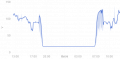
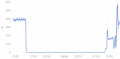
My FM80 solar array voltage for a 24VDC LiFePO4 system.
1728242782648.png
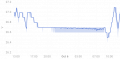
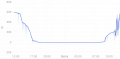
Battery Bank voltage.
1728242846025.png
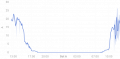
Bank current.
1728243226721.png

Off grid power loads, mainly to the heat pump.

1728243028852.png

Grid-tie power into the house to offset utility usage.

1728243095101.png
 

MisterBill2

Joined Jan 23, 2018
27,186
If he's got Victron, then it works with 12V, 24V and 48V battery voltages, and the solar array input to the MPPTs can be anything up to 250V.
OK, so now we know that the Victron can use multiple voltages.
Now consider that there is no reason that an electric water heater MUST be supplied with the rated voltage. Of course the actual hearing power will be less, but why would that be an issue?? It will still heat water some, which will still reduce the quantity of heat required from the mains supply. And working at half power for free is still a cost reduction. And the use of a lower voltage certainly is not going to damage anything. Heaters DO NOT need to only be operated at their maximum possible level.
 

Ian0

Joined Aug 7, 2020
13,097
OK, so now we know that the Victron can use multiple voltages.
Now consider that there is no reason that an electric water heater MUST be supplied with the rated voltage. Of course the actual hearing power will be less, but why would that be an issue?? It will still heat water some, which will still reduce the quantity of heat required from the mains supply. And working at half power for free is still a cost reduction. And the use of a lower voltage certainly is not going to damage anything. Heaters DO NOT need to only be operated at their maximum possible level.
It also depends on where he is in the world. In Britain and Europe the standard, cheap, off-the-shelf water heater element is 230V 3kW, about 20Ω. If what you have is 48V then that gives a rather miserable 115W. If the usual element is 120V then it makes DC operation of a standard mains heater rather more viable.
 

Thread Starter

Kibirad

Joined Oct 18, 2021
35
OK, so now we know that the Victron can use multiple voltages.
Now consider that there is no reason that an electric water heater MUST be supplied with the rated voltage. Of course the actual hearing power will be less, but why would that be an issue?? It will still heat water some, which will still reduce the quantity of heat required from the mains supply. And working at half power for free is still a cost reduction. And the use of a lower voltage certainly is not going to damage anything. Heaters DO NOT need to only be operated at their maximum possible level.
So to not segment the thread as much I will answer to the few previous posts in this one.

I would usually describe my problem in more detail, the things I rejected and why. But every time I do that the first post is long (even longer than this one) and most likely people don't want to read it and I end up with absolutely no answer.

The DC solution is something I don't want to do. It has more disadvantages than advantages at least by my standards. Yes it would be more efficient and some time back I would be looking at the most efficient way of doing this but in the end, if I lose even in some extreme case let's say 500W it is still 500W of heating (the whole PV setup is inside my house). So even though it is a loss of electric energy it is a gain in heat energy inside of the house so I don't mind.

I will take a little sidestep to describe my system:
1x Victron Multi II 5 kVA, 2x 150V 40A MPPTs (I'm planning to expand to at least 4 or even 5 MPPTs)
I'm also considering AC coupling another PV array on the Victron output to create a microgrid (eighter central inverter and optimizers or microinverters. The reason is that the roof gets asymmetrically shaded and normal string configuration would be badly impacted. Using multiple MPPTs wouldn't be economical). The PV has a voltage of 80 V under load from MPPT.

Back to the DC system. It is just a pain in the... As said above you need to use bigger cables, special contactors, rellays etc. that are noticeably more expensive at those DC currents. If you connect the heating element parallel to the MPPT you are impacting the MPPT algorithm and you don't want to do that. If you use something to switch between the MPPT and heating element you need to do it twice (currently running two MPPTs and in the future even more). If you do that you can't power your current house consumption from PV. You could say that you can only switch one MPPT "off" and the heating element "on" but if the load in the house increases and the second PV array can't supply that much power you are discharging the battery. Switching in that case the second MPPT "on" would be just messy. In that case, you are also only using excess power from only one MPPT. The second one used to power the loads is leaving energy "on the roof". Also just by directly connecting the heating element to the PV you are losing the MPPT feature. Just as the @lan0 posted while I'm writing this. So you can get watts or hundreds of watts in the better case instead of kilowatts because you can't meet the requirements of the maximum power transfer theorem. And we are basically at the same issue as with the AC. If you could gradually regulate the internal resistance of the heating element you could regulate the power it consumes. But you can't. There are ways of going around this but in the end, you will still have to use this solution isolated from the MPPT (MPPT disconnected by contactor, relay...) so as not to interfere with its algorithm or something even worse. BTW I have two inverters for hot water heating that do exactly this and I used them for two years until I installed Victron recently. But they can't work with the current voltage level (lower - I changed the PV panels wiring) and even if they could you are still in the above-described situation. There are more issues with direct DC heating. One of them is that you should never use a "wet" heating element with DC etc. but I think that what I said is enough.

You could say that a lot of the issues could be solved by moving the load behind the MPPTs topological on the battery side. You could match the heating elements resistance to the IR of the battery and get close to the maximum attainable energy but the currents get even bigger and you still didn't solve the issue the entire thread is about and that is how to "regulate the load" to get the maximum possible energy from the PV to the load but just enough so it wouldn't be at the expense of "sucking" all the power to the heading element and the load of the house would be then discharging the battery. You want to use a maximum of generatable energy but just enough not to discharge the battery and "starve" the loads.

I also must contradict what are you saying. On one hand, you are talking about the DC system being the most efficient. That will be true but on the other hand, you are saying that even though the heating element won't generate as much heating energy as it could it is still cost reduction. Also truth. But in that case, we are changing switching losses (DC-DC-AC) for the inefficiency caused by the mismatched power supply and the load → low power transfer. In the proposed solution we will lose some power due to the multiple conversions. If it would be as much as 30% I still believe that in the end, you would be able to generate more heat energy by this approach than by just directly connecting the heating element to the PV with no switching losses. In the end, as mentioned above, if I lose 30% of the electrical energy in the conversion it won't be a biggie because it is still in the house and instead of heating directly water (used for heating/washing), the conversion losses will heat the air and mass of the house. Direct PV solution would "leave the power outside".

I hope It didn't come over as too rough of an answer. I just already thought about the DC solution and I don't see any benefit to it than the higher efficiency that gets annihilated by the disadvantages.
 

Thread Starter

Kibirad

Joined Oct 18, 2021
35
I also use a shop 12,000 BTU mini-split heat-pump as a micro-grid (4kW off-grid inverter) or grid load (3kW GTI inverter power limited to in house use only so we don't backfeed the grid).
https://forum.allaboutcircuits.com/...rge-controller-datalogger.194146/post-1936356

My system uses a few custom controller boards (convert local data to json format and upload to the MQTT server) and software with Home Assistant (linked with MQTT and json) to interface the FM80 charge controller, inverters, switching and metering into a system optimizes usable solar energy.
https://forum.allaboutcircuits.com/...rge-controller-datalogger.194146/post-1915886
View attachment 333141
I tried DC dump loads for a while for a earlier system but mechanical safety and temp control systems devices like over-temp switches/thermostats are designed for AC breaking and will fail (arcing contacts) when interrupting DC at high power levels.

Practicality of application sometimes overrides the best efficiency methods.
What is your normal mode of operation of the AC? I think the AC as dump load will be a little bit specific mode of operation because I don't need to reach a certain temperature, just want to use the maximum of the generated energy. I'm not sure about how would you directly regulate the power consumption of the AC. The simple answer would be to set the target temperature lower but I don't think is that easy.

I would guess that the lower ΔT between the medium temperature (heated air/water) and target temperature (set on the AC) would mean less of a load on the AC and thus lower power consumption. On the other hand, the low ΔT would definitely have an impact on the COP (efficiency) of the heat pump / AC no?
 

nsaspook

Joined Aug 27, 2009
16,251
What is your normal mode of operation of the AC? I think the AC as dump load will be a little bit specific mode of operation because I don't need to reach a certain temperature, just want to use the maximum of the generated energy. I'm not sure about how would you directly regulate the power consumption of the AC. The simple answer would be to set the target temperature lower but I don't think is that easy.

I would guess that the lower ΔT between the medium temperature (heated air/water) and target temperature (set on the AC) would mean less of a load on the AC and thus lower power consumption. On the other hand, the low ΔT would definitely have an impact on the COP (efficiency) of the heat pump / AC no?
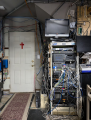
The AC is in the server/shop room so there's almost always a cooling demand for most of the year. One of the other switchable off-grid loads is the server rack.
1728260441612.png
Most have two power supplies for redundant power. I have one PS to UPS on utility and the other switchable from utility (with a possible grid-tie variable power offset) or off-grid power inverter. the system is designed to keep a positive (the actual value is calculated from several factors) energy feed into the batteries so we can reach full charge daily quickly. Then at battery float, the system switches into full solar panel power to loads while keeping the power In/out at max without using too much from the battery bank. As the solar stops at night, it then switches into power shift mode for over-night duty.

I turned the mini-split cooling system off for while when I was away for a day as a test on a cool day and night with the next day back to the 70's outside.
1728259355122.png

It was pretty warm in the room when I returned and set the temp control point in the mid 70's and up to 79 today.

1728261766676.png
System in/out energy balance between solar inputs (battery charging) and all loads.
 
Last edited:
Top