Beauty

MrAl

Joined Jun 17, 2014
13,707
Yes that's a cool thing in math and can help with some electrical circuits.

It would be hard for me to name the most beautiful equation or expression in math as I see it. There are so many.
One that stands out because we use it a lot is the Laplace Transform and companion the Inverse Laplace Transform. It's amazing how we see a helix from a different angle become a sine wave or damped sine wave. That would be called a 3d projection onto a 2d surface.

There are many simpler ones too that are collectively referred to as "witches", and others called "asteroids". Both of these are really just line curves but it's amazing how they look like things we've all seen in real life even before we knew anything about math. Then we have the lemniscates which can sometimes form familiar looking shapes also.

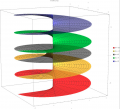
Then we have the rotational 3d objects and the generated 2d lines/curves. Some of these are amazing too.
Of course the Fractals are at the head of the class here, it's hard to beat the beauty that can be found in these things both for the finished appearance and also the beauty of the simple math functions that create them :)
 
Last edited:

Ya’akov

Joined Jan 27, 2019
10,235
Yes that's a cool thing in math and can help with some electrical circuits.

It would be hard for me to name the most beautiful equation or expression in math as I see it. There are so many.
One that stands out because we use it a lot is the Laplace Transform and companion the Inverse Laplace Transform. It's amazing how we see a helix from a different angle become a sine wave or damped sine wave. That would be called a 3d projection onto a 2d surface.

There are many simpler ones too that are collectively referred to as "witches", and others called "asteroids". Both of these are really just line curves but it's amazing how they look like things we've all seen in real life even before we knew anything about math. Then we have the lemniscates which can sometimes form familiar looking shapes also.

Then we have the rotational 3d objects and the generated 2d lines/curves. Some of these are amazing too.
Of course the Fractals are at the head of the class here, it's hard to beat the beauty that can be found in these things both for the finished appearance and also the beauty of the simple math functions that create them :)
The most beautiful equation is:

\(A = P \left(1 + \frac{r}{n}\right)^{nt}\)

Where:

\(A\) is the money accumulated after \(t\) years
\(P\) is the principal amount
\(r\) is the annual interest rate
\(n\) is the number of times the interest is compounded per year.
\(t\) is the time span in years
 

Thread Starter

nsaspook

Joined Aug 27, 2009
16,328
The most beautiful equation is:

\(A = P \left(1 + \frac{r}{n}\right)^{nt}\)

Where:

\(A\) is the money accumulated after \(t\) years
\(P\) is the principal amount
\(r\) is the annual interest rate
\(n\) is the number of times the interest is compounded per year.
\(t\) is the time span in years
My man!
 

MrAl

Joined Jun 17, 2014
13,707
The most beautiful equation is:

\(A = P \left(1 + \frac{r}{n}\right)^{nt}\)

Where:

\(A\) is the money accumulated after \(t\) years
\(P\) is the principal amount
\(r\) is the annual interest rate
\(n\) is the number of times the interest is compounded per year.
\(t\) is the time span in years

Ha ha, yeah, I have to agree fully especially when 'A' is large ha ha :)

I forgot to include one of the best, although its beauty arises from a different standpoint. That's the partial differential wave equation which ties in with the speed of light:


1724238073238.png

where 'c' is the speed of light.

I guess we could also argue that the time dilation (and related) equations are beautiful in that they describe reality better than anything that came before that.
For example, now Mark Kelly has to celebrate his birthday 5 milliseconds sooner than his twin brother :)
 
Last edited:

MrAl

Joined Jun 17, 2014
13,707
I always found some originators of ideas in various areas to have a name that amazingly coincides with what they came up with.
For example, the Poynting Vector, which points in the direction of energy flow. From what I gather the name "Poynting" is actually pronounced in English as "pointing", which of course means to point in a certain direction with say the forefinger.
It's almost comical sometimes.
 

cmartinez

Joined Jan 17, 2007
8,765

As Saha and Sinha discovered more than 600 years later, Madhava’s formula is only a special case of a much more general equation for calculating pi. In their work, the string theorists discovered the following formula:

1724955594471.png

This formula produces an infinitely long sum. What is striking is that it depends on the factor λ , a freely selectable parameter. No matter what value λ has, the formula will always result in pi. And because there are infinitely many numbers that can correspond to λ, Saha and Sinha have found an infinite number of pi formulas.
 
Last edited:

MrAl

Joined Jun 17, 2014
13,707
I am not sure of the significance of this find, but it's still interesting. I've always found that trying to find new ways to calculate pi has always been interesting. The usual idea though is to try to find as few digits as possible to get as many digits of pi as possible.
For example:
22/7 gives us 3 or 4 digits, and so we only gained maybe 1/2 digit (one function and 3 digits to get just over 3 digits of pi).
A little better is:
cuberoot(31) which gives us 4 or 5 digits, so that's one function and 2 digits to get just over 4 digits, so that's a good improvement.

The idea is to find a coincidence between the numbers and functions, that's about it, that lead to a good approximation of pi.
It might be a little interesting that we end up with these things by accident. What else could we find by accident.
 
Thread starter Similar threads Forum Replies Date
cmartinez Off-Topic 2
marshallf3 Analog & Mixed-Signal Design 6
Top