Yes that's the one thanks for linking to it.
I have that in one of my programs where I have to calculate the value of pi to an arbitrary number of digits.
Yes that's the one thanks for linking to it.
Yes that's a cool thing in math and can help with some electrical circuits.
The most beautiful equation is:Yes that's a cool thing in math and can help with some electrical circuits.
It would be hard for me to name the most beautiful equation or expression in math as I see it. There are so many.
One that stands out because we use it a lot is the Laplace Transform and companion the Inverse Laplace Transform. It's amazing how we see a helix from a different angle become a sine wave or damped sine wave. That would be called a 3d projection onto a 2d surface.
There are many simpler ones too that are collectively referred to as "witches", and others called "asteroids". Both of these are really just line curves but it's amazing how they look like things we've all seen in real life even before we knew anything about math. Then we have the lemniscates which can sometimes form familiar looking shapes also.
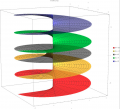
Then we have the rotational 3d objects and the generated 2d lines/curves. Some of these are amazing too.
Of course the Fractals are at the head of the class here, it's hard to beat the beauty that can be found in these things both for the finished appearance and also the beauty of the simple math functions that create them![]()
My man!The most beautiful equation is:
\(A = P \left(1 + \frac{r}{n}\right)^{nt}\)
Where:
\(A\) is the money accumulated after \(t\) years
\(P\) is the principal amount
\(r\) is the annual interest rate
\(n\) is the number of times the interest is compounded per year.
\(t\) is the time span in years
The most beautiful equation is:
\(A = P \left(1 + \frac{r}{n}\right)^{nt}\)
Where:
\(A\) is the money accumulated after \(t\) years
\(P\) is the principal amount
\(r\) is the annual interest rate
\(n\) is the number of times the interest is compounded per year.
\(t\) is the time span in years

If you do that, I suggest you stick to beer ...I'll feature these at my next party
So that's what it looks like to fall into a Black Hole right after a really huge number of snails fell in just before you did.Mandelbrot Zoom World Record, Part 1:
and it continues...11 parts, 24 hours.
I'll feature these at my next party.
You mean instead of LSD right?I you do that, I suggest you stick to beer ...
I always found some originators of ideas in various areas to have a name that amazingly coincides with what they came up with.
As Saha and Sinha discovered more than 600 years later, Madhava’s formula is only a special case of a much more general equation for calculating pi. In their work, the string theorists discovered the following formula:
This formula produces an infinitely long sum. What is striking is that it depends on the factor λ , a freely selectable parameter. No matter what value λ has, the formula will always result in pi. And because there are infinitely many numbers that can correspond to λ, Saha and Sinha have found an infinite number of pi formulas.
I am not sure of the significance of this find, but it's still interesting. I've always found that trying to find new ways to calculate pi has always been interesting. The usual idea though is to try to find as few digits as possible to get as many digits of pi as possible.
| Thread starter | Similar threads | Forum | Replies | Date |
|---|---|---|---|---|
|
|
The weirdest beauty queens... | Off-Topic | 2 | |
|
|
The beauty of PFC capacitors | Analog & Mixed-Signal Design | 6 |
| Similar threads |
|---|
| The weirdest beauty queens... |
| The beauty of PFC capacitors |