Beauty

MrAl

Joined Jun 17, 2014
13,704
Hi,

Yes interesting to think about and it touched on one area that always bothered me about problems like this that involve gravity similar to the "center of gravity".
It's interesting that they touched on these issues but even the center of gravity is a bit flawed as we see in the news lately. The Earth is not perfectly homogenous and it's not even a sphere. If we created a model of the planet Earth using smaller "planets" that were perfectly spheroids, there would be spaces in between the smaller spheres, and that would mean the gravity would fluctuate as we moved from one place to another near the surface of the Earth model. That would mean the path would really be a distorted ellipse. That would look like an ellipse with little up and down variations that ideally might look like higher harmonic ellipses.
If that doesn't make too much sense, then just think of our multiple planet model as having only two sub planets. As the object moves from one to the other, the gravity is going to fluctuate rather than be constant in any single direction.

It was still interesting to think about though and compare the usual path to the more accurate path depicted in the article.
 

cmartinez

Joined Jan 17, 2007
8,763

It might surprise you to learn that Gauss never actually drew a regular heptadecagon. He didn’t need to. He proved that the shape is constructible in principle by expressing the special length x [cosine (2π ⁄17)] solely in terms of the five algebraic operations that the compass and straightedge permit. Even if you don’t find his equation particularly enlightening, its complexity demonstrates how much work the adolescent must have poured into the problem:

Mathematical equation shows how Gauss calculated the value of the special length x.
 

MrAl

Joined Jun 17, 2014
13,704
Hi,

That's something that always amazed me. I'll have to watch that video a bit later but I hope I can get to it soon.

This may tie in with some theories on sets. It reminds me of the Barber Paradox that goes like this...

The Barber in the village shaves everyone who does not shave themselves.
But then who shaves the Barber?

He's part of the set but not part of the set, so it becomes unsolvable.

I think another related theory is if we have a set S that includes A, B, and C, then A (or B or C) cannot contain S. This makes sense because if we let A include S, then that 'sub' S also has A in it, and therefore that 'sub' A would also have to contain S which also contains another A (because S originally held A), which then must contain S, which then contains A, then S again, the A again, etc., which would lead to an infinite set which probably does not help solve anything.
When I use the word "another" it's only for clarity, it would be the very same A, which makes it sort of fictional right off, at least in the classical sense.
 

Thread Starter

nsaspook

Joined Aug 27, 2009
16,325
She's just a new particle denier.
+1

Easy to be one when all the prediction of new stuff as failed (it was designed to find evidence of the Higgs boson from the old school standard model) and with low expectations of new stuff with a new, very expensive machine.

https://www.science.org/content/art...hysicists-face-nightmare-finding-nothing-else
Ten years after the Higgs, physicists face the nightmare of finding nothing else
Unless Europe’s Large Hadron Collider coughs up a surprise, the field of particle physics may wheeze to its end

https://www.science.org/doi/10.1126/science.315.5819.1657
1726953584310.png
 
Last edited:

cmartinez

Joined Jan 17, 2007
8,763
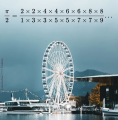
The 17th century English mathematician John Wallis found that half a π is equal to an infinite product of double even numbers divided by an infinite product of double odd numbers.

1728916487312.png
 

MrAl

Joined Jun 17, 2014
13,704
The 17th century English mathematician John Wallis found that half a π is equal to an infinite product of double even numbers divided by an infinite product of double odd numbers.

There are several older formulas. One of them like this one uses factorial.
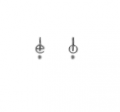
Back in the 1980's I had come up with a different notation for the factorial of even numbers than for odd numbers. For even it was an "E" with an exclamation point typed right on top of it, while for odd it was an "O" with an exclamation point typed right on top of it (like an overtyped character). This would be hard to show on the internet though I think without using an image. Not sure if any math software can show characters that are typed one on top of the other.
 

MrAl

Joined Jun 17, 2014
13,704
Something like \(\stackrel{!}{E}\) or \(\stackrel{!}{O}\)? Or like \(\rlap{\,\boldsymbol{!}}E\) and \(\rlap{\,\boldsymbol{!}}O\)?
Yes the second set, although the exclamation point would be much taller than the E or the O.
Now that I think back I think I used lower case e and o (see drawing).

I also seem to remember someone telling me there was not enough use for those new symbols but I still used them in my handwritten notes.
 

Attachments

ZCochran98

Joined Jul 24, 2018
351
Yes the second set, although the exclamation point would be much taller than the E or the O.
Now that I think back I think I used lower case e and o (see drawing).

I also seem to remember someone telling me there was not enough use for those new symbols but I still used them in my handwritten notes.
Ah. Based on what I found earlier, a double factorial sign is used in modern notation to indicate both.
 
Thread starter Similar threads Forum Replies Date
cmartinez Off-Topic 2
marshallf3 Analog & Mixed-Signal Design 6
Top