Battery Simulator

Thread Starter

BigShawarma

Joined Jan 20, 2025
7
Hello,

I want to design a battery simulator circuit to test my board. My board connects to a single cell li-on battery, 3.8V 2400mAH and it has a wireless charger circuit with up to 400mAH charge.

The battery simulator needs to provide up to 1A to the board and to be "charged" at 400mA.
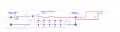
1737382598411.png
The PS is 3.45V and 1A.
The board is working but nothing seems to "charge".

Thank you for the answers.
 

ericgibbs

Joined Jan 29, 2010
21,420
Hi Big,
Welcome to AAC.
Checking your circuit, it shows that the C2 470uF capacitor would charge up to 3.45V almost instantly???

E
 

Thread Starter

BigShawarma

Joined Jan 20, 2025
7
Hi Big,
Welcome to AAC.
Checking your circuit, it shows that the C2 470uF capacitor would charge up to 3.45V almost instantly???

E
Hi eric,
thank you for your answer.
how does affect my charging function or its affect all the circuit?

because my board turn on when i power it and its even pass all the test (its a jig) except charging test
 

ericgibbs

Joined Jan 29, 2010
21,420
hi Big,
If the battery is Lithium say 3.7V, a 3.4V 1A PSU will not charge the battery.
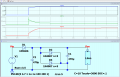
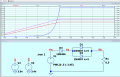
This LTSpice shows the results, using a 4.7V charge voltage
E
EG57_ 2581.png
 

Thread Starter

BigShawarma

Joined Jan 20, 2025
7
hi Big,
If the battery is Lithium say 3.7V, a 3.4V 1A PSU will not charge the battery.
This LTSpice shows the results, using a 4.7V charge voltage
E
View attachment 340801
hi eric.
thank you for your reply.

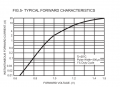
maybe i didn't understand your answer, but i don't try to charge a real battery, the diodes suppose to to act like a battery and "charge" and then from the board under test i will measure the current of the charging.

when i measure the diodes in discharge mode the voltage is ~3.4v and in charge mode it suppose to up to ~3.9v (i measure it from a working jig, but i cant copy it without break it)
 

MisterBill2

Joined Jan 23, 2018
27,358
Diodes have an intrinsic forward voltage drop, they do not act like resistors. To simulate the current drawn by a charging battery you need a much different circuit, which will be a transistor with an op-amp controlling it to hold a constant voltage as it draws current. Functionally that will be a "shunt voltage regulator" circuit.
 

ronsimpson

Joined Oct 7, 2019
4,664
I want to design a battery simulator circuit to test my board.
I worker/worked for a company that has battery simulators. You don't have that kind of money.

For first order simulation: take a bench power supply, (hopefully one that is programmable) and add a very small resistor to act like the battery internal resistance.
Monitor Voltage and Amps using a micro/ laptop/ Raspberry Pi computer. The amount of charge is only a number in the computer.
For discharging start out with 2400 of charge. Use the battery discharge curve in the data sheet. So at 1200 of charge the voltage drops a little. As you approach 100 of charge the voltage is dropping fast.
For charging, pretend to add to the charge number and follow a curve back up.

The software can be slow. It should respond 100/sec but 1/minute will work.

I know this is not accurate but it is a start.

At first I used a bench supply and just turned the know by hand. AT 500mHa the voltage should be _______ fill in the blank.
I have a fraction of an ohm resistor box to make the internal resistance adjustable. Or use a 1 ohm power pot.

For testing "my board" I wanted to know will my board function with a fully charged battery while it is still being charged and will the board work at low voltage with internal resistance.
 

MisterBill2

Joined Jan 23, 2018
27,358
Hi,
He is NOT using the diodes as resistors!
E
It certainly LOOKS like the diodes are connected to draw current in response to an applied voltage. That seems a lot like a resistor's application. The fact that it is not a linear function is incidental at this point.
My understanding is that a battery charger is used to pump current into a battery against an opposing voltage, thus adding charge. Just like a diode, that function is rather non-linear. At least in my experience it is non-linear. I apply a voltage and very littler if any, current flows until the applied voltage exceeds the battery voltage, At that point the current rises in something sort of close to a linear manner, but still not really linearly. So the diodes are serving a bit like a load resistor, but not like a linear load resistor.
 

ericgibbs

Joined Jan 29, 2010
21,420
Hi,
The diodes represent the discharged 2.8V voltage condition of a Lion 3.7V battery in his simulation.

You should learn how to read and understand LTSpice simulation circuit plots.

E
 
Top