Battery-Powered Heavy Load Transfer Cart

Status
Not open for further replies.

Thread Starter

seremmi

Joined Apr 21, 2025
11
Hello,


I’m a university student and I have an assignment to complete.
I’m doing research on a battery-powered/rechargeable transfer trolley with a 10-ton capacity, and I will be drawing its power and control circuit.


To do this, I first need to create a bill of materials. Then I plan to draw the circuit based on the datasheets.
I’ve chosen two 1.5kW BLDC motors for the system.
The battery will be 48V 400Ah.


What else do I need? A controller, BMS, connectors, charger, etc.?
Does anyone have any documents related to this?
 

Ian0

Joined Aug 7, 2020
13,112
What else do I need? A controller, BMS, connectors, charger, etc.?
Does anyone have any documents related to this?
Seems to me that this is part of the assignment.
But I will contribute one suggestion - don't forget the safety systems. 10 tonnes of moving mass can do a lot of damage.
MODs - please move this to "homework".
 

BobTPH

Joined Jun 5, 2013
11,482
Let’s do some math.

10 tons (metric) = 10000 kg.

1W will accelerate 1kg by 1m/s^2

1500w will accelerate 10000 kg at .15 m/s^2

1km / hour = 1000/3600 = .256 m/s

5 km /hour = 1.28 m/s

It takes 1.28 /.15 = 8.5s

So it takes 8.5 seconds to accelerate to walking speed, if there is no frictional loss, and the surface is flat.

You might want to calculate the maximum slope it can ascend.
 

Thread Starter

seremmi

Joined Apr 21, 2025
11
Let’s do some math.

10 tons (metric) = 10000 kg.

1W will accelerate 1kg by 1m/s^2

1500w will accelerate 10000 kg at .15 m/s^2

1km / hour = 1000/3600 = .256 m/s

5 km /hour = 1.28 m/s

It takes 1.28 /.15 = 8.5s

So it takes 8.5 seconds to accelerate to walking speed, if there is no frictional loss, and the surface is flat.

You might want to calculate the maximum slope it can ascend.
A mechanical engineer friend of mine did the calculations.
And when I looked at companies that manufacture these systems, I saw that they generally use a BLDC motor with a maximum power of 2.2 kW anyway.
Also, is it accurate to make this calculation based on a single motor without knowing the motor’s RPM?
 
Last edited:

Thread Starter

seremmi

Joined Apr 21, 2025
11
Is there anyone who can share documents or provide assistance regarding electric/battery-powered heavy load transfer carts?
 

Irving

Joined Jan 30, 2016
5,064
it's a three phase motor in star configuration.
Is there anyone who can share documents or provide assistance regarding electric/battery-powered heavy load transfer carts?
Depends what you want to know. As a systems engineer I've done a lot of work around battery powered human transport, eg wheelchairs. Other than an obvious weight difference the rest is pretty similar, in the end it all comes down to numbers and how you apply them to design decisions (or vice versa!)
 

BobTPH

Joined Jun 5, 2013
11,482
Also, is it accurate to make this calculation based on a single motor without knowing the motor’s RPM?
The calculation is assuming the motor is properly geared so that the required torque is supplied. It is based only on energy in and energy used. It is only a rough estimate to be used as a sanity check. A torque analysis over the entire range of speed would be more accurate.

How fast do you want it to accelerate and how steep a hill do you want it to climb at what speed? Then you can do the calculations, and I would probably double the size of the motor so that it works well in the real world and the motor isn’t over stressed.
 

Thread Starter

seremmi

Joined Apr 21, 2025
11
The calculation is assuming the motor is properly geared so that the required torque is supplied. It is based only on energy in and energy used. It is only a rough estimate to be used as a sanity check. A torque analysis over the entire range of speed would be more accurate.

How fast do you want it to accelerate and how steep a hill do you want it to climb at what speed? Then you can do the calculations, and I would probably double the size of the motor so that it works well in the real world and the motor isn’t over stressed.

Torque is : 5,25 Nm.
RPM : 2750
I think its enough for my sistem.?
 

Thread Starter

seremmi

Joined Apr 21, 2025
11
Depends what you want to know. As a systems engineer I've done a lot of work around battery powered human transport, eg wheelchairs. Other than an obvious weight difference the rest is pretty similar, in the end it all comes down to numbers and how you apply them to design decisions (or vice versa!)
I need to make a product selection.


After selecting the motor, I need to choose the driver, battery, BMS, fuses, charger, contactors, etc.
When selecting these components, should I choose all of them as 48VDC, or should I use a converter for some of them?
Similarly, what calculations do I need to perform when selecting these components? For example, current (amperage) calculations.
Or what should I consider when selecting the charger?


These are some of the questions I have in mind.


After selecting the components, I can design the project based on their datasheets.
 

Irving

Joined Jan 30, 2016
5,064
You need to get your mechanical design basically in place first. That will determine speed & acceleration requirements, gearing, required motor torque and revs and therefore power and then input power/current and therefore controller and BMS requirements. Worrying about the battery charger at this stage is irrelevant - its simply an operational decision. How long will your battery last, and how long can you afford to wait til its recharged? You have no idea because you have no functional requirements to determine power input and no operational requirements to size the charging regime.

You need to start with the basics; for example, what wheels/tyres will handle a 10 ton load (or 25% + safety margin)? I've no idea, but they sound truck-sized. Then, given some basic math, you can work out the drive train requirements. YOU need to understand how to do this, not some 'friend' because you may have to iterate a few times; there is no one right answer, its a best fit for your requirements, but you have no spec yet...

For example, taking a typical 'golf buggy' sized wheel operating at walking pace is around 42rpm so you'll need to gear down for that from some nominal motor speed. You say your nominal motor speed is 2750rpm - is that no load or peak torque or peak efficiency? Which ever, you'll need to gear down; how are you going to do that? Chain, belt, gearbox or what, maybe some combination? Each has their own benefits and efficiencies/losses and torque handling capability. Again, without functional requirements, eg what acceleration do you want, and what top speed and what slope you want to be able to climb you can't make a choice. Then you'll need to read and understand the motor curves to determine where you want to sit on the torque v speed and torque v efficiency curves. If you don't have the curves its all guesswork. Your motor(s) may be suitable, but we have no idea. Picking it based on a 'power rating' without knowing how you're going to use it isn't a good way to start.
 

BobTPH

Joined Jun 5, 2013
11,482
I just realized. 1.5KW — that is about 2HP, less power than a typical lawnmower. Sounds a wee bit low for moving a 10 ton cart.
 

Irving

Joined Jan 30, 2016
5,064
I just realized. 1.5KW — that is about 2HP, less power than a typical lawnmower. Sounds a wee bit low for moving a 10 ton cart.
There are two motors apparently, and, as you showed, it all depends on the requirements.... which are still unknown!
 

Thread Starter

seremmi

Joined Apr 21, 2025
11
You need to get your mechanical design basically in place first. That will determine speed & acceleration requirements, gearing, required motor torque and revs and therefore power and then input power/current and therefore controller and BMS requirements. Worrying about the battery charger at this stage is irrelevant - its simply an operational decision. How long will your battery last, and how long can you afford to wait til its recharged? You have no idea because you have no functional requirements to determine power input and no operational requirements to size the charging regime.

You need to start with the basics; for example, what wheels/tyres will handle a 10 ton load (or 25% + safety margin)? I've no idea, but they sound truck-sized. Then, given some basic math, you can work out the drive train requirements. YOU need to understand how to do this, not some 'friend' because you may have to iterate a few times; there is no one right answer, its a best fit for your requirements, but you have no spec yet...

For example, taking a typical 'golf buggy' sized wheel operating at walking pace is around 42rpm so you'll need to gear down for that from some nominal motor speed. You say your nominal motor speed is 2750rpm - is that no load or peak torque or peak efficiency? Which ever, you'll need to gear down; how are you going to do that? Chain, belt, gearbox or what, maybe some combination? Each has their own benefits and efficiencies/losses and torque handling capability. Again, without functional requirements, eg what acceleration do you want, and what top speed and what slope you want to be able to climb you can't make a choice. Then you'll need to read and understand the motor curves to determine where you want to sit on the torque v speed and torque v efficiency curves. If you don't have the curves its all guesswork. Your motor(s) may be suitable, but we have no idea. Picking it based on a 'power rating' without knowing how you're going to use it isn't a good way to start.


Actually, I have already determined many of the requirements based on my own calculations.


  • 2 x 1.5kW 48VDC motors, Torque: 5.25Nm, Speed: 2750 RPM
  • 2 x 48VDC controllers (No reducers, speed will be adjusted with these controllers. Each wheel will be driven separately. The rear wheels will be idle.)
  • Battery: LFP 48V 210Ah (I calculated it will work for about 4 hours)
  • Wheel diameter: 350mm x 4
  • Car size: 2m x 4m x 0.75m
  • BMS with 70A-80A support. Peak current: 160-170A
  • Charging: 2.5kW, 50A (I calculated it will fully charge in 4 hours)

So, I think the information you provided is quite clear.
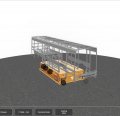
Also, attached is an image of a sample car.

However, I need help to verify the accuracy of these calculations.
videoframe_3133.png
 

Thread Starter

seremmi

Joined Apr 21, 2025
11
I just realized. 1.5KW — that is about 2HP, less power than a typical lawnmower. Sounds a wee bit low for moving a 10 ton cart.
Yes, it sounds funny, doesn’t it? :)
But most of the transfer cars on the market are like this.
You can also check the image I sent in the previous messages.
With the right calculations, this is something that can be done. And like I said, it’s already being done.
 

Futurist

Joined Apr 8, 2025
725
Hello,


I’m a university student and I have an assignment to complete.
I’m doing research on a battery-powered/rechargeable transfer trolley with a 10-ton capacity, and I will be drawing its power and control circuit.


To do this, I first need to create a bill of materials. Then I plan to draw the circuit based on the datasheets.
I’ve chosen two 1.5kW BLDC motors for the system.
The battery will be 48V 400Ah.


What else do I need? A controller, BMS, connectors, charger, etc.?
Does anyone have any documents related to this?
Do you have any use cases? examples of expected real world applications for the system?
 
Status
Not open for further replies.
Top