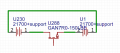
I wanted to know if it was simply possible to make a connection between two or more batteries to put them in series using MOSFETs, in my case gallium nitride MOSFETs.
I guarantee that when the MOSFET conducts the batteries will rise to a high temperature and could potentially explode spreading shrapnel and corrosive chemical residues. WTF are you thinking here?
what do you mean when you say "The Batteries can remain connected in series indefinitely", the voltage of the battery is 4 volts , I'm trying to design a circuit that allows me to recharge batteries in parallel and then connect them in series via mosfets. I've opted for GaN mosfets because they enable control of high-power loads (high voltage and high current) with a gate voltage suitable for a 3.3V microcontroller, with very low thermal losses
I had a sneaking-suspicion that this was going to be a Charging-Scheme.
Technically it can be done that way, but it's a poorly thought-out, and overly-complex plan,
unless, maybe, You are actually only going to use a total of 2 Cells and
You plan to charge them with your Car's ~12-Volt Electrical-System.
Then "maybe" this setup might be a possible option.
There are hundreds of excellent "All-In-One" Chips designed specifically
to charge Li-Ion-Cells which are permanently wired in series.
Charging Li-Ion Cells efficiently and safely is not a trivial task,
designing your own Charger can easily result in a Chemical-Fire that You can't put-out,
and shortened Cell-Life-Expectancy too.
If You want help with this problem you will have to put in some serious study-time first.
There are very nice Chargers designed for
Radio-Controlled Hobby Planes, Quads, and Cars, that will do an excellent job, without all the complexity.
This will require purchasing an appropriate Battery-Pack matched to your intended application.
.
.
.

 Facebook
 Google
 GitHub
 Linkedin