Basic help with a gate circut

Thread Starter

Mhenry

Joined Dec 28, 2016
6
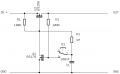
I know this is a very basic circuit that I am struggling with, however I hope that a few of you may help me with some advice. I am attempting to design a circuit that allows me to turn on and off a rearview camera in my automobile using the following switch.

APEM LED Switch
http://www.apem.com/files/apem/brochures/switch-pushbutton-IP-mom-ENG.pdf

The display of the video is triggered by a video feed signal through the RCA cable which leaves me with the design to turn on and off the switched ACC from the ignition as the (+) source (12V 6A).

LED colour: Blue (L0B)
Forward current: 20mA
Typ. forward voltage: 3,2V
Max. forward voltage: 3,8V

I also see that from the datasheet that:
"A resistor must be series-connected by the user.
Resistor value = (supply voltage - LED forward voltage)/LED forward current" 12V-3.2V=8.8/0.02=440 Ohm, is this correct?

Further, I am unsure of how to integrate this switch into the circuit that uses a simple momentary push button. The switch I have uses three wires as per the datasheet. Wire colours : black : NO contact, red : LED anode(+), blue : LED cathode(-)

The circuit that I am contemplating is described here:http://www.mosaic-industries.com/embedded-systems/_detail/microcontroller-projects/electronic-circuits/push-button-switch-turn-on/latching-high-side-push-on-push-off-toggle-switch-circuit.png


Please help as I am feeling a bit lost in how to make all of this work.

Thank you for your advice in advance and my first bit of help maybe how to change the title of your posting as I included a typo. ;)
Michael-
 

Thread Starter

Mhenry

Joined Dec 28, 2016
6
That looks right to me!

Just one follow-up question. Did you set the resistor values to the correct resistance or do I need to do that?

Thanks for your help!
Michael
 

#12

Joined Nov 30, 2010
18,224
I didn't set any values. I copied that off another member here. Anyway, it's all about proportionality and the timing capacitor. I would tend to use lower value resistors and bigger capacitors to improve noise immunity like 1uf and reduce all resistors by a power of 10. Just keep the proportions the same.
 

Thread Starter

Mhenry

Joined Dec 28, 2016
6
"Anyway, it's all about proportionality and the timing capacitor."

So you are referencing R1, R3, and C1? Further, how do I ensure the proper signal voltage to Q1 while protecting the LED?

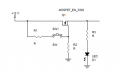
Ah, I think I see. These momentary switches are designed for this type of circuit so that the cathode side and ground are one in the same. This allows for you to protect the LED as a separate circuit fed by the final switched power?

Like in this circuit:
 
Last edited:

#12

Joined Nov 30, 2010
18,224
You want 5 amps at 48 volts for do-it-yourself prices in a $100,000 car?
And you're still going to have to push the button twice to get the two functions?
And I'm going to the wrecking yard on New Years Day to buy car parts for half of regular junk yard prices.
I'm working at the wrong website.:(
 
Last edited:

Thread Starter

Mhenry

Joined Dec 28, 2016
6
I know that I am not going to engender any sympathy, and it is a pretty awesome car. I got sick and tired of just working on cars that offered no reward for the bloody knuckles, temper tantrums and an empty wallet. I wanted something more challenging, and now I have this pretty awesome car to build up. Additionally, I got tired of working 80 hour weeks to win the race to the end, and now I have something to enjoy Sunday afternoon.

With that being said, some of my best memories as a child and later as an adult were at the pick yard. I even took a few of my girlfriends there to "help". I wish there was a pick yard for my car as this darn tactile switch cost me $80 and I don't want to mess it up.

I came to this site since my electronics skills are more than rusty, even though as a child I pretty much lived for this stuff. Since then, I spend most of my time figuring out math and physics problems in lieu of circuitry.

On to the topic at hand. This circuit needs to be run from the tactile switch with three light weight leads specified in this data sheet (http://www.apem.com/files/apem/brochures/switch-pushbutton-IP-mom-ENG.pdf). The circuit turns on a rearview camera mounted to the rear license plate frame. Since this is a mid-engine car the rearview mirror is useless since only reflects the supercharger on the top of the engine.
The the turn on with ignition is very useful as a backup camera and then as my rearview mirror. That is why I thought the last circuit shown may be best:

The circuit shows that it is designed to use 5-18 VDC and all I have to do is figure out the function of this switch and integrate it into the overall circuit. Then when the ignition is activated the camera and switch LED turns on, then after backing one press of the switch turns the camera off, or it can be left on as a rearview mirror.

I really do appreciate the help and my apologies for my lack of knowledge in this area :)
 

#12

Joined Nov 30, 2010
18,224
You need to clear up some ambiguity. You say you want to use this in a car, which never sees anything above 16 volts on the battery, except for "load dump" spikes from the alternator. Then you say you want to duplicate this particular switch. Which is it?

The load dump spikes are taken care of in the protective part of the design, like choosing transistors that can survive 60 volt transient moments. The switch functions are taken care of in the "normal use" design. What your verbal description sounds like is that you want the new circuit to operate continuously at 48 volts. Do you have a 48 volt battery in your car?

Now you have posted a circuit for "press on, hold for off". Is that what you want or do you want a click-0n, click-off circuit, or do you want a circuit that comes on with the ignition switch and is cancelled with a push-button, and can be clicked back on with a second click of the push-button?
Then you say, "
when the ignition is activated the camera and switch LED turns on, then after backing one press of the switch turns the camera off, or it can be left on as a rearview mirror.
What does that have to do with, "hold for off"?

Next, you have labeled a switch as auto-on and auto-off. Do you mean, "ignition switch off" and "ignition switch on"? Do you mean, "automatically on" regardless of what you do to the push-button? Or does that mean you want to be able to disable the auto-on camera function with an over-ride switch?

how do I ensure the proper signal voltage to Q1 while protecting the LED?
Any indicator LED can be placed at the output. The LED has nothing to do with signal voltages or gate charge. Quit pretending it has anything to do with the circuit function. It's just a pretty do-dad that you hang on the circuit after you're done, like an ornament.

Do you want this to last until Hell freezes over, or will 10 to 15 years between servicing be sufficient?

What I see happening is that the more you stir the pot, the muddier it gets. Settle down and say what you want, clearly.
Quit posting drawings that contradict your words.
Define the car voltage and the camera current.
 

hp1729

Joined Nov 23, 2015
2,304
Design 1111 PUSH ON PUSH OFF.PNG
I know this is a very basic circuit that I am struggling with, however I hope that a few of you may help me with some advice. I am attempting to design a circuit that allows me to turn on and off a rearview camera in my automobile using the following switch.

APEM LED Switch
http://www.apem.com/files/apem/brochures/switch-pushbutton-IP-mom-ENG.pdf

The display of the video is triggered by a video feed signal through the RCA cable which leaves me with the design to turn on and off the switched ACC from the ignition as the (+) source (12V 6A).

LED colour: Blue (L0B)
Forward current: 20mA
Typ. forward voltage: 3,2V
Max. forward voltage: 3,8V

I also see that from the datasheet that:
"A resistor must be series-connected by the user.
Resistor value = (supply voltage - LED forward voltage)/LED forward current" 12V-3.2V=8.8/0.02=440 Ohm, is this correct?

Further, I am unsure of how to integrate this switch into the circuit that uses a simple momentary push button. The switch I have uses three wires as per the datasheet. Wire colours : black : NO contact, red : LED anode(+), blue : LED cathode(-)

The circuit that I am contemplating is described here:http://www.mosaic-industries.com/embedded-systems/_detail/microcontroller-projects/electronic-circuits/push-button-switch-turn-on/latching-high-side-push-on-push-off-toggle-switch-circuit.png


Please help as I am feeling a bit lost in how to make all of this work.

Thank you for your advice in advance and my first bit of help maybe how to change the title of your posting as I included a typo. ;)
Michael-
Why all the elaborate circuit? Keeping it simple ...
 
Top