Basic circuit design and block diagrams.

Thread Starter

ManisMan

Joined May 27, 2017
1
Im having trouble understanding the way circuits operate on some fundamental level.

http://www.electrosmash.com/images/tech/tube-screamer/tube-screamer-block-diagram.png

This is a pretty simple version of block diagram and it seems self evident. I understand arrangement of circuit components for amplification, but there's a point I cant reach. If I look over schematics of simple circuits, I can understand them for the most part, but any new collection of circuits doesn't make sense.

I have read a number of books and articles on this website for it but it still hasn't 'clicked'. At some point, is it possible that extremely complex circuits are composed of basic building blocks that snap together like legos? Can those building blocks be self-discovered easily if you're thinking clearly enough or should they just be memorized? How do you go from having an idea to designing a circuit?

In that linked photo, I don't understand why they put certain lines between certain components, for example. It seems like AC bleeds everywhere in the circuit and affects everything.
 

DickCappels

Joined Aug 21, 2008
10,661
That's a pretty good example of a good schematic. It took a bit to figure out how that whole bypass circuit is supposed to work.

It gets easier with experience. Learning to read schematics and block diagrams is a lot like learning a new language. With time you learn to identify certain common circuits and configurations of components. This happens at many levels from the simple -a resistor in series with a voltage source will result is some IR drop to the more complicated -take a superhetrodyne receiver as an example -what are the typical stages, what the individual circuits look like, etc.

Sometimes one can stare at a schematic for a very long time and not be able to puzzle out for sure what a particular part of the circuit is doing until simulating it or putting a scope probe on it because the behavior of some circuits are heavily dependent upon subtleties of component values and and the applied signal, so recognizing where and how particular circuits are used in a given field is very helpful in understanding the circuit in depth.

Keep studying schematics and reading about the functioning of electronics and your electronic "vocabulary" will continue to expand.
 

Sensacell

Joined Jun 19, 2012
3,780
Circuit typologies are like words in language, your vocabulary grows over time.
At the beginning, there are words you don't understand, and that makes the sentence hard to understand.

Unfortunately, there is no way to google an unfamiliar circuit configuration, unless you already know it's function.
After a while, you can recognize the configurations and it all clicks, the subtleties of how they are interfaced together becomes the fun part.

At the highest level, this circuit is an amplifier with clipping, and a flip flop (Q5 and Q6) to control a bypass switch (Q2 and Q4)
The switch removes the clipper from the circuit, every other time you hit the switch.
 

MrChips

Joined Oct 2, 2009
34,700
Circuit typologies are like words in language, your vocabulary grows over time.
At the beginning, there are words you don't understand, and that makes the sentence hard to understand.

Unfortunately, there is no way to google an unfamiliar circuit configuration, unless you already know it's function.
After a while, you can recognize the configurations and it all clicks, the subtleties of how they are interfaced together becomes the fun part.

At the highest level, this circuit is an amplifier with clipping, and a flip flop (Q5 and Q6) to control a bypass switch (Q2 and Q4)
The switch removes the clipper from the circuit, every other time you hit the switch.
I like that analogy. Think of circuit schematics as a language to communicate ideas and concepts.
Circuit components such as resistors and capacitors are letters.
You put together letters to form words that describe objects.
You string together words to create phrases and sentences, building blogs to a form a paragraph.
The paragraphs are your collection of ideas that create the whole story.

(The lines and connections are like punctuation marks and grammar. There are established rules along with personal style.)

Take one step at a time. From components to building blocks. With continual exposure and practice, one day you will become an expert creator in your own right.
 

Mellisa_K

Joined Apr 2, 2017
391
At the highest level, this circuit is an amplifier with clipping, and a flip flop (Q5 and Q6) to control a bypass switch (Q2 and Q4)
The switch removes the clipper from the circuit, every other time you hit the switch.
I like this narrative approach. It's a story. And each block can be described below this highest level in terms of present tense narrative.

In this, my early stage of learning my electronics hobby, I want to be able to describe each circuit I build in this way before I move onto the next circuit project. And to write it down.

It's the only way I can learn. I can revisit each such story as I learn more and embelish and enrich it with more insights or corrections along the way.

MK
 

Mellisa_K

Joined Apr 2, 2017
391
I like that analogy. Think of circuit schematics as a language to communicate ideas and concepts.
Circuit components such as resistors and capacitors are letters.
You put together letters to form words that describe objects.
You string together words to create phrases and sentences, building blogs to a form a paragraph.
The paragraphs are your collection of ideas that create the whole story.

(The lines and connections are like punctuation marks and grammar. There are established rules along with personal style.)

Take one step at a time. From components to building blocks. With continual exposure and practice, one day you will become an expert creator in your own right.
Encouraging words!
 

dl324

Joined Mar 30, 2015
18,272
Welcome to AAC!

That schematic is drawn fairly well. The toggle flip flop used the traditional topology, so it's easy to see the functionality. If it had been drawn willy nilly, it would have taken more analysis to determine function. There's an art to creating a well drawn schematic; that is one that clearly communicates function.

At some point, is it possible that extremely complex circuits are composed of basic building blocks that snap together like legos?
In general, no. That's not called designing anyway; it's assembling.
Can those building blocks be self-discovered easily if you're thinking clearly enough or should they just be memorized?
If you learn how to analyze the circuits, you don't have to remember as much or only understand if a certain topology is used.
How do you go from having an idea to designing a circuit?
You just design the circuit. If you don't know how to design any of the parts, you can adapt existing designs for your application.

The bottom line is that you're not going to be a proficient designer unless you understand how the circuits you want to use function. Most of us took years of specialized training to get there. That's not unlike any profession. If it was easy enough that anyone with no training could do it, there's no future in that profession. Electrical Engineering isn't a field that many find easy.

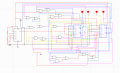
Here's an example of an unreadable schematic:
Capture (1).PNG
 
Last edited:

#12

Joined Nov 30, 2010
18,224
I hobbied around with this stuff for 6 years, then did 3 years fixing TVs and a year in a California factory doing precision analog meters, diagnosis, repair, and calibration, and then, the light bulb in my head lit up. That was like 10 years of pounding sand down a rat hole, but it finally paid off.

All the time I was struggling to read schematics and desperately working out which part needed replacing, I was building inventory in my head. What's a diode? Why is a Zener different? How is a vacuum tube like an NPN transistor? How does a 555 timer chip work? It took me a week to wrap my head around an operational amplifier.:( But that was the moment when feedback loops clicked into place and I started to think in larger terms than components.

Remember while you're trying to read schematics, some of the best designers in the world made those circuits, and some of them took weeks to optimize. You don't get it in 30 minutes? Join the club. That still happens to me after some 50 years of doing this. You will never know it all, but you will get better for as long as you keep doing it.;)
 

Mellisa_K

Joined Apr 2, 2017
391
I hobbied around with this stuff for 6 years, then did 3 years fixing TVs and a year in a California factory doing precision analog meters, diagnosis, repair, and calibration, and then, the light bulb in my head lit up. That was like 10 years of pounding sand down a rat hole, but it finally paid off.

All the time I was struggling to read schematics and desperately working out which part needed replacing, I was building inventory in my head. What's a diode? Why is a Zener different? How is a vacuum tube like an NPN transistor? How does a 555 timer chip work? It took me a week to wrap my head around an operational amplifier.:( But that was the moment when feedback loops clicked into place and I started to think in larger terms than components.

Remember while you're trying to read schematics, some of the best designers in the world made those circuits, and some of them took weeks to optimize. You don't get it in 30 minutes? Join the club. That still happens to me after some 50 years of doing this. You will never know it all, but you will get better for as long as you keep doing it.;)
Thanks for these encouraging words, #12, they make a difference.

Big take home msg for me: "think in larger terms than components"
 

Mellisa_K

Joined Apr 2, 2017
391
Im having trouble understanding the way circuits operate on some fundamental level.

http://www.electrosmash.com/images/tech/tube-screamer/tube-screamer-block-diagram.png

This is a pretty simple version of block diagram and it seems self evident. I understand arrangement of circuit components for amplification, but there's a point I cant reach. If I look over schematics of simple circuits, I can understand them for the most part, but any new collection of circuits doesn't make sense.

I have read a number of books and articles on this website for it but it still hasn't 'clicked'. At some point, is it possible that extremely complex circuits are composed of basic building blocks that snap together like legos? Can those building blocks be self-discovered easily if you're thinking clearly enough or should they just be memorized? How do you go from having an idea to designing a circuit?

In that linked photo, I don't understand why they put certain lines between certain components, for example. It seems like AC bleeds everywhere in the circuit and affects everything.
I know how frustrated you feel. But there are keys to it. The most important for the novice is ohms law. It really does unlock the cupboard to every thing in electronic. Big call? Nup. Nup. Nup.

My tips are
1 start with ohms law. Don't move on until u really know it. Rehearse it. Know it in yr sleep. Do different little circuits on bread boards demonstrating how ohms law works in practice. Get this book. And learn from the thousands of little narratives contained therein:
http://www.booktopia.com.au/electro...nMLR0qaPUG2quaYQkBic2YPSARRT0hLGEUaAiFj8P8HAQ

2 go to 1
 

OBW0549

Joined Mar 2, 2015
3,566
At some point, is it possible that extremely complex circuits are composed of basic building blocks that snap together like legos?
Some are, although saying the building blocks "snap together like Legos" is an oversimplification. But there's an element of truth to it, in that many circuits, even complex ones, can be decomposed into-- and are often designed as-- a not-terribly-large collection of various basic circuit blocks such as inverting and non-inverting amplifiers; low-pass, high-pass and band-pass filters; differential amplifiers; integrators and differentiators; current-controlled voltage sources and voltage-controlled current sources; precision rectifier circuits, and so on and so forth. There are perhaps several dozen of these that are commonly used.

Can those building blocks be self-discovered easily if you're thinking clearly enough or should they just be memorized?
With an extreme amount of extremely clear mental effort, you could probably synthesize all of those building blocks yourself, without referring to any pre-existing design guides-- but why bother? Learn about the basic circuit blocks through textbooks, articles and appnotes (NOT through Youtube or Instructables!), learn to adapt each to function to a specific set of requirements, and learn to recognize them when you see them in a schematic diagram.
 

#12

Joined Nov 30, 2010
18,224
Just an after-thought...never hesitate to re-draw a circuit. Perfectly simple building blocks can be hidden in a drawing by distributing them across the whole page, drawing them facing backwards, or jumping to two or three other pages to connect to inputs, outputs, and complete the feedback loop. At one time, my sister had a job drawing schematics and she didn't have a clue that signal moves from left to right and power moves from top to bottom. She could turn a drawing of two comparators into a bowl of spaghetti. Sometimes, the only thing a draftsman knows is that it all has to fit on one page. That's when you find 7 parallel lines that are impossible to track with your eyes and they are all going to different places and doing different things. Then, there is occasionally a mistake. Mistakes are rare, but they do happen. Do not hesitate to re-draw the circuit to show the reality of the physical parts you found. Trying to hold all the errata in your head while it's already spinning just doesn't work. Besides, you will forget half of it by the time you arrive at work tomorrow and it will all be gone before the next time another one of that particular model comes in for a repair. Your pencil is your best memory device. Use it.
 

Mellisa_K

Joined Apr 2, 2017
391
Just an after-thought...never hesitate to re-draw a circuit. Perfectly simple building blocks can be hidden in a drawing by distributing them across the whole page, drawing them facing backwards, or jumping to two or three other pages to connect to inputs, outputs, and complete the feedback loop. At one time, my sister had a job drawing schematics and she didn't have a clue that signal moves from left to right and power moves from top to bottom. She could turn a drawing of two comparators into a bowl of spaghetti. Sometimes, the only thing a draftsman knows is that it all has to fit on one page. That's when you find 7 parallel lines that are impossible to track with your eyes and they are all going to different places and doing different things. Then, there is occasionally a mistake. Mistakes are rare, but they do happen. Do not hesitate to re-draw the circuit to show the reality of the physical parts you found. Trying to hold all the errata in your head while it's already spinning just doesn't work. Besides, you will forget half of it by the time you arrive at work tomorrow and it will all be gone before the next time another one of that particular model comes in for a repair. Your pencil is your best memory device. Use it.
YES: "my sister had a job drawing schematics and she didn't have a clue that signal moves from left to right and power moves from top to bottom" a convention i havent realised - only sort of organically not explicitly. thanks #12. Any more conventions that come to mind send them our way :)
 

Mellisa_K

Joined Apr 2, 2017
391
Im having trouble understanding the way circuits operate on some fundamental level.

http://www.electrosmash.com/images/tech/tube-screamer/tube-screamer-block-diagram.png

This is a pretty simple version of block diagram and it seems self evident. I understand arrangement of circuit components for amplification, but there's a point I cant reach. If I look over schematics of simple circuits, I can understand them for the most part, but any new collection of circuits doesn't make sense.

I have read a number of books and articles on this website for it but it still hasn't 'clicked'. At some point, is it possible that extremely complex circuits are composed of basic building blocks that snap together like legos? Can those building blocks be self-discovered easily if you're thinking clearly enough or should they just be memorized? How do you go from having an idea to designing a circuit?

In that linked photo, I don't understand why they put certain lines between certain components, for example. It seems like AC bleeds everywhere in the circuit and affects everything.
another good tip manisman is to get to know how the AAC Forums work in terms of the BB codes, the protocols, AAC is an enormous resource that you should be able to effortlessly use. that means not having to figure out how to explain your question with quotes, attachments, files, drawings BEFORE you have the problem in the circuit youre examining. you can then concentrate more on the question and getting the answers and less on the mechanics of how to get it across the AAC helping universe, which is truly waiting to help but only if you can convince them yre geniunely respectful and trying to solve the problem yourself.
 

WBahn

Joined Mar 31, 2012
32,760
That's a pretty good example of a good schematic. It took a bit to figure out how that whole bypass circuit is supposed to work.

It gets easier with experience. Learning to read schematics and block diagrams is a lot like learning a new language. With time you learn to identify certain common circuits and configurations of components. This happens at many levels from the simple -a resistor in series with a voltage source will result is some IR drop to the more complicated -take a superhetrodyne receiver as an example -what are the typical stages, what the individual circuits look like, etc.

Sometimes one can stare at a schematic for a very long time and not be able to puzzle out for sure what a particular part of the circuit is doing until simulating it or putting a scope probe on it because the behavior of some circuits are heavily dependent upon subtleties of component values and and the applied signal, so recognizing where and how particular circuits are used in a given field is very helpful in understanding the circuit in depth.

Keep studying schematics and reading about the functioning of electronics and your electronic "vocabulary" will continue to expand.
I like the layout of the schematic, and adding blocks to show the functions is extremely helpful.

But there are a few things that don't make sense (though perhaps they would if I spent more than just a minute looking at it).

How is the ground reference established?

I was expecting the bottom node of the "power supply" block to be tied to ground. But it's not connected to anything except the jack sleeve.

As best I can guess, the jack on the power supply is so that an external 9 V source can be used or, if nothing is plugged in, the battery is used.

But why is the negative terminal of the battery ONLY connected to the default pin (don't know the proper name) of the input connector? If the purpose is to provide a 0 V input signal when no input source is plugged in, then that default pin should be tied to ground. As it is, when the signal source is connected the battery is effectively removed from the circuit entirely.

Then the 4.5 V output of the supply is very high impedance (5 kΩ). It is connected to several 510 kΩ resistors, which doesn't bother me, but I'm concerned about it being connected to two 10 kΩ resistors. Seems like that is begging for unwanted coupling between the clipping amp and the tone/volume stage.
 

MrAl

Joined Jun 17, 2014
13,684
Im having trouble understanding the way circuits operate on some fundamental level.

http://www.electrosmash.com/images/tech/tube-screamer/tube-screamer-block-diagram.png

This is a pretty simple version of block diagram and it seems self evident. I understand arrangement of circuit components for amplification, but there's a point I cant reach. If I look over schematics of simple circuits, I can understand them for the most part, but any new collection of circuits doesn't make sense.

I have read a number of books and articles on this website for it but it still hasn't 'clicked'. At some point, is it possible that extremely complex circuits are composed of basic building blocks that snap together like legos? Can those building blocks be self-discovered easily if you're thinking clearly enough or should they just be memorized? How do you go from having an idea to designing a circuit?

In that linked photo, I don't understand why they put certain lines between certain components, for example. It seems like AC bleeds everywhere in the circuit and affects everything.
Hi,

My advice would be for you to learn how to analyze circuits first, at least DC circuits, maybe some AC analysis, then start analyzing every circuit you come across. Once you have analyzed a lot of circuits you will start to get the feel for what is required in circuits that do various things.
You have to realize that there are many different components but you should start with resistors and voltage sources, then add capacitors and inductors. You could learn the basics of transistors also. You also have to understand that there are different ways of looking at devices so you may end up learning the same device more than once for various aspects that are more important in certain applications.
It takes time, there's no way around it.

You start with the math, then move to circuit analysis, then actually start to analyze circuits.
The math includes at least algebra, then trig, then calculus. You can go pretty far with algebra, so that's a place to start.

This means you need books on math (that may include one or more math reference books), and at least one book on circuit analysis.

Sorry but it does take some time to learn how to design circuits and do them correctly taking many things into account. If you go to college you can learn faster if you are up to it.

Some circuits can be broken down into blocks that are sometimes called sub circuits. If you know how the sub circuits work you can figure out the basic operation of the circuit. If you need detailed analysis then you may have to figure out how they interact as well. Circuit analysis helps with all this, and you can also use a free circuit simulator. You have to be careful though as you might get spoiled using a simulator.
 
Top