Ballistic Chronograph project

Thread Starter

JAR4x4

Joined Apr 26, 2017
1
Hello!

I'm new to this forum. I have some experience with electronic projects, mainly related to drone construction and homeautomation.

Now I'm trying to build a ballistic chronograph. There are many commercial products available, but I want to construct my own.

The idea is to measure the time a copperjacket bullet at about 800 - 900 m/s uses to travel between two sensors placed X mm apart.

On the sensor side I want to use an electromagnetic sensor. Since most bullets are made of a non ferrous metal maybe a eddy current sensor could be a right approach?

Can anyone point me in the right direction on how to construct the sensor. My initial plan is to hook the senors up to an ESP32 module that can take care of the speed calculation.

Alex
Norway
 

OBW0549

Joined Mar 2, 2015
3,566
The idea is to measure the time a copperjacket bullet at about 800 - 900 m/s uses to travel between two sensors placed X mm apart.

On the sensor side I want to use an electromagnetic sensor. Since most bullets are made of a non ferrous metal maybe a eddy current sensor could be a right approach?
There isn't any eddy current to sense, as there is nothing to cause an eddy current to flow.

Use an optical sensor, like the commercially available units.
 

Reloadron

Joined Jan 15, 2015
7,888
On the sensor side I want to use an electromagnetic sensor. Since most bullets are made of a non ferrous metal maybe a eddy current sensor could be a right approach?
I really don't see that as working. Aside from some of the really new methods like using doppler RADAR the old method is tried and true. The use of optical sensors replaced the old wire mesh grids which were used but after a single shot needed repaired. How to build a ballistic chronograph? I would start with the beginning in that Velocity = Distance / Time. I would start with optical sensors sensitive to daylight unless you want something IR where you will need an emitter and detector configuration. Once the optics are worked out you can choose to either go with a micro-controller (uC) or similar or do it the old fashion way with gates and counters.

My chronograph is an old Oehler 35P which was a gift from my wife about 25 years ago and it still works great. However, many of today's reasonably good chronographs can be had for about $100 USD give or take a little. That includes models which will interface with your PC and do all the work and math for you.

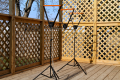
Should you wish to "roll your own" using IR the Fairchild QEE 123 is a popular emitter when paired with the Fairchild Semiconductor QSE773 Photodiode as a detector. My old Oehler 35P uses MRD 3056 daylight spectrum detectors in the sky screens which I believe is also a NTE 3032. Don't hold me to the latter part numbers. Here is what my setup looks like:

Chrony 2.png

The reason for three screens is the use of a proof screen. My spacing here in the US is 24" or Two Feet and if you do the math you can see how critical the spacing actually is. Also my sensors do use a small plastic lens to focus the light on each of the three sensors. Remember the spacing is critical as is your clock frequency. My old Oehler uses an 8 MHz clock quartz crystal controlled. Clock frequency is critical also.

While roll your own is a nice concept getting it done is no easy feat. Today's micro controllers do make it easier but considering what I can buy an average chronograph for I would buy and will if my Oehler ever dies or I shoot it. :) I routinely chronograph bullets in velocity ranges between 2500 and 4000 FPS (Foot Per Second) here in the US.

Ron
 

Picbuster

Joined Dec 2, 2013
1,058
Hello!

I'm new to this forum. I have some experience with electronic projects, mainly related to drone construction and homeautomation.

Now I'm trying to build a ballistic chronograph. There are many commercial products available, but I want to construct my own.

The idea is to measure the time a copperjacket bullet at about 800 - 900 m/s uses to travel between two sensors placed X mm apart.

On the sensor side I want to use an electromagnetic sensor. Since most bullets are made of a non ferrous metal maybe a eddy current sensor could be a right approach?

Can anyone point me in the right direction on how to construct the sensor. My initial plan is to hook the senors up to an ESP32 module that can take care of the speed calculation.

Alex
Norway
The most simple way is to use day light and 4 light sensors the must be fast.
all connected in pipes looking into the sky.
Distance between them should allow you to obtain time for measurement. ( counter speed and light sensor response time)
you have 3 timers. counter start goes from pipe zero and each pipe will stop the related counter.
Creating 3 values these you should use to control and calculate the speed up- or degrease between the pipes.
that's all
Picbuster
 

Wingsy

Joined Dec 18, 2016
86
If you're set on using a magnetic sensor I can offer up my thoughts on how I would approach this.
* Powerful horseshoe magnet.
* Coil of many turns in the magnetic field.
* Positioned so the bullet passes in front of the open ends of the magnet, at right angles to it.
* Induced voltage in the coil is your signal.
The copper jacket would have some voltage induced into it as it passes through the field, and therefore a current. This current and its magnetic field would disturb the static field produced by the magnet, and the disturbance would cause a slight voltage to be induced into the coil. I would guess that the signal would be one polarity of voltage followed by the opposite polarity as the bullet passes by. Calibrating two of these sensors would be difficult I would think. Is this along the same lines as you were thinking?
 

DNA Robotics

Joined Jun 13, 2014
670
If you're set on using a magnetic sensor I can offer up my thoughts on how I would approach this.
* Powerful horseshoe magnet.
* Coil of many turns in the magnetic field.
* Positioned so the bullet passes in front of the open ends of the magnet, at right angles to it.
* Induced voltage in the coil is your signal.
That may be a good application for a Wheatstone bridge - Wikipedia
I understand they are very sensitive.
 

Sensacell

Joined Jun 19, 2012
3,784
It's easy to see that this magnetic approach will be very hard to calibrate, the distance between sensor elements being so short.

How would you calibrate it unless you had another unit to compare it to?
 

Tom S

Joined Mar 22, 2018
8
I do have the MagnetoSpeed Sporter.

According to the patent it’s using a permanent magnet and a circuitboard wire-coil that seems to formed around the permanent magnet

The one I have is able to detect 22 caliber lead pellets, but I have to be very careful with positioning the sensors (located in the bayonet). I placed small rare earth magnets to reach proper spacing between the sensors and the bullet path. And possibly to strengthen the magnetic field of the permanent magnets inside the bayonet.

I may have to pry it apart to see exactly what part/components they are using for the sensors.
 

Tom S

Joined Mar 22, 2018
8
There were several studies showing high accuracy, one even 1 ft./s accuracy. The manufacturer claims 99.5 to 99.9% accuracy
 

Reloadron

Joined Jan 15, 2015
7,888
The thread is about a year old and the original poster only left one single post. Currently there seems to be three popular methods to measure projectile speed. One of the more expensive units is Lab RADAR, LabRadar Ballistic Velocity Doppler Radar Chronograph which comes in at about $560 and is available from distributors such as Brownell's and Midway (linked) shooters supply. Next up there is the units recently discussed and that being the MagnetoSpeed Sporter Chronograph which is lighter on the wallet with a $180 USD price tag. Finally on the lower price range end there is the Caldwell, Shooting Chrony and a host of others. They all use different sensor techniques to Start / Stop a timer and some are obviously more expensive than others. My chronograph is now about 25 years old and when it was purchased as a gift from my wife it was the defacto standard. The skyscreens are pictured in post #3.

Velocity = Distance / Time so the uncertainty of a chronograph is a function of the sensor spacing and the accuracy of an internal clock oscillator. With the exception of course the newer Lab RADAR type units. Anyway it all starts (and stops) with the chosen sensors which open (Start) and Close (Stop) a gate allowing the pulse count. With the time known it is divided into the fixed distance between sensors. Before optical and magnetic sensors and RADAR use you shot through two wire mesh boards breaking a small gauge wire.

Anyway, again the thread is about a year old. Anyone looking for a chronograph today I would suggest reading all of the reviews and consider what you want to spend (piggybank size). Also consider the features offered by each. Do you want to interface to a smart phone or maybe laptop? How many shots in a string do you wish to record?

Ron
 

Tom S

Joined Mar 22, 2018
8
Yes, I am familair with the Labradar, some of the airgunner use it with great success. Good to calculate BC of pellets which is very important for air rifles due to the shorter distance and significant drop, Reasonable price also.

I have the COMBRO (small optical chrono mounted on the barrel), and the Shooting Chrony. I also built a barrel mounted chrono using IR sensors posted by someone on the internet.

I would like to use the magnetic sensor because it does not need to be cleaned like the IR sensor glass that can foul up with lead dust.

I think I can figure out the circuit that reads the signals, I just need some help in making or finding a sensor that is suitable. Max speed of the pellet would be 1,400 fps and of course the material of the projectile is lead (non-ferrous). The MagentoSpeed Sporter requires a 1/8-0.375 inch distance between the pellet's path and the sensors' surface.

The Sporter has this in the patent application for the sensor(s):

"....a permanent magnet 230 is surrounded by molded plastic structure 210. Sensor coil 108 is a wire coil formed within a printed circuitboard.Preferably,sensor coil 108 is formed by a metal trace within a printed circuit board. Also,both sensor coils 106 and 108 can be formed by one metal trace within one printed circuit board. Permanent magnet 230 provides a stable magnetic field to sensor coil 108. An electromagnet made from a separate coil can also be utilized to provide a stable magnetic field to sensor coil 108 ..."
 

Reloadron

Joined Jan 15, 2015
7,888
My best guess on this and knowing somewhere around nothing about the sensors is they might, on a very small scale, work similar to a traffic sensor where there is a fixed magnetic field ruining an oscillator. When the field is interrupted the oscillator frequency changes producing a pulse. What I don't get is how they do it with non magnetic materials. The shooters I know who are using the Magneto Speed chronographs are all happy with them and across the board they seem to work very well. This considering only a 6" distance.

Ron
 

Tom S

Joined Mar 22, 2018
8
I suspect that you are right about the oscillator and the frequency-change used as a proximity sensor detecting a disturbance in the sensors' magnetic field. The key is on "disturbance" which relies on a non-ferrous mass of the projectile passing above the sensors disturbing the static magnetic field. If the "detection" method would have been relied on primarily then the sensors would have triggered by the passing of a ferrous projectile generating a trigger signal.

Albeit the patent mentions voltage change as the trigger, maybe they are using a frequency to voltage converter. I know very little about inductance circuits, but I assume that the oscillation frequency is critical and must be precisely matched to the materials in the sensing coil and statis magnets, and in general to the materials used in the projectiles. I think most current low cost processors such as the Arduino Nano should be able to process the timing required for the triggers, or using a standalone circuit/chip wich would feed an analog (amplified/scaled ?) or digital trigger signal to the Arduino. Again....due to my limited knowledge I am on shaky grounds here as far as the detection circuit...
 

Sensacell

Joined Jun 19, 2012
3,784
The patent for magnetic sensing mentions nothing about oscillators in the sensing circuit.

Any circuit that used changing frequency would introduce timing errors that would slaughter the accuracy of the device.
Random phase shifts would make accurate timing almost impossible.

It works via the eddy currents created in the conductive material of the bullet, the eddy currents create a counter magnetic field that interacts with the permanent magnet's field, this flux change induces a voltage in the coils surrounding the magnet.

Tom s- I'll bet your trick of adding additional magnets throws the accuracy off quite a bit.
 

Tom S

Joined Mar 22, 2018
8
Thank you for the clarification about the frequency and the timing errors.

Admittedly , I did not measure the velocity against a reference chrony at the range before and after adding and removing the magnets from the sensors. But the fps velocity (of the same pellet) remained consistent with the previously shot strings. My air rifles are able to maintain a 5-15 fps shot to shot consistency (in most cases 4-5 fps) for at least a 30-40 long shot string. I adjust the velocity usually to around 880 fps.

I believe that the display/processor device that connects to the bayonet/sensors with a wire calibrates itself when powered up. I would think this is necessary because of the close proximity of metal objects (barrel end) expected during operation. This is in addition to the routine temperature/voltage, etc calibration. In a simplified way, the voltage spike caused by the magnetic field disturbance is used as the trigger for measuring the velocity between the two sensor according to the patent. I gather, if initial calibration took place upon powering up...the variance of the magnetic field (by adding or removing the auxiliary permanent magnets) is scaled to the expected operating range of the detector/processor circuit. I suspect that the detector circuit is measuring at the extreme points of the variance (spike or drop) in voltage. So even if the sensor generated sine wave is not the same amplitude each time a projectile is fired, the time period between the extreme points (highest rise or lowest drop) of the two sine waves serves as the basis of the calculation.
 

Tom S

Joined Mar 22, 2018
8
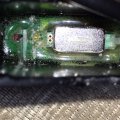
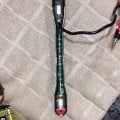
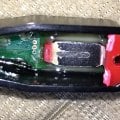
Well, I took the courage and pried off the cover over the two sensors. Unfortunately, the entire sensor and PCB are submerged halfway in some form of an epoxy. There is a PCB that connects the two sensors at each end 5 inches apart. I cannot see any components on the board itself, but I am sure it has traces.

The sensors themselves are of interest, but unable to tell how they are constructed. There is certainly a rectangular (looks like neodymium) shaped magnet. Cannot see any wire coils because of the epoxy. The patent mentions metal traces on PCB may be used as coils, so there may be some very thin traces of metal forming a coil on the PCB with the magnet serving as the permanent magnetic force.

The circuit (based on the patent) uses a voltage reference in one side of a comparator and the sensors' signal in the other one one line. When the Sensor 1 trigger voltage exceeds the reference voltage (projectile passes) the controller takes 2 readings (per sensor) of the sine wave (averages them) and starts Timer1. Same repeats with Sensor 2 and Timer 2. The controller calculates the speed based on the time difference and the known distance between the two sensors (5 inches).

I did some voltage and resistance measuring. The two sensors are in series with each other (in the patent) and they connect with a regular stereo headphone plug to the controller. The Ground, and Sensor 2, Sensor 1, are on the tip of the plug. The controller powers up as soon as the plug is connected and the sensor circuit has 1V DC. I suspect this is the threshold voltage. Unplugged, the resistance for both sensor circuits together is 32 ohms. For each sensor circuit their resistance is around 16 ohms (actually 16.7 & 17 Ohms). So for the sensor, there is either a 16 Ohm coil wrapped around the magnet core (or located beneath the magnet) OR a there is a PCB-trace coil with a magnet on top of it. Or there is a metal trace coil of (negligible resistance) with a magnet on top and with a 16 Ohm resistor in series for load?

Without tearing further and damaging the rest of the setup, how can I identify the sensor (assuming it's an off-the-shelf item)?

Thank you for any assistance.


EDIT: While attaching the photos I noticed that there is a PCB coil circuit (fairly certain) below the magnet of the sensor! If that's the case....should I assume that there is a 16 Ohm resistor also? Or the PCB coil can be made to 16 ohm resistance by using certain metals/materials?


IMG_8571.JPG IMG_8576.JPG IMG_8572.JPG IMG_8571.JPG IMG_8576.JPG IMG_8572.JPG
 
Top