Automotive Coolant Sensor Ohm Value

Thread Starter

Nathann92

Joined Sep 9, 2025
1
Hello

Is it possible to increase the ohm rating outputted by a coolant sensor on a motorbike?

I replaced the dash and now it thinks the bike is overheating on idle.

The sensor outputs:
60oC 125ohm
85oC 48.5ohm
110oC 24ohm
125oC 15ohm

The dash needs
0 bar 699-558ohm
1 bar 557-194ohm
2 bars 193-137ohm
3 bars 136-126ohm
4 bars 125-83ohm
5 bars 82ohm

It doesn’t have to be exact and it’s a carby bike so the sensor is only for the visual temp reading. I was thinking increasing the reading from the sensor by around 60ohm would be good enough.

Thanks
 

Sensacell

Joined Jun 19, 2012
3,769
Possible, but rather difficult- just buy the correct sensor if you can.

You would need to study the circuit carefully and design a circuit that would emulate the different resistance, it would need power from the battery too- more wiring and inconvenience.
You need to understand how the system works before you could design anything, you cannot just "increase ohms" - it's more complex than that.
 
Last edited:

crutschow

Joined Mar 14, 2008
38,325
You could just add a 60Ω or so resistor in series with the sensor to prevent the overheating indication, but the dash-bar indicators would be way off at lower temperatures.

As Sensacell noted, it requires added circuitry to mimic the higher resistance sensor.

What temperature does each bar indicate?
 

crutschow

Joined Mar 14, 2008
38,325
You could use two LM324 IC quad opamp packages to switch in six different resistor values for the bar display in response to the sensor output resistance change.

Are you up to wiring such a circuit on a vector board and connecting it into you bike?
 
Last edited:

panic mode

Joined Oct 10, 2011
4,867
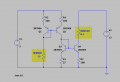
you can use current mirror (Widlar circuit) and adjust asymmetry by resistor in emitter circuit.
if needed to change polarity, additional mirror can be used (with opposite transistor polarity).

here is the idea.
Q1/Q2 are flipping sensor current direction (1:1).
Q3/Q4 are second mirror that is adjusted by ratio R1/R2 to your display needs.
1757510136782.png
 
Last edited:

crutschow

Joined Mar 14, 2008
38,325
you can use current mirror (Widlar circuit) and adjust asymmetry by resistor in emitter circuit.
An interesting approach, although it generates a current, not a resistance, so the characteristics of the display would need to be determined (i.e. its output voltage in particular).

Did you simulate that circuit over the full resistance range for the sensor (15 to 125Ω)?
(You can set the SENSOR resistance value to R=15+time*1150 to have it change over that range during the 0.1s sim time.
Alternately you can step the resistor value of {R} using the .step param R 15 125 5 function, and use the .op sim command to give an output over the resistance .step range)
 

panic mode

Joined Oct 10, 2011
4,867
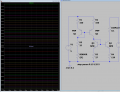
correct... but target resistance is about 4x higher (and with same conditions current will be some 4x lower). hence imbalanced mirror idea.

i did not have time so just tried to present the idea... just sketched it quickly and.. discarded it already ... :oops:

but it was easy to recreate. noticed that adding R5 made the spread was better:
1757526206364.png
 

Attachments

Last edited:

crutschow

Joined Mar 14, 2008
38,325
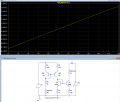
If you sim with a .op command you will get one curve instead of many, which are hard to decipher.

Your equivalent resistance of the Q4 current is much higher than desired.

1757527078204.png
 
Last edited:

panic mode

Joined Oct 10, 2011
4,867
thanks for the tip

also R5 is not needed if one reduces values of R3/R4 to 5.6 and 22 Ohm for example but i am a cautious guy and prefer to limit the current where possible (avoid problems if sensor is shorted for example)

1757527362819.png
 
Last edited:

crutschow

Joined Mar 14, 2008
38,325
Why did you change from models of real transistors to the LTspice generic types?

R5 will change the linearity of the sensor current vs sensor resistance, but that may not be a problem.
 
Last edited:

panic mode

Joined Oct 10, 2011
4,867
because i have other responsibilities. i look at forum only while waiting for computer to catch up or if i am on a break. i did share the file for anyone wanting to play with it.
 

crutschow

Joined Mar 14, 2008
38,325
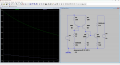
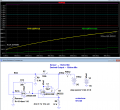
Okay, I had a Eureka moment, and found how to do a relatively simple circuit which generates an output that appears as an Ohmic resistance as the gauge expects, with the emulated resistance value constant, independent of the applied voltage from the sensor (below):

It works by applying a bias voltage to the sensor that is proportional to the voltage from the display, which makes the circuit basically ratiometric.
That way the emulated resistance tracks the sensor resistance, independent of the applied voltage from the display (within the limits of the op amp operation of course).

As you can see in the sim below, the emulated resistor value the display sees (yellow trace) is constant for the voltage from the display varying for 4V to 8V (top traces), showing the emulated resistance acts a true Ohmic resistance, the same as the sensor.

(Edited to eliminate the unnecessary op amp).

1757777085769.png
 
Last edited:
Top