Automated Air Locker for Truck

Thread Starter

Blank_Stare

Joined Jul 29, 2017
44
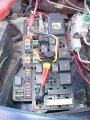
Air Locker Install / Air Shock Integration on a 1998 Dodge Ram 1500 Quad Cab Pick up truck.

(I wanted to be able to add something of value to this forum. Recently, folks here were very helpful with a project I worked on, and I thought maybe this would be of value to someone here, at some later date. Besides which, it never hurts to put your projects where you can share them, without having to recreate it, each time someone takes an interest.)

I dreamed this up 10 years ago, and with the help of some folks on another forum, managed to bring it to reality, install it, and use it for about two years, before I started having persistent problems blowing out relays. I eventually threw my hands in the air, and gave up, but fortunately, I no longer had the pressing need I did when I conceived it. More on that, below.

The purpose of this circuit is to keep an air tank (mounted under the hood, in the engine compartment,) charged at all times that the circuit is activated, with the pump being activated when the pressure drops down to what ever lower end is selected by the user. The tank is used to feed the leaky air shocks line pressure, and allow on-the-fly pressure adjustments through a standard, manual, dial-type regulator in the cab of a 1/2-ton pick-up truck. This increased it's max effective pay-load by almost a quarter ton, making heavy trailers easier for the truck to handle. I also had a quick-disconnect on the tank itself, for a hose that I used for filling tires, and blowing air to clean off, or dry off things like chainsaws, for when I was gathering firewood in the woods. It was great for all of these purposes, and for the time it worked, I was very happy to have created/installed it.

I shared the design with some local acquaintances who are auto electronics engineers and techs (handy living near Detroit...lot's of auto-workers in my area...), who assured me that the collapsing magnetic field in the relay was causing the burn out. Each came to that conclusion independantly, after viewing my schematics, and each suggested a xener diode solution, almost identical to the other. I disassembled a relay to diagnose, and the high-amperage side of the relay was fused closed, as they suggested it would be. I added some (xener) diodes (not in schematic) of the size, and in the locations they suggested, to no avail. I should mention that the air pump this system governs is big, loud, and pumps a lot of air in a hurry. However, except when running it for multiple cycle of filling/purging the tank, consecutively, it never got hot, as it has a duty rating of 100%.

It did blow fuses from time to time. To solve that, I installed an automatic breaker of the appropriate rating. I never had fuse problems after that.

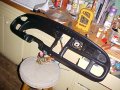
Taking a schematic, and turning it into a finished project under the hood, and on the dashboard of a truck are two very different things. It took a lot of effort, and a considerable amount of determination for me, a layperson, to complete the project, but I did enjoy the process, and it was very useful to me, during the time that I needed it.

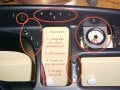
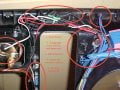
Some things that are not too obvious from the following schematics / pictures:
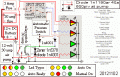
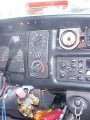
  • I originally had a gauge that was dual color illumination, and had a pot for dimming the brightness. It lasted about a month, before it revealed it's shoddy craftsmanship, and was replaced. I never bothered to remove the switch and pot, as they looked better than holes in the dash, IMO.
  • The reason I needed a dual needle gauge, was that one was monitoring the line pressure to the shocks, and one was monitoring the reserve air tank, or "locker".
  • I quickly learned where the sweet spots on the shocks were, when riding empty, verses with loaded trailer. I pulled a trailer exceeding 8000 pounds at least a dozen times with this system, and never had any problems with tracking, or control of the steering. No, I am not exaggerating the weight, and I may even be understating it, by as much as 10%. Live, wet oak logs are very heavy, even when cut into 16-inch rounds.
  • The regulator, which I mounted in the cab, below the gauge, controls the pressure in the shocks, and there is also a "dump valve" mounted nearby, to allow depressurization of the lines, when unloaded. The shocks came with plastic lines, and I had troubles getting them to seal properly, so I used copper tubing/compression fittings for (almost) all of the air lines. (There were a couple places where I used flared tubing fittings, because that's what was available, without buying adapters, and creating more potential leaks.)
  • It's a fact that almost all air shocks leak, and that's why I automated this system - having to stop in the middle of a 4 hour trip to charge the air lines was not something I was going to tolerate. Automation comes with limitations, however, as cut-in / cut-out air pressure switches work on ranges that are set manually, and not easily adjusted on the fly. For that reason, I added the over-ride switch, that allowed me to turn on the pump, even if the tank pressure exceeded the cut-in setting of the air pressure switch. I didn't need it often, but I found that when the tank was full, it did a lot better job at blowing tools clean, and filling high-pressure (80 PSI) Tires.
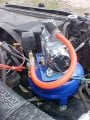
  • The tank was a pancake tank from a tiny air tools set up, made to be run in a non-pro setting, for light tools, like an air stapler, or a brad nailer. The tank has a "pop-it" valve, or safety valve, that automatically opens, when the tank pressure exceeds 125 PSI.
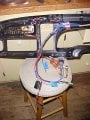
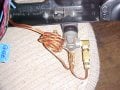
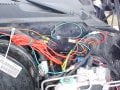
20130115 finaldraft05colorized.gif 1dashpanel.jpg 3dashpanel.jpg 4dashpanel.jpg 5dashpanel.jpg 6dashpanel.jpg Mvc-434f.jpg Mvc-435f.jpg MVC-436F.JPG Mvc-437f.jpg

Yes, the hood closes without touching my install. I doubt I could say that, on a truck built recently - they just don't leave any extra space under the hoods anymore.

Questions are welcome. It's been a while since I did this project, but I'll do my best to answer anything you want to know.

Thanks again, to everyone who has helped me on my projects.
 
Last edited by a moderator:

WBahn

Joined Mar 31, 2012
32,703
MOD NOTE: I've reported your post so that the Mod staff can discuss whether it belongs in a different forum. We'll bat it around and let you know.
 

WBahn

Joined Mar 31, 2012
32,703
You said that the relays showed arcing/fusing on "high amperage side", which I assume is the switched circuit and not the relay coil. The diodes protect the relay coil (and should be there). But the arcing/welding on the switched side probably stems from opening the switch while in inductive load is drawing current. The diode you have (#16) should help, but there is still going to be a tendency to arc across the relay switch contacts as they open. You might put a capacitor across the contacts. This serves the same purpose as the condenser in an old-style ignition system in that it clamps the voltage across the contacts as they open by absorbing the short current spike.
 

philba

Joined Aug 17, 2017
959
That's a good point. High current relays are designed to handle arcing, maybe the ones in your circuit need to be upgraded to handle the inrush current. Typically motors have much higher startup current so spec'ing the relay based on running current will cause you problems.
 

strantor

Joined Oct 3, 2010
6,875
That's a good point. High current relays are designed to handle arcing, maybe the ones in your circuit need to be upgraded to handle the inrush current. Typically motors have much higher startup current so spec'ing the relay based on running current will cause you problems.
+1. that 30A relay you're using looks like the bosch type I'm used to seeing for things like head lights (resistive load) and small inductive loads. That compressor is going to be one helluva inductive load (tries to draw infinite amps @ inrush). How many amps is the compressor rated? If it's anywhere near an actual 30A, I would use a starter solenoid to switch it on instead of any relay.
 

Thread Starter

Blank_Stare

Joined Jul 29, 2017
44
A 30 amp fuse lasted many cycles, before blowing - that's why I installed the breaker, which solved that problem. With that in mind, I bought a monstrous 50 amp relay - it was about the size of a medium apple. It lasted 3 cycles, less than any of the small black 30 and 40 amp relays that I had used prior, and after. Something strange goes on in that circuit, that seems to defy the logic of the specs.

BTW, seems like I tried a solenoid too, but I don't remember for sure. It might be that I considered, just before abandoning the system, due to no longer needing it. I was getting pretty frustrated at the end, and it's been over 7 years since I stopped messing with it, so my memory isn't as clear as it once was.

The capacitor idea is interesting, but I won't pretend I understand the science well enough to say it's the holy grail answer.

Since I am no longer using the system, I can not make alterations, and test it out. Perhaps someone else will use this circuit, along with the suggestion(s) in this thread, and let us know what happens. If I ever need to install this system in another application (doubtful), I will be sure to consult the folks here, in regards to specs, sizes, etc for any suggested modifications. A Solenoid will be top of my agenda...
 
Last edited:

Thread Starter

Blank_Stare

Joined Jul 29, 2017
44
is this the compressor you're using?
You didn't show anything...

The one I used was a ViAir Compressor, 100% duty rating. You can see a (poor) picture of it in one of the last few images, sitting atop the blue air tank.

(I'm not sure I spelled the brand name correctly...)
 

WBahn

Joined Mar 31, 2012
32,703
MOD NOTE: You may have noticed that your thread has been moved to the Completed Projects forum. Congratulations -- the couple of mods that handle that forum can be hard to satisfy, but they felt you had done enough to make the cut.
 

Thread Starter

Blank_Stare

Joined Jul 29, 2017
44
MOD NOTE: You may have noticed that your thread has been moved to the Completed Projects forum. Congratulations -- the couple of mods that handle that forum can be hard to satisfy, but they felt you had done enough to make the cut.
Well, I guess I felt like it was completed, so it makes sense to me.

However, based on the issues I was having, there is clearly room for improvement, since it never served it's function very long, before requiring repairs.

For that reason, I hope we can leave this thread open, so that others may continue to offer ideas on how to perfect the system.

THANKS!
 
I'm going to take a stab at your problem without looking at it in detail. No amount of contact protection is gonna help.

I think you need hysteresis (On and off trip point different) in your set points or an ant-short cycle timer. e.g. http://www.clrwtr.com/SymCom-HVAC-Controls.htm These are typically set for 1-5 minutes.

These are used in air conditioners so that the compressor doesn't start under full load and will prevent a relay from chattering. Power glitches from lightning will destroy a fuseholder without one.
 

WBahn

Joined Mar 31, 2012
32,703
Well, I guess I felt like it was completed, so it makes sense to me.

However, based on the issues I was having, there is clearly room for improvement, since it never served it's function very long, before requiring repairs.

For that reason, I hope we can leave this thread open, so that others may continue to offer ideas on how to perfect the system.

THANKS!
The criteria isn't just that the project be "completed", but that it meet a minimum quality level as far as documentation is concerned. I don't spend much time in that forum, so I don't try to keep up on what the expectations are. I've seen them a few times and they aren't unreasonable, but some of the stuff that folks submit doesn't even come close.

The threads there generally stay open as almost any such project is seldom truly complete -- we all like to tinker with things.
 

WBahn

Joined Mar 31, 2012
32,703
I'm going to take a stab at your problem without looking at it in detail. No amount of contact protection is gonna help.

I think you need hysteresis (On and off trip point different) in your set points or an ant-short cycle timer. e.g. http://www.clrwtr.com/SymCom-HVAC-Controls.htm These are typically set for 1-5 minutes.

These are used in air conditioners so that the compressor doesn't start under full load and will prevent a relay from chattering. Power glitches from lightning will destroy a fuseholder without one.
When I read through the post (which was pretty quickly) I thought I had seen that he used a pressure switch to detect when to activate the pump. I guess I assumed that it was shut off by a higher pressure switch, perhaps as part of the compressor itself. But looking over the schematics I can see that that probably isn't the case, even if the pump has it's own max-pressure shutoff (I sure hope it does). If the pump doesn't have a high-pressure shutoff (or at least a relief valve on the tank that can keep up with the pump), he doesn't want a timer (unless it's short enough that there is no way it could build up to max pressure in that amount of time). I like the hysteresis approach better.
 

strantor

Joined Oct 3, 2010
6,875
You didn't show anything...

The one I used was a ViAir Compressor, 100% duty rating. You can see a (poor) picture of it in one of the last few images, sitting atop the blue air tank.

(I'm not sure I spelled the brand name correctly...)
DOH! Brain fart. It was the right one I think. On amazon.
 

Thread Starter

Blank_Stare

Joined Jul 29, 2017
44
When I read through the post (which was pretty quickly) I thought I had seen that he used a pressure switch to detect when to activate the pump. I guess I assumed that it was shut off by a higher pressure switch, perhaps as part of the compressor itself. But looking over the schematics I can see that that probably isn't the case, even if the pump has it's own max-pressure shutoff (I sure hope it does). If the pump doesn't have a high-pressure shutoff (or at least a relief valve on the tank that can keep up with the pump), he doesn't want a timer (unless it's short enough that there is no way it could build up to max pressure in that amount of time). I like the hysteresis approach better.
In automatic mode, the power to the pump is switched by a typical portable air pressure system, like contractors use. In fact, the same type of system is used in commercial garages, and on water well bladders, to turn the power to the pump off and on. It's the black box that has the orange hose going down into the tank next to it, and then around to the pump, in picture #8. That box controls the high pressure cut-out, and the low pressure cut-in, and has some screw adjusters inside, for fine-tuning the PSI settings. They come in a variety of different specs, where the high and low settings are a wider, or narrower range, as well as max and min settings are different. If that device is calling for pressure, and the system is powered on, the relay (that kept seizing in the closed circuit position) closes, and the pump starts. If the system is powered on, and the manual over ride is pressed, the controller device is by-passed, and the pump comes on.

Was that clear as mud? :)
 

WBahn

Joined Mar 31, 2012
32,703
In automatic mode, the power to the pump is switched by a typical portable air pressure system, like contractors use. In fact, the same type of system is used in commercial garages, and on water well bladders, to turn the power to the pump off and on. It's the black box that has the orange hose going down into the tank next to it, and then around to the pump, in picture #8. That box controls the high pressure cut-out, and the low pressure cut-in, and has some screw adjusters inside, for fine-tuning the PSI settings. They come in a variety of different specs, where the high and low settings are a wider, or narrower range, as well as max and min settings are different. If that device is calling for pressure, and the system is powered on, the relay (that kept seizing in the closed circuit position) closes, and the pump starts. If the system is powered on, and the manual over ride is pressed, the controller device is by-passed, and the pump comes on.

Was that clear as mud? :)
Yes, I understand. The pressure switch isn't just a simple pressure switch -- it is designed for this task and has hysteresis built into it. Good.
 

bassbindevil

Joined Jan 23, 2014
918
Most air compressors I've played with have a check valve at the tank, and an unloader valve which releases the air in the line between the tank and pump when it stops. That way, when the pump starts up it can turn freely and build up momentum. This reduces the starting current a bunch. This feature is usually part of the pressure switch, but it could be done with a small solenoid valve that's normally open, and which closes when the pump motor runs. I don't know if this applies to small direct-drive 12V compressors, but I've come across more than one DIY compressor setup that lacked an unloader and as a consequence either needed an oversized motor or couldn't be trusted to cut in without giving the flywheel a push.
 

Thread Starter

Blank_Stare

Joined Jul 29, 2017
44
Most air compressors I've played with have a check valve at the tank, and an unloader valve which releases the air in the line between the tank and pump when it stops. That way, when the pump starts up it can turn freely and build up momentum. This reduces the starting current a bunch. This feature is usually part of the pressure switch, but it could be done with a small solenoid valve that's normally open, and which closes when the pump motor runs. I don't know if this applies to small direct-drive 12V compressors, but I've come across more than one DIY compressor setup that lacked an unloader and as a consequence either needed an oversized motor or couldn't be trusted to cut in without giving the flywheel a push.
I have experienced the same with contractors compressors. In fact, I had a problem with the needle valve on a new compressor I purchased, back in the 80's. Since I had no clue how these things work, I drove an hour to a warranty service shop, and watched the guy fix it. It was an important education.

That compressor was a piston-drive type. I never thought to check the type that this one was, but I suspect it is also piston drive. That is likely the reason I was blowing fuses, now that you mention it.

Do you think that could weld the relay contacts closed, as well? If that's the case, then the fix is simple in concept, but just a little bit more complicated in practice, since the system I designed was parts from many different sources.

Good thinking!
 

Janis59

Joined Aug 21, 2017
1,894
RE:""The purpose of this circuit is to keep an air tank (mounted under the hood, in the engine compartment,) charged at all times that the circuit is activated, with the pump being activated when the pressure drops down to what ever lower end is selected by the user. The tank is used to feed the leaky air shocks line pressure""

Actually I have the 3,5 ton 17-places bus too, with `air-suspension` system, where my bus is able for "ducking" if I release the air out of tank (very useful for older passengers to get in or out) and then it refills by electric compressor at some 2 or 3 minutes. BUT, the refilling takes an energy of some 50 Amps as the smallest. Yes, it leaks somewhere I cannot easy to find where, its true, but it takes a whole night stand to become empty and only few minutes to refill.
However, I use that car only few times a year, for long-range tourism, because normally I go by the smaller car which is far more economic (bus 11 liters and car 4 liters for 100 km). Thus if I left a bus for the night, at morning I shall have a fully pumped suspension system BUT completely empty battery. Somehow I cannot to see any rationale in such `upgrade`. Sorry, if I misunderstood anything correctly.
 
Top