Help with circuitry for a fully automated analog wooden clock with day, date, and month rings

Thread Starter

Easykill

Joined Aug 19, 2024
2
Gday!

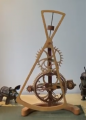
I'm an avid woodworker and I'm wanting to make an analog clock that has a the ability to display day, date, and month that won't require manual adjustment for leap years and such. I think the best woodworking way would be rings like this with cogs on the back, mine would have a facade covering all the spare days, dates, and months, and have minutes and hours hands clock on it, see my primitive mock-up.

FYISUUMKCNDN562.jpg Untitled.png

I have no experience with electronic components and hoping y'all could help me, I have messed about with simple electric circuits, but never anything with chips. I'm looking for some help in learning how to create the circuitry for this, I've read about Arduino and it seems handy, but still a little complex to dive into with no experience. I've tried internet researching, but it's all so overwhelming with so many weird acronyms and terms.

From research I believe an RTC would be the most optimal way for this to be done given thats how phones always know time and date. Obviously this immediately throws in the problem that I need some way of telling the RTC what timezone I'm in, hoping you guys may have a solution for that as well.

I need some system that can be both wall (230V) and battery powered and can send signals telling each ring how much to rotate by/which thing to rotate to.

Maybe there's an even easier way and I'm over-complicating the hell out of this ahaha, any help or suggestions are much appreciated!
 

nsaspook

Joined Aug 27, 2009
16,249
Don't expect miracles. There is no easy way to even understand a possible solution with no or little experience. The root problem is not really electronics, it's electro-mechanical in nature.
 

djsfantasi

Joined Apr 11, 2010
9,237
Gday!

I'm an avid woodworker and I'm wanting to make an analog clock that has a the ability to display day, date, and month that won't require manual adjustment for leap years and such. I think the best woodworking way would be rings like this with cogs on the back, mine would have a facade covering all the spare days, dates, and months, and have minutes and hours hands clock on it, see my primitive mock-up.
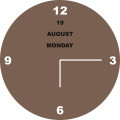
View attachment 329534 View attachment 329536

I have no experience with electronic components and hoping y'all could help me, I have messed about with simple electric circuits, but never anything with chips. I'm looking for some help in learning how to create the circuitry for this, I've read about Arduino and it seems handy, but still a little complex to dive into with no experience. I've tried internet researching, but it's all so overwhelming with so many weird acronyms and terms.

From research I believe an RTC would be the most optimal way for this to be done given thats how phones always know time and date. Obviously this immediately throws in the problem that I need some way of telling the RTC what timezone I'm in, hoping you guys may have a solution for that as well.

I need some system that can be both wall (230V) and battery powered and can send signals telling each ring how much to rotate by/which thing to rotate to.

Maybe there's an even easier way and I'm over-complicating the hell out of this ahaha, any help or suggestions are much appreciated!
In addition to the mechanics (woodworking) and electronics, you’re likely going to need to know how to program. The RTC clocks you see are meant to be used on a microprocessor and with software you write.
 

crutschow

Joined Mar 14, 2008
38,316
That is not a trivial design problem, as djsfantasi noted.

So one solution would be to use a real-time clock with leap year compensation (example) interfaced to a microprocessor.
The micro when then be programmed to control the various wheels based upon the time signals from the RTC.
The wheels could be controlled by stepper motors,
The wheels could generate an index signal at the beginning of their rotation (January, Sunday, day 1, 12 o'clock) which the micro would detect by rotating the discs upon power application to determine how many stepper motor pulses would then be required to go to the desired date and time.

If you are not up to doing all that, then you will need to find someone who can.
 
Last edited:

MrChips

Joined Oct 2, 2009
34,626
It is interesting that you call this an analog clock whereas it is digital.
I know what you mean. Your idea of digital is displaying digits as in an LED display.

If the wheels are interlinked by gears then you will end up with a display showing the space in between 15 and 16, July and August, Wednesday and Thursday. I am sure that you do not want that.

What you want is a digital movement, i.e. discrete steps.

As others have suggested, this is more of a mechanical challenge than an electronics problem.

Let's start with the straight forward movements with no exceptions, Months, and Days of the Week.
How are you going to move the wheel in 360/12 = 30° steps and 360/7 = 51.42857143° steps?

Edit: See my post #21.
 

panic mode

Joined Oct 10, 2011
4,864
i do not think that would be much of a problem. leap year is something only adjusted once every 4 years. bigger issue is daylight saving which would occur twice a year.

if the rings are geared, then entire contraption can be driven by a single stepper motor, controlled by MCU.
 

BobTPH

Joined Jun 5, 2013
11,463
It is certainly doable. I would use a stepper motor to drive each ring, if that means anything to you.

If the cogs are carved out of the wood, I don’t see it lasting long. I would use a toothed belt and metal cogs as are used in 3D printers.
 

MrChips

Joined Oct 2, 2009
34,626
By now, from the engineering responses, you should be getting the idea that mechanical movement of the wheels is going to be a serious problem.

A viable solution is to use a stepper motor for each wheel, driven by a microcontroller (MCU). The MCU can be programmed to rotate each wheel with the required precision, and skip over the unused days for each month. It can also be programmed to deal with daylight savings time and leap years and even the 400-year anomaly.
 

panic mode

Joined Oct 10, 2011
4,864
Don't see how that would accommodate the different number of days in each month.
people were interested in things like this have come up with different solutions, including ancient.
modern versions such as laser cut puzzles can be bought for few dollars. as expected, secret is in gear mechanism.
 

Ian0

Joined Aug 7, 2020
13,097
if the rings are geared, then entire contraption can be driven by a single stepper motor, controlled by MCU.
The only problem with that would be that the date (for example) would show fully centred at midnight, but halfway between one date and the next at midday.

If one thinks about the way a pendulum clock knows how many times to strike and when, then a tiny motor could be used for each wheel which is triggered when, for example, the hours reach midnight, and then runs until a sensor stops it, at which point the next date would be fully within the window.
 

crutschow

Joined Mar 14, 2008
38,316
The only problem with that would be that the date (for example) would show fully centred at midnight, but halfway between one date and the next at midday.
You could possibly use a step indexer, such as a Geneva mechanism to avoid that problem.
 

Thread Starter

Easykill

Joined Aug 19, 2024
2
Firstly, thank you all so much for your replies, it's amazing to have so many suggestions and points raised. I appreciate every comment. I'll try to reply to as many as possible. I don't know whether you guys prefer lots of individual messages (1 for each reply), or to have all replies in 1 message. I'll do the latter this time, but let me know if you prefer individual.

In addition to the mechanics (woodworking) and electronics, you’re likely going to need to know how to program. The RTC clocks you see are meant to be used on a microprocessor and with software you write.
What sort of programming would I need to learn? Would you be able to direct me to an information source where I could learn whats necessary please? I'm happy to teach myself something new

If the wheels are interlinked by gears then you will end up with a display showing the space in between 15 and 16, July and August, Wednesday and Thursday. I am sure that you do not want that.
The only problem with that would be that the date (for example) would show fully centred at midnight, but halfway between one date and the next at midday.
Thanks both of you for raising the problem with simple cogs I overlooked of it displaying halfway between days.

i do not think that would be much of a problem. leap year is something only adjusted once every 4 years. bigger issue is daylight saving which would occur twice a year.
I didn't think of this either, so thank you for raising daylight savings so I can factor it in.

If the cogs are carved out of the wood, I don’t see it lasting long. I would use a toothed belt and metal cogs as are used in 3D printers.
You're right, and I am probably going to get the cogs 3D printed for ease of manufacturing and replace-ability. I have thought about metal cogs but I worry that the manufacturing costs would be quite high, although seeing as they'd likely last forever maybe it's a hit I'll take, see how I go when I get there.

So one solution would be to use a real-time clock with leap year compensation (example) interfaced to a microprocessor.
The micro when then be programmed to control the various wheels based upon the time signals from the RTC.
The wheels could be controlled by stepper motors,
The wheels could generate an index signal at the beginning of their rotation (January, Sunday, day 1, 12 o'clock) which the micro would detect by rotating the discs upon power application to determine how many stepper motor pulses would then be required to go to the desired date and time.
A viable solution is to use a stepper motor for each wheel, driven by a microcontroller (MCU). The MCU can be programmed to rotate each wheel with the required precision, and skip over the unused days for each month. It can also be programmed to deal with daylight savings time and leap years and even the 400-year anomaly.
I hope I've interpreted all this correctly, so......based on all of the responses it seems as though an RTC on a microprocessor is the way to go, I can then hook this up to a microcontroller which is in turn hooked up to stepper motors. This should allow it to be programmed to factor in all time/date anomalies. By the sounds of it, 4 stepper motors would be needed, 1 per ring, and then 1 for the actual minute/hour clock.

If that's correct, then could someone point me towards some resources where I could learn about this stuff, and how to get it setup.

Thank you!
 

djsfantasi

Joined Apr 11, 2010
9,237
I hope I've interpreted all this correctly, so......based on all of the responses it seems as though an RTC on a microprocessor is the way to go, I can then hook this up to a microcontroller which is in turn hooked up to stepper motors.
You only need one microcontroller to use the RTC and control the motors. Most microcontrollers can do both easily Depending on the microcontroller you select, there are shields, hats or external modules that simplify controlling your motors. In the Arduino environment, they are called “shields” and there are several motor (stepper) shields which you could utilize.

What sort of programming would I need to learn? Would you be able to direct me to an information source where I could learn whats necessary please? I'm happy to teach myself something new
I’ve been programming for almost 60 years, so it’s difficult for me to make a recommendation to you for how to learn. I’d start with C. I’ve seen this book, Sam’s Teach Yourself C, recommended elsewhere. Learning to program takes several weeks/months. Again, once you select a microcontroller (my personal choice is an Arduino) the best way to learn is by doing. Start with making an LED blink. The Arduino language reference pages (another resource) includes sample sketches for each statement. Arduino is coded with a version of C. Due to historical reasons, programs are called sketches in the Arduino environment.

You can do a lot with an Arduino. I wrote an animatronics control language (AnCode(tm)) that can control 16 servos and process several inputs.
 

MrChips

Joined Oct 2, 2009
34,626
When thinking of designing a TOD (Time-of-Day) clock, it is understandable to think that you require an RTC (Real Time Clock) module. But that is not a necessity.

MCU (microcontroller units) require a processor clock signal. These are usually provided with an RC oscillator (think ±5% stable) or a quartz crystal oscillator (5-10 ppm or 0.0005-0.001 %).

Ordinary wrists watches use a 32768 Hz quartz crystal which can be trimmed to give better than 1ppm accuracy. That is better than ±1 minute per year drift. Many MCUs can also use this crystal. The advantage of using a low frequency clock signal in an MCU is that power consumption goes way down. This feature, as well as ultra low power and sleep modes on an MCU, means that the MCU powered system needs very little power to maintain accurate time, without requiring an actual RTC module.

The biggest contributor to crystal frequency drift is temperature variation. For long term stability, there is such a thing as a TCXO (temperature controlled xtal oven).

For best time keeping, you can use the 50 Hz or 60 Hz line frequency. The total number of cycles per day is regulated by the electric utility to give an exact number. Hence over the long term, you get exact time, barring any electrical power disruptions.
 
Top