ATTiny85V + TIP122 transistor to explode giant balloons

Thread Starter

liberalbid

Joined Apr 27, 2017
24
I watched your video how was you turning on the glow plug with the uno
relay a 1.5 volt battery. You do realise that when you go from 1.5 to 3 volts the batteries
now need to output 5 amps. if the glow plug is for 2.5 amps at 1.5 volts the loading of the batteries come into play the more you add the less current you'll get.
1 AA is right at the limit of giving you 2.5 amps when you add 1 to get 3 volts the batteries resistance come into play.
be80be, the unit used in the video was an early version using an UNO and an Estes rocket igniter, not a glow plug. Powered by ~9v (6 x AA).

Estes instructions for the rocket igniters: 6-12v. 0.69Ohm resistance. 2 Amps for guaranteed fire.

Glow plug instructions: 1.5v. 0.8Ohm resistance. No amps advised but when we test with both 1.5 and 3 volts (AA and 2xAA) we measure around 2 following an initial spike.

I don't (and didn't) understand the issue of more batteries, less current.
Does a doubling in voltage result in a doubling of current because the load's resistance remains the same? Ohms Law?
When we apply 1.5v to a glow plug, our DMM measures around 2A. If we apply 3v to the glow plug, we still measure 2A. Does the increased resistance for Ohms Law to hold true then come from the battery?
(I've really shown my (uneducated) hand now)

LB ...

I think I need to develop some circuit analysis skills.
 
Last edited:

be80be

Joined Jul 5, 2008
2,395
Yes the glow plug is not going to change. So when you add 2 AA your adding resistance of the batteries.

I remember the days I messed with the cox plane you could start it with 1 D battery at 1.5 volt two at 3 volt wouldn't start it.
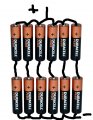
But if you google AA you'll see that 1 AA at 1.5 volt can drop 2800 mA on a load to in parallel can drop 5.600 mA
But in series you get 3 volts but the batteries become loads to and heat up trying to output more amp's then they can. Plus the glow plug is still something like .60 ohm load but you raised the voltage to 3 volts.
It now take's 5 amps to heat the glow plug where as at 1.5 it only took 2.5
The AA can't supply that you'd have to parallel them it would take more of them looks like 9
From what i figure this get you close to a little over 4 amps
7098.jpg
 

ebeowulf17

Joined Aug 12, 2014
3,307
Plus the glow plug is still something like .60 ohm load but you raised the voltage to 3 volts.
It now take's 5 amps to heat the glow plug where as at 1.5 it only took 2.5
I don't understand this part. Heat from the glow plug is a function of wattage, not current, right?

So, ignoring battery limitations for a moment, increasing voltage should decrease the amount of current it takes to heat the glow plug sufficiently, right?

Power = Voltage x Current

To achieve the same power output, if you increase one, you can decrease the other.

Now, back to batteries, I understand that the internal resistance of the batteries muddles things quite a bit, but unless the internal resistance of the battery is more than the resistance of the load, you'd still expect two batteries to deliver more power (perhaps slightly higher voltage and slightly lower current) than one, wouldn't you?

I know battery chemistry gets really complicated, so nothing would really surprise me there, but regarding my first question at the top, it really seems like more voltage across the glow plug should not require more current to deliver the required heat. If anything, it should mean you need less current to reach the desired heat.

If that's not true, please help me understand how and why. Thanks!
 

be80be

Joined Jul 5, 2008
2,395
Only reason I'd go for small relay is that he would get full output to the glow plug.
MOSFET maybe work ,But i would go relay here.
 

128ITSH

Joined Jul 20, 2017
101
I think you shouldn't stick to AA batteries. There are tons of cheaper, smaller batteries out there.
Once you will get a better voltage/current source most of your problems will be solved, so don't try to work around these low power limits but change them to proper values - it might be a better solution.
 

Thread Starter

liberalbid

Joined Apr 27, 2017
24
I think you shouldn't stick to AA batteries. There are tons of cheaper, smaller batteries out there.
Once you will get a better voltage/current source most of your problems will be solved, so don't try to work around these low power limits but change them to proper values - it might be a better solution.
Hi 128ITSH, and thanks for helping, I appreciate it.

If we were going to be the only ones using the devices then we would definitely look to a better battery but the device is likely to be used by many different people, away from our control, and particularly by school groups. My thinking was that AA batteries were very easy for them to source. I'm concerned that if they had to source unusual or expensive batteries, or pay for a charging system, then they might just not bother.

Mind you, I really don't know what is on offer so have you any suggestions?

Thanks again.

LB
 

Thread Starter

liberalbid

Joined Apr 27, 2017
24
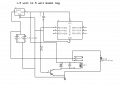
This would be a good bet .
View attachment 140765
I'm sorry I first put the NPN as follower
Wow! be80be above and beyond. I'm humbled and very thankful for the effort you've been going to here. Thank you so much.

Let's see if I've wrapped my brain around this:
Two AA batteries which will ultimately power the glow plug when the relay is turned on.
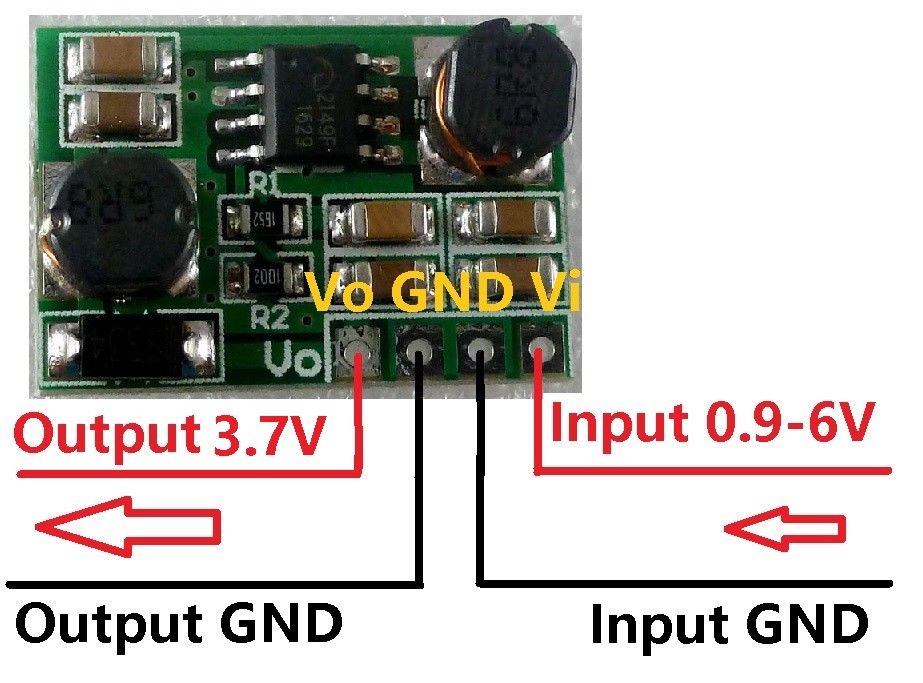
The same AA batteries run through a buck/boost? converter which I presume lifts the voltage to 5 volts to power the ATTiny.
Why is the BJT? transistor there?

Interestingly, in my very first attempt at this I used 9v, UNO, and a 5v relay module. The journey since led me to transistors instead of the relay because I thought they would save space but I don't mind going back to the relay option if it is a solution.

LB
 
Last edited:

be80be

Joined Jul 5, 2008
2,395
You maybe can find a small relay that has a 40ma or less coil in 5 volts but there's lot's of small 5 volt 5 to 10 amp relays in the 40 to 100 mA range you could try a MOSFET for the relay but I would stick with the relay.

Why because it's not going to take away from the current output of the AA battery .
The transistor is a switch to let you use most any relay in the 40 to 200 mA range.
https://www.aliexpress.com/store/pr...V-4-5V-to-5V-Voltage/1525466_32409755078.html


There's better one's then that one just posted it


Just make sure you get a .09 to1.5 volt to 5 volt booster
 
Last edited:

Thread Starter

liberalbid

Joined Apr 27, 2017
24
You maybe can find a small relay that has a 40ma or less coil in 5 volts but there's lot's of small 5 volt 5 to 10 amp relays in the 40 to 100 mA range you could try a MOSFET for the relay but I would stick with the relay.

Why because it's not going to take away from the current output of the AA battery .
The transistor is a switch to let you use most any relay in the 40 to 200 mA range.
https://www.aliexpress.com/store/pr...V-4-5V-to-5V-Voltage/1525466_32409755078.html


There's better one's then that one just posted it
https://www.ebay.com/i/332458080213?chn=ps

Just make sure you get a 1.5 volt to 5 volt booster
OK, be80be, I'm going to get the booster, a relay with a 5v coil and at least 3A max contact current, a basic NPN transistor, try it all out and report back.
Are the capacitors in your schematic 0.1uF?

I'm very hopeful about this, be80be, thank you again for your help. It will take some time for me to source the components where I live but as soon as I have them, I'll report back on how it goes.

LB
 

128ITSH

Joined Jul 20, 2017
101
Hi 128ITSH, and thanks for helping, I appreciate it.

If we were going to be the only ones using the devices then we would definitely look to a better battery but the device is likely to be used by many different people, away from our control, and particularly by school groups. My thinking was that AA batteries were very easy for them to source. I'm concerned that if they had to source unusual or expensive batteries, or pay for a charging system, then they might just not bother.

Mind you, I really don't know what is on offer so have you any suggestions?

Thanks again.

LB
If that's the situation then you are right and better stay with the AA, and be80be's solution looks good for you - but just know you can use any boost converter that outputs a voltage between 1.8 - 5.5V (attiny85V recommended supply voltage) and accepts input voltage of 1.5V. also notice the maximum current/power the converter can output.
 

be80be

Joined Jul 5, 2008
2,395
The one I linked is 480 mA most are that much I'd boost to 5 volts cause the relays easy to find.
Power the glow plug at it's 1.5 you be good to go.
 

redrok

Joined Aug 27, 2010
11
Thanks, BR-549, food for thought. Interestingly I'm not wedded just to the popping, it's just that we got so far down that path that I'd like to see the idea to it's end.

The compressed spring interests me. Originally we had started this whole project with a solenoid pin in mind but that didn't work because the travel distance of the pin was insufficient to overcome the latex' elasticity. The spring idea might be a suitable alternative. Can you think of any devices that might use a similar mechanism?

LB
An alternative would be to use a small motor, possibly a tiny Pager Motor. Attach a blade or pin and drill your way through the balloon.
These motors draw very little current.
redrok
 

mtripoli3

Joined Mar 1, 2016
35
Yes the glow plug is not going to change. So when you add 2 AA your adding resistance of the batteries.

I remember the days I messed with the cox plane you could start it with 1 D battery at 1.5 volt two at 3 volt wouldn't start it.
But if you google AA you'll see that 1 AA at 1.5 volt can drop 2800 mA on a load to in parallel can drop 5.600 mA
But in series you get 3 volts but the batteries become loads to and heat up trying to output more amp's then they can. Plus the glow plug is still something like .60 ohm load but you raised the voltage to 3 volts.
It now take's 5 amps to heat the glow plug where as at 1.5 it only took 2.5
The AA can't supply that you'd have to parallel them it would take more of them looks like 9
From what i figure this get you close to a little over 4 amps
View attachment 140745
 

mtripoli3

Joined Mar 1, 2016
35
Really, really bad idea series/paralleling alkaline (or carbon) batteries like this. I'm not going to go into all the why and wherefore's, there's tons of info out there about this. Check the "tech' sections of Energizer, Duracell for white papers. For those that want to argue the point; do it among yourselves, I'll not join in. If you want to make the argument that "it's done all the time using Lithium-Ion, NiMH, etc." do the research to understand why they can do this, and under what, very specific circumstances.
 

mtripoli3

Joined Mar 1, 2016
35
I designed a commercial device to do this exact thing; pop large balloons for commercial events, parties, etc. I went down exactly the same road as talked about here. It's a dead-end... I came up with a mechanical solution that works beautifully... I've PM'd the OP (I think, I started a conversation with them...).

MT
 

be80be

Joined Jul 5, 2008
2,395
I don't want argue I'd use a better battery LOL and I wouldn't use a glow plug but that's what OP wanted it probably work
I was going to test it with some balloons I did do some battery test and it looked ok

Plus do you own a cordless drill there But you done no that Ok
the thing with series/paralleling alkaline (or carbon) when one die's you need take them out our next time you want use it one of them will have leaked out and caused corrosion I fix my grand kids toys all the time and there friends.
Oh I for got something the paralleled batteries in toys are the worst.
I got them trained now the take them out when dead.
 
Last edited:

ebeowulf17

Joined Aug 12, 2014
3,307
I designed a commercial device to do this exact thing; pop large balloons for commercial events, parties, etc. I went down exactly the same road as talked about here. It's a dead-end... I came up with a mechanical solution that works beautifully... I've PM'd the OP (I think, I started a conversation with them...).

MT
You're not willing to share the solution with the rest of us? Is the design secret? After so much thought and effort has gone into this discussion, I'm sure I'm not the only one interested in hearing what you've learned.
 
Top