Facebook
 Google
 GitHub
 Linkedin

Hi folks,
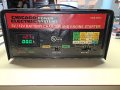
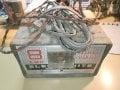
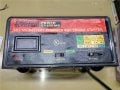
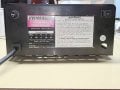
I opened up an old car battery charger the other day to see if I could replace the current meter which no longer works. I'm pretty sure I can, but of course now I've become curious as to how it works. Its a Chicago Electric Battery Charger 66783. There's lots of pictures of it around the internet, so I'll just show the front of it for now:
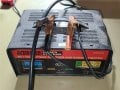
It's not antient; it has LEDs and transistors in it. I have a much older charger that has selenium rectifiers. (I've only just recently learned what those are.)
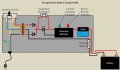
I've already learned quite a bit. It has a center tap rectifier that uses only two diodes. I didn't know that was a thing before. And switching between the different charging modes is done by a rather clever (in my humble opinion) sliding switch that changes the number of turns on the primary side of the transformer. I made up a picture of what I understand so far:
Unfortunately, when it comes to components with more that two legs, I'm pretty mystified as to how they work. I did some searching and found that someone else has drawn up a diagram of the circuit board. I've re-drawn it; hoping that it will be easier to read. I don't know if it was drawn correctly in the first place, or if I've recreated it accurately, but I spent quite a lot of time making sure I got it right.
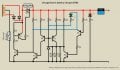 Here is a link to the one I found originally: https://electronics.stackexchange.com/questions/268069/car-battery-charging-circuit
I think I can see a voltage divider in there, but really I don't understand how it all makes the charger behave the way it does. I'm pretty sure the SCR at the top has something to do with reverse polarity protection, and short circuit protection. I think it may also be involved in how the charger is able to tell if a battery is fully charged. Or at least is used somehow to shut off the current once the battery is full.
Anyway, I'm planning to replace the busted current meter with a digital one that also measures voltage. I plan to hook it up so that it uses the battery power to operate. That way I can see what the battery voltage is even with the charger off or when the charge cycle is complete.
While I'm in there, I'd also like to add a power switch on the AC side, as well as a fuse. On the DC side there is a thermal breaker just before the output, but nothing I can see that would protect the AC side. I've read on several occasions that the charger is supposed to be unplugged whenever connecting or disconnecting a battery. (Apparently it's to protect the charger's delicate innards.) I'm fine with unplugging it when I put it away, but it's really annoying to have to unplug it every time I want to change batteries or do a load test or something.
As far as I know, these changes shouldn't affect the charger. Unless anyone sees a reason that I shouldn't do it?
I opened up an old car battery charger the other day to see if I could replace the current meter which no longer works. I'm pretty sure I can, but of course now I've become curious as to how it works. Its a Chicago Electric Battery Charger 66783. There's lots of pictures of it around the internet, so I'll just show the front of it for now:
It's not antient; it has LEDs and transistors in it. I have a much older charger that has selenium rectifiers. (I've only just recently learned what those are.)
I've already learned quite a bit. It has a center tap rectifier that uses only two diodes. I didn't know that was a thing before. And switching between the different charging modes is done by a rather clever (in my humble opinion) sliding switch that changes the number of turns on the primary side of the transformer. I made up a picture of what I understand so far:
Unfortunately, when it comes to components with more that two legs, I'm pretty mystified as to how they work. I did some searching and found that someone else has drawn up a diagram of the circuit board. I've re-drawn it; hoping that it will be easier to read. I don't know if it was drawn correctly in the first place, or if I've recreated it accurately, but I spent quite a lot of time making sure I got it right.
Here is a link to the one I found originally: https://electronics.stackexchange.com/questions/268069/car-battery-charging-circuitI think I can see a voltage divider in there, but really I don't understand how it all makes the charger behave the way it does. I'm pretty sure the SCR at the top has something to do with reverse polarity protection, and short circuit protection. I think it may also be involved in how the charger is able to tell if a battery is fully charged. Or at least is used somehow to shut off the current once the battery is full.
Anyway, I'm planning to replace the busted current meter with a digital one that also measures voltage. I plan to hook it up so that it uses the battery power to operate. That way I can see what the battery voltage is even with the charger off or when the charge cycle is complete.
While I'm in there, I'd also like to add a power switch on the AC side, as well as a fuse. On the DC side there is a thermal breaker just before the output, but nothing I can see that would protect the AC side. I've read on several occasions that the charger is supposed to be unplugged whenever connecting or disconnecting a battery. (Apparently it's to protect the charger's delicate innards.) I'm fine with unplugging it when I put it away, but it's really annoying to have to unplug it every time I want to change batteries or do a load test or something.
As far as I know, these changes shouldn't affect the charger. Unless anyone sees a reason that I shouldn't do it?


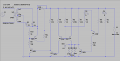



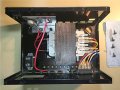
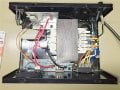
 In fact, the Volt/Amp meter works perfectly, and seems accurate. I wired it so it will run off of whatever battery is connected even if the charger itself is off or unplugged. I even got the wire direction through the CT sensor right the first time.