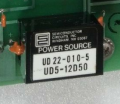
One board I plan to reverse-engineer soon has a DC-DC converter to power a 1488 RS-232 driver from a 5V supply, but this board went out of production literally decades ago. I'm not looking for a replacement; I just need to find a datasheet with the pinout so I can draw the symbol properly in KiCAD.
Why not use a MAX232 chip (many variants) the handles the positive and negative supplies directly? I think they can be had for 23 cents or less on LCSC, and need only five 1uF (maybe 100nF) caps to do their magic.
True, but my goal is to document what is there now.
If I wanted to do a modern re-spin, I would definitely want updated / more readily available drivers etc.
Welll... for now I just knocked out a schematic symbol, and if I get my hands on the board that uses this part, i'll update the pin numbering then. Thought I'd ask anyway, but it seems the part in question is truly "old and forgotten"...
I would guess that it has 5 pins 2of them will be the 5 volt input 3 of them will be the common , +15V and -15V. outputs.
Why not just measure the voltages between the pins ?
@metermannd, I hate to break it to you, but the "Spice Order" for the pins in a simulation model have absolutely positively NOTHING to do with the pin numbering on an actual package. You need to quickly abandon that notion.
To be honest, I've never messed around with LTSpice.
Again, this was ONLY so I could document it correctly on the recreated schematic.
Moot anyway, as I have that board on the way after the seller offered it to me at a good price.
Got the board in hand... wasn't pleased to see this chip was socketed - not so much that, but that it was in one of those horrible Scanbe brand sockets. The part should have been soldered in the board (and I am seriously considering it even though I'm not likely to actually put it back in operation); the part still has the original full lead length.
Package fits a DIP-24 footprint, with pins on 1-3, 10-12, 13-15, 22-24.
I reverse engineered that portion of the board and the default arrangement uses exactly ONE gate each from a 1488 and a 1489 for the default TX / RX path. An available (but never implemented) option would have allowed the addition of RTS / CTS to the serial port.
I'm sure if the MAX232 was available in the early '80s, that would have been a far, FAR more elegant approach. Just another of the many "Now why did they do it like that?!" things I have found as I reverse engineer this pile of boards.
Edit: I also discovered that this board had a day-one solder short... fixed it even though it is not at all likely to find its way back into one of the few remaining working systems on the planet.