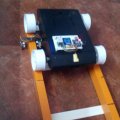
I tested using all the methods , but actual trigger is not getting when a flaw found , is there any other way to measure the echo to detect the flaw ,.
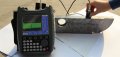
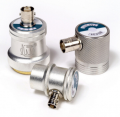
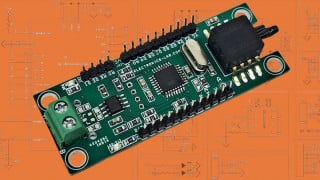
As @John P and @ErnieM have said, just because its ultrasonic, does not mean your particular transducer setup will work in this application. The picture you posted shows a high power, high frequency transducer in contact with the rail so that the first echo will be from the flaw, not the surface of the rail as you are encountering. The sensor you have is designed to work through air, not heavy materials. You might be able to detect large gaps in the rail but not cracks. Keep in mind too that the controller on the sensor you are using is designed to latch on the first echo it sees and that's it - because its a rangefinder. In your application, again unless the gap is very big, the first echo will always be the the top of the rail - it's finding the range. Even 'focusing' the signal with the tubes won't help much because your acoustic signal has to be wide enough so that the receiver can hear it. That automatically means that the size of the gaps you can detect will be very large relative to what you are looking for and seeing internal flaws like the picture is out of the question.
Its just not the right sensor for the application unless the gaps to sense are very big. It won't work at all in detecting internal flaws.
10MHz ultrasound will be very strongly attenuated in air. There would need to be close acoustic coupling, e.g. provided by a thin liquid layer, between the transducer and the rail.
You will have to check the speed of sound for the material you are testing and make sure the pulse of your outgoing ultrasonic signal is already off by the time your echo returns. The speed of sound in steel (for crack detection) is much, much faster than the speed of sound in air (used for distance measurement).
Please read post 27. Look up the speed of sound for your material and do the calculations.
Also, you will likely need a specific tip to uniformly transmit the sound into the material and something more than an arduino to sense/analyze the echo (see "spectrum analyzer").

 Facebook
 Google
 GitHub
 Linkedin