Arc Fault Detection Circuit breakers

ebp

Joined Feb 8, 2018
2,332
When it comes to ordinary receptacles, I will use only "specification grade," also called "commercial grade" (in Canada; perhaps different in the US). I regard the standard receptacles sold for residential use as house burners. The contacts are usually poorly designed and lose holding tension easily. The spec grade receptacles are typically at least 3 times as expensive, but they aren't garbage before they even leave the factory. I suspect arc fault breakers exist in part to deal with the hazards created by cheap receptacles.
 

be80be

Joined Jul 5, 2008
2,395
Arc fault are good people bad lol we have to use them on all branch circuits.
They do save you from fires do to bad wiring, But get you a job today and you'd see see fast why there needed.
It's crazy they hire kids that don't know nothing teach them nothing and they hook stuff up wrong.

They hide wire I don't want get started but just think about this I pulled some wire in 20 feet of pipe you couldn't pull it I had to take it all down
and deburr the conduit, What you think happens to the wire. Same guy hooks up the lights they hook both the 120 and the 277 to the hot
what happen's to the light the wire pulled in the box without the jacket.

Good talkers and and fast running around but what's it going to cost you when the burn you house down
 

Reloadron

Joined Jan 15, 2015
7,891
Nuts, I suspect you're right and it's exactly what I feared. That means I ordered the wrong boxes and they'll have huge gaping holes. More time standing in the hardware store looking for a way to fit it all together. On the other hand, I haven't bought the conduit yet. I suppose using 3/4" conduit would solve some issues and make it that much easier to pull the wires.
They make adapters so you can run 1/2" into a 3/4" box. The reducers are not that much. Using 3/4 conduit just means it will cost a little more. I just bought 50 feet of Liquid Tight at Home Depot and in 3/4" it runs about a buck a foot. The 3/4" easil;y handles 4 conductors of AWG 6. The 1/2" is less costly and will easily handle 3 conductors of AWG 12.

Ron
 

Thread Starter

wayneh

Joined Sep 9, 2010
18,108
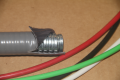
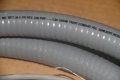
I've figured out that the cable I have (photo in #12) is PVC-jacketed, metal clad cable. Something like this:
or this:

It's a very cost-effective alternative to running weather-proof conduit and pulling wires.

That's all great, but nobody sells it in anything less than a 250' reel. I only need ~25', so that's impractical. Looks like I'll have to run conduit and pull my own wires. And buy all those water-proof fittings. Sigh. :(
 

Reloadron

Joined Jan 15, 2015
7,891
Your links go to what looks to be BX with a rubberized coating. Most pool supply places sell about the same in what is called a "whip". They normally can be had with AWG 14 or AWG 12 wire already in them in 6 foot lengths. You can also get a whip less the rubber coating called a BX cable whip. The rubber coating makes for water resistant which is why pool supply houses carry them. Technically BX is called AC or Armored Cable.

Ron
 
Last edited:

-live wire-

Joined Dec 22, 2017
959
When I was a teen, while on vacation, it was late and I couldn't fall asleep. I wondered: could you turn a lamp partially on by getting the switch in just the right position? So I tried to do so. I ended up making some arcs in the lamp switch by having the contacts just the right distance apart. The arcs made an interesting sound, and it was cool to watch. :eek: I know. In retrospect, it may not have been the brightest idea. But nothing burned down, nor did anyone get electrocuted.


And on the topic of different circuit breakers, just the other day, one of them in my basement near my work bench tripped. I powered up my soldering iron and turned on my fan. I had some random extension cords lying around, and it was all kind of a jumble. I heard a loud popping sound. My fan turned off, as did my soldering iron. I tried flipping the switches on the extension cords and devices, but nothing happened.

Later, I got my meter and measured the voltage between L and N - .3VAC. As I suspected, a breaker tripped. I went to the breaker panel and was perplexed. None of them seem to have tripped. I tried flipping a few of them back and forth, just in case they were tripped but were not fully in the "off" position. I went back and still measured ~.3V. Then I saw the GFCI outlet in the corner. I went over, and pressed in the reset button. I then measured the typical 123V. I turned on my appliances, and they worked.

I still have not identified the culprit. I didn't see any appliances that were obviously live, and I didn't see any failed insulation. So maybe it falsely triggered. Or maybe there is a dangerous non-isolated appliance that I have not identified. Either way, it was an interesting experience.
 

Reloadron

Joined Jan 15, 2015
7,891
I still have not identified the culprit. I didn't see any appliances that were obviously live, and I didn't see any failed insulation. So maybe it falsely triggered. Or maybe there is a dangerous non-isolated appliance that I have not identified. Either way, it was an interesting experience.

A residential GFCI will trip at about 5 or 6 mA of leakage current. Older metal frame motors and refrigerator compressors would trip them They come in different classes with for example a Class A tripping at 6 mA but a Class B tripping at about 20 mA (I think). Metal frame motors are open to both inductive and capacitive leakage. Nuisance trips can have any number of causes. Outdoor units I have seen trip simply from moisture or condensate forming around them.

Ron
 

sdowney717

Joined Jul 18, 2012
805
AFCI breakers have improved, Everyone I buy are the combo AFCI/GFCI breakers and they are expensive.
We are selling a house and home inspector said needed GFCI outlets in all kitchens and baths. I bought 3 combo breakers and 2 GFCI outlets.
Washer got a GFCI outlet
Kitchen got a GFCI outlet, entire string includes kitchen and dining room, not the fridge.
Two upstairs circuits each got a combo breaker to protect entire upstairs.
Dishwasher got combo breaker.

3 GE combo breakers = $150 from HDepot
2 GFCI outlets = $30 from Lowes.

Of course old house so things like old attic fan kept tripping combo breaker, new fan = $90
Various other issues like a few old outlets with loose screws could trip combo breaker.
Another issue is shared neutrals will trip a combo breaker, somehow it knows!

I pulled on chain to turn on closet light = tripped combo breaker.
After exercising switch 10 times, no more tripping breaker.
 

Reloadron

Joined Jan 15, 2015
7,891
If neither Lowes or Home Depot has exactlt what you are looking for then your best bet is to find a local electrical supply house. Here in my area of Cleveland, Ohio for example I use Mars Electric as one of several available. Most retail the stuff by the foot. Home Depot sells 25' lengths. How much exactly do you need for this project? Any electrician should be able to turn you on to a supply house or order it online from an industrial distributor like McMaster Carr Supply.

Ron
 

Thread Starter

wayneh

Joined Sep 9, 2010
18,108
If neither Lowes or Home Depot has exactlt what you are looking for then your best bet is to find a local electrical supply house. Here in my area of Cleveland, Ohio for example I use Mars Electric as one of several available. Most retail the stuff by the foot. Home Depot sells 25' lengths. How much exactly do you need for this project? Any electrician should be able to turn you on to a supply house or order it online from an industrial distributor like McMaster Carr Supply.

Ron
I need about 25’. Neither Home Depot nor MMC, nor anyone else, offers by-the-foot. As I said, I’ve given up and I’ll just use waterproof conduit and pull wires. Everything I need for that approach is widely available.
 

MisterBill2

Joined Jan 23, 2018
27,563
This is an example of the box you have in several flavors. If you scroll down you will see several options for use as covers and consider the "box" cover design mentioned previously. Your second image reflects what I commonly like to call Seal Tite or Liquid Tite. The latter comes in a wide range of diameters with a wide range of couplings or couplers. While I linked to McMaster Carr Supply most, if not all of this stuff can be had at any home improvement store like Lowes or Home Depot.

Ron
SealTite is an industrial strength sealed conduit with a steel sheath covered by a plastic jacket. It is great stuff but the fittings are quite expensive. Liquid Tite is an all plastic water resistant conduit that does NOT have that steel sheath. It is adequate for a lot of things but not nearly as good of an armor as the sealTite stuff. Also it does not protect as well from very hot stuff. AND it uses different fittings than the other stuff.
 

MisterBill2

Joined Jan 23, 2018
27,563
There are at least 3 different types of rigid metal conduit and all 3 come in a number of sizes. If you get half inch thinwall conduit, you will need adapters for the boxes and those adapter go into 3/4 inch diameter holes, and usually use a nut on the inside to retain the adapter. Rigid conduit is sized like regular pipe, so half inch has a 1/2 inch INSIDE diameter, like pipe. Tubing is usually sized by the OUTSIDE diameter, except for some types of refrigeration tubing, sized by inside diameter. So it can be very confusing.
There are also plastic conduits that look a lot like plastic water pipes except that the sizes may not be quite exactly the same. The thing that I like about the plastic conduit is that it does not rust, no matter what, and that can be a HUGE advantage. The downside is that it must be glued and so it is wasteful when changes must be made, or when the plans change, or when something does not fit just right.
 

Reloadron

Joined Jan 15, 2015
7,891
SealTite is an industrial strength sealed conduit with a steel sheath covered by a plastic jacket. It is great stuff but the fittings are quite expensive. Liquid Tite is an all plastic water resistant conduit that does NOT have that steel sheath. It is adequate for a lot of things but not nearly as good of an armor as the sealTite stuff. Also it does not protect as well from very hot stuff. AND it uses different fittings than the other stuff.
Yes, I know what it is. I have used Liquid Tight in both Metallic and Non-Metallic and while the last link I posted does say Non Metallic here is what I bought and it pretty clearly says Liquid Tight on the stuff. The 3/4 inch pictured was about a buck a foot and you can buy metallic or plastic fittings for the stuff.

Liquid Tight 1.png

Liquid Tight 2.png

I have also used the plain non metallic stuff you mention but Liquid Tight comes in Metallic and Non Metallic. Made by Southwire it is available from Home Depot as well as a dozen other suppliers. Either Seal Tight or Liquid Tight is fine for outside weather.

Ron
 

MisterBill2

Joined Jan 23, 2018
27,563
OK, it has been quite a few years and I may have got my names reversed. I have some of that stuff you show running underground to power a motion sensor light for my front walk. One inch ID Tygon tube is a very tight fit on the stuff, and then it also is a tight fit on the plastic conduit, making a waterproof connection below grade so that coming up the post is the hard plastic pipe, which looks much nicer when painted to match the post. Sorry about the product plug but none of the "equal" products match Tygon for stretchability and sealing.
 

Reloadron

Joined Jan 15, 2015
7,891
Tygon is a gift from the Gods. :) The only reason I mentioned it was I just had to buy some for a new outside emergency generator I am installing. Matter of fact the old generator used Seal Tight. No the good stuff isn't cheap but for what the thread starter needs if he could find it by the foot it wouldn't hurt too much. With the 3/4" stuff I was able to push (albeit tightly) 4 conductors of #6. I like the stuff as it is easier to work with that even EMT let along screwing with and bending pipe which I suck at.

I have no clue why the thread starter couldn't find the stuff at the local Home Depot?

Ron
 

Thread Starter

wayneh

Joined Sep 9, 2010
18,108
Yes, I know what it is. I have used Liquid Tight in both Metallic and Non-Metallic and while the last link I posted does say Non Metallic here is what I bought and it pretty clearly says Liquid Tight on the stuff. The 3/4 inch pictured was about a buck a foot and you can buy metallic or plastic fittings for the stuff.

View attachment 159150

View attachment 159151

I have also used the plain non metallic stuff you mention but Liquid Tight comes in Metallic and Non Metallic. Made by Southwire it is available from Home Depot as well as a dozen other suppliers. Either Seal Tight or Liquid Tight is fine for outside weather.

Ron
My new circuit has a 20A breaker and I’ve confirmed it’s the combo type. Since I’m going to use 1/2” conduit, there’s plenty of room for 10 AWG wire. But I’m wondering if it is too hard to work with or if there are any downsides compared to 12AWG. It’s probably harder to find locally but assuming I can find it, would you choose 10 over 12?
 
Top