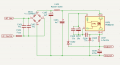
This is a quick drawing of the power board (not including relays). Its a nasty, non-isolated current-mode controller. I doubt the fault is the chip itself, possibly a leaky c107. Either way, hard to debug without specialist tools... Just to add... 'Ground' isn't ground, its approximately 325v above/below the mains Earth... so extremely dangerous to work on.... That fuse in the neutral side... if it blows it still leaves everything connected to live, completely useless and potentially illegal...
What you could do, in the meantime, is get a source of 5 - 12v, wall wart or something and attach it to the main board (disconnected from the power board obviously) and see if you get 3.3v out of that 1117 regulator though I suspect you may have to replace it (again). If you do, then at least you can see if the main and display boards work - I suspect not... but you can but try...
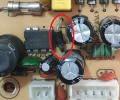
Satisfy my curiosity: see that big fat "resistor" on the power board by the two electrolytic capacitors... check its DC resistance (power off and disconnected) is it 910ohms, or something closer to 1 so its actually a 910uH inductor.
What you could do, in the meantime, is get a source of 5 - 12v, wall wart or something and attach it to the main board (disconnected from the power board obviously) and see if you get 3.3v out of that 1117 regulator though I suspect you may have to replace it (again). If you do, then at least you can see if the main and display boards work - I suspect not... but you can but try...
Satisfy my curiosity: see that big fat "resistor" on the power board by the two electrolytic capacitors... check its DC resistance (power off and disconnected) is it 910ohms, or something closer to 1 so its actually a 910uH inductor.
OK, so it is a choke then. I'll update the drawing
According to the PN8024R datasheet, now translated from the Chinese, it should provide a fixed 12.5v output. It senses the VDD value from the output and uses that to control the output. There is a separate shutdown mechanism if VDD is greater than 24 - 29v. So 22v and rising suggests its in an error state - it could be a faulty chip therefore.. There's a diode (D103 in circuit) that looks a bit dodgy, can you tell what markings it has?
OK, so it is a choke then. I'll update the drawing
According to the PN8024R datasheet, now translated from the Chinese, it should provide a fixed 12.5v output. It senses the VDD value from the output and uses that to control the output. There is a separate shutdown mechanism if VDD is greater than 24 - 29v. So 22v and rising suggests its in an error state - it could be a faulty chip therefore.. There's a diode (D103 in circuit) that looks a bit dodgy, can you tell what markings it has?
Soon, I connected 9V battery to AMS1117, and the screen turned on, speaker beeped, the wifi lamp is blinking... Tomorrow I will solder back wifi module to the control PCB and see if it works together.
Possibly, but I wouldn't until its fixed. Apart from the two transistors controlling the relays there's nothing on the power board that feeds back to the controller, unless it senses the heater elements somehow - maybe a temperature sensor - and not getting feedback, closes down.
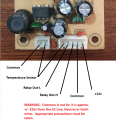
Where does the little 2-pin connector on the power board go to?
Possibly, but I wouldn't until its fixed. Apart from the two transistors controlling the relays there's nothing on the power board that feeds back to the controller, unless it senses the heater elements somehow - maybe a temperature sensor - and not getting feedback, closes down.
Where does the little 2-pin connector on the power board go to?
Ah, that makes sense. That connects back to pin 5 of the other connector so takes the temperature sensing back to the control board. Clearly the software recognizes it can't see the temperature sensor and shuts down.
Ah, that makes sense. That connects back to pin 5 of the other connector so takes the temperature sensing back to the control board. Clearly the software recognizes it can't see the temperature sensor and shuts down.
So I tried with power board and temperature sensor attached. It works.. but after like a 2 minutes it shuts down, like it looses power... I guess we need to fix power board, I will wait till that part comes from. AliExpress, so it can be awhile to update this. Thank you all for your support and time with this thing!
Thought so, I'm surprised it lasted 2min. The current draw of that unit is way more than a PP3 can sustain for very long. A brand new battery might do longer, especially if it's a lithium (non-rechargable) one. But it at least it shows the boards are potentially working.
You could try the following, carefully (I'd advise rubber gloves). Disconnect the power board from the others, then, making sure it's not likely to short out or touch anything metallic, power it up from the AC supply. Measure the DC voltage on the common (black) and +12v (red) pins on the 5pin connector - that should be 12v but from previous tests I suspect not. Now set your multimeter to a range that will show around 300v and measure from common (black) on the 2pin connector to pins 7 & 8 (red) of the PN8024. That should be in the region of 325v or so, assuming 230v AC input. Move the red lead to pin 4 of the chip - what's the voltage there?
Thought so, I'm surprised it lasted 2min. The current draw of that unit is way more than a PP3 can sustain for very long. A brand new battery might do longer, especially if it's a lithium (non-rechargable) one. But it at least it shows the boards are potentially working.
You could try the following, carefully (I'd advise rubber gloves). Disconnect the power board from the others, then, making sure it's not likely to short out or touch anything metallic, power it up from the AC supply. Measure the DC voltage on the common (black) and +12v (red) pins on the 5pin connector - that should be 12v but from previous tests I suspect not. Now set your multimeter to a range that will show around 300v and measure from common (black) on the 2pin connector to pins 7 & 8 (red) of the PN8024. That should be in the region of 325v or so, assuming 230v AC input. Move the red lead to pin 4 of the chip - what's the voltage there?

 Facebook
 Google
 GitHub
 Linkedin