Anyone invested in bit coins?

bogosort

Joined Sep 24, 2011
696
The real problem with these cryptosystems is that they derive all of their value from WORK performed and thus ENERGY consumed. Which in turn leads to ever-rising energy prices. Once that skyrockets out of control electrical resources may become so scarce that people will struggle just to keep the lights on. ("Can you spare a watt Brother?")
Bitcoin doesn't use energy, it uses electricity. This is an important distinction because electricity can be produced in sustainable ways. It's also important to note that Bitcoin was designed with a feedback loop to account for varying levels of mining power. The computational effort required to create a block on the Bitcoin ledger auto-scales by the average amount of time miners are finding blocks. Miners will only mine if it's profitable to them. Thus, if the cost of electricity causes less people to mine, the amount of work required to produce a block will decrease in proportion. Bitcoin mining always finds an equilibrium.

The obvious solution is to eliminate work-based schemes altogether. Proof of stake systems don't make money out of the thin air blowing out of a CPU fan as Bitcoin does. They don't require lots of energy and therefore much better for society as a whole.
Proof of stake is contrary to decentralization. Bitcoin run by a conglomerate is no longer Bitcoin (it's Ethereum ;)).
 

bogosort

Joined Sep 24, 2011
696
No, it's not really any of those things except being open source (I've run a locally compiled Bitcoin node for at least 10 years). It's not decentralized today, any sort of bank and so far the listed product features are fan fantasies. The value of Bitcoin is in the collectibles value.
How is it not decentralized? Who exactly is controlling it? The past decade has shown that Bitcoin is resistant and robust to governmental and corprorate (e.g., Segwit2x) pressures to change it.

There will be a future of digital cash with actual banking and useful features, the odds of that being based on the current Bitcoin blockchain processing system is low IMO.
Bitcoin is most certainly a bank. The Bitcoin ledger today contains every single transaction that has ever occurred, including the very first in 2009. The blockchain is both the bank and the coin, and it exists on every single node, including yours.

Or would you rather continue to trust the US government and the banking industry with your wealth? We've seen what they're doing to the dollar. Every other asset -- securities, gold, real estate -- can be confiscated, censured, and/or depreciated out of existence. Bitcoin represents the first store of value in human history that is immune to the whims of the ruling authority. Why do you think China hates it so much?
 

nsaspook

Joined Aug 27, 2009
16,432
Yes, I'd rather trust the US government and the banking industry with my wealth, that's an easy choice. US treasury bonds are backed by the guns and prisons of US governmental power with help from the greed of the banking industry. That's a hell of a better bet for long term stability than Bitcoin exchanges being willing to trade tokens for actual cash to buy bread. The ideological rationale for possession of Bitcoin is interesting but using Bitcoin for long-term investments of critical personal wealth is IMO very risky.

Bitcoin immune to the whims of the ruling authority? Bitcoin need digital connectivity to exist. Guess who controls the worlds digital connectivity, ruling authority.
 
Last edited:

bogosort

Joined Sep 24, 2011
696
Yes, I'd rather trust the US government and the banking industry with my wealth, that's an easy choice. US treasury bonds are backed by the guns and prisons of US governmental power with help from the greed of the banking industry. That's a hell of a better bet for long term stability than Bitcoin exchanges being willing to trade tokens for actual cash.
Suit yourself, risk is a personal assessment. I have significantly less faith in the government than I do in the blockchain.
 

nsaspook

Joined Aug 27, 2009
16,432
This is pretty funny. Proof of space?
https://www.newscientist.com/articl...troyed-hard-disc-supply-chains-says-its-boss/
Bitcoin rival Chia 'destroyed' hard disc supply chains, says its boss
Bitcoin requires so-called miners to do vast amounts of useless calculations to maintain the network, a system that is known as proof of work. The most recent studies show that bitcoin may currently consume 0.53 per cent of the world’s electricity supply. Chia instead uses a proof-of-space approach that ditches these calculations and relies on empty hard disc space. The more space a miner devotes to the task, the higher their probability of receiving new coins.

In theory, this would consume less energy, but there has been a surge in demand for hard discs since the currency launched earlier this year. Around 12 million terabytes of hard disc space is currently being used to mine Chia, having risen on an exponential curve since its launch in March. When New Scientist first reported on Chia just two weeks ago, that figure was only at 3 million terabytes.

These discs still require energy to produce and run, and there are reports that the constant reading and writing involved in mining can wear them out in weeks, rendering them useless. Hoffman says this problem only affects the cheapest discs.
https://www.chiaexplorer.com/charts/netspace

disk.png
 

bogosort

Joined Sep 24, 2011
696
The ideological rationale for possession of Bitcoin is interesting but using Bitcoin for long-term investments of critical personal wealth is IMO very risky.
I'm honestly debating right now whether to cash out my relatively meager 401k (less than 6 figures) and put it all in BTC while it's on sale. My logical side is screaming at me that it's the only rational thing to do, though of course there is risk. I acknowledge that something unexpected could happen and make Bitcoin worthless, but I also acknowledge that at this point, the probability of such an event seems less likely than any of the other possible wealth-destroying events. My wife thinks I'm crazy, and I'm aware that I likely have FOMO bias, but the more I think about Bitcoin the more I'm convinced that it will become the new gold standard.

Bitcoin immune to the whims of the ruling authority? Bitcoin need digital connectivity to exist. Guess who controls the worlds digital connectivity, ruling authority.
The internet is decentralized and cannot be controlled. And as long as encryption is possible, this will always be the case. Governments have tried and failed; even China can't stop their citizens from getting to the "Western internet". Comcast and Time-Warner can influence traffic (up until public outcry affects their bottom line), network peering agreements are subject to corporate politics, but all of this just makes the internet less convenient. And if the worst should come to pass with governments seizing and shutting down every NAP, the internet will reemerge in the form of a network of peer-to-peer networks built and managed by individuals.

The internet is foremost an idea, and a suite of protocols for implementing that idea. That cat is out of the bag and is never going back in. I think the same is true of Bitcoin, much to the chagrin of governments and the banking industry.
 

nsaspook

Joined Aug 27, 2009
16,432
I'm honestly debating right now whether to cash out my relatively meager 401k (less than 6 figures) and put it all in BTC while it's on sale. My logical side is screaming at me that it's the only rational thing to do, though of course there is risk. I acknowledge that something unexpected could happen and make Bitcoin worthless, but I also acknowledge that at this point, the probability of such an event seems less likely than any of the other possible wealth-destroying events. My wife thinks I'm crazy, and I'm aware that I likely have FOMO bias, but the more I think about Bitcoin the more I'm convinced that it will become the new gold standard.


The internet is decentralized and cannot be controlled. And as long as encryption is possible, this will always be the case. Governments have tried and failed; even China can't stop their citizens from getting to the "Western internet". Comcast and Time-Warner can influence traffic (up until public outcry affects their bottom line), network peering agreements are subject to corporate politics, but all of this just makes the internet less convenient. And if the worst should come to pass with governments seizing and shutting down every NAP, the internet will reemerge in the form of a network of peer-to-peer networks built and managed by individuals.

The internet is foremost an idea, and a suite of protocols for implementing that idea. That cat is out of the bag and is never going back in. I think the same is true of Bitcoin, much to the chagrin of governments and the banking industry.
Listen to your wife. Bitcoin is based on crypto (getting long in the tooth crypto) and all practical (deterministic) crypto systems will eventually become obsolete.

The internet is better viewed as being distributed, both in terms of technologies and governance arrangements. It was not and has never been decentralized nor was it designed to be decentralized. Control the Border Gateway Protocol and you control the Internet. Sure, you count revert back to a individual circuit to circuit topology like UUCP or ad-hoc PP networks but that's not the Internet.
 
Last edited:

bogosort

Joined Sep 24, 2011
696
Listen to your wife. Bitcoin is based on crypto (getting long in the tooth crypto) and all practical (deterministic) crypto systems will eventually become obsolete.
Elliptic curve cryptography isn't long in the tooth. The only potential threat is that either P = NP (lol) or that quantum computing becomes practical enough that it can be used to mine BTC. We're a long way from that happening, and since the barrier to quantum computing is an engineering barrier, we'll only be taking incremental steps toward thousand-plus qubit computers. If and when that day becomes a real possibility, everything will have to change over to quantum cryptography, including the Bitcoin protocol.

The internet is better viewed as being distributed, both in terms of technologies and governance arrangements. It was not and has never been decentralized nor was it designed to be decentralized. Control the Border Gateway Protocol and you control the Internet. Sure, you count revert back to a individual circuit to circuit topology like UUCP or ad-hoc PP networks but that's not the Internet.
Can you explain further why you don't believe the internet is decentralized? IP routers are nodes, and each node is independent. The thing that makes a network of nodes an internet is just the number of nodes participating. The thing that makes the internet the Internet is that everyone agrees it is. If some entity irrevocably breaks this network that we call the Internet, another network will become the Internet.
 

nsaspook

Joined Aug 27, 2009
16,432
Elliptic curve cryptography isn't long in the tooth. The only potential threat is that either P = NP (lol) or that quantum computing becomes practical enough that it can be used to mine BTC. We're a long way from that happening, and since the barrier to quantum computing is an engineering barrier, we'll only be taking incremental steps toward thousand-plus qubit computers. If and when that day becomes a real possibility, everything will have to change over to quantum cryptography, including the Bitcoin protocol.


Can you explain further why you don't believe the internet is decentralized? IP routers are nodes, and each node is independent. The thing that makes a network of nodes an internet is just the number of nodes participating. The thing that makes the internet the Internet is that everyone agrees it is. If some entity irrevocably breaks this network that we call the Internet, another network will become the Internet.
Is there a mathematical proof for the complexity of the discrete logarithm problem? Sure, it's a hard nut to crack but how hard really is it?

Those IP routers directly on the Internet get assigned IP numbers. The numbers don't come from some decentralized authority.
https://www.cnet.com/news/how-ip-addresses-get-distributed/

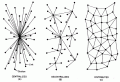
I call it distributed because that's what the inventor called it. He knew the difference.
1602603277969.jpg

https://www.rand.org/about/history/baran.html

Paul Baran and the Origins of the Internet
Baran envisioned a network of unmanned nodes that would act as switches, routing information from one node to another to their final destinations. The nodes would use a scheme he called “hot-potato routing” or distributed communications.
https://www.rand.org/pubs/research_memoranda/RM3420.html
1612812901809.gif
 

bogosort

Joined Sep 24, 2011
696
Is there a mathematical proof for the complexity of the discrete logarithm problem? Sure, it's a hard nut to crack but how hard really is it?
We don't have a proof that discrete logs are hard, or that factoring large numbers is hard, or even in fact that NP-complete problems are hard. But decades of research makes it clear that one-way functions are indeed computationally hard. Could some kid in grad school suddenly find a classical algorithm that will find discrete logs or primes in polynomial time? It's possible, but about as likely as some kid proving that P = NP, in which case nothing's hard.

Those IP routers directly on the Internet get assigned IP numbers. The numbers don't come from some decentralized authority.
We've delegated IP assignment to various authorities because it has been organizationally convenient to do so, especially with the scarcity of 32-bit addressing. But nothing in the IP stack requires a central authority. If we decided to start a new internet using only 64-bit addresses, we could design it with decentralized and automatic address provisioning.

I call it distributed because that's what the inventor called it. He knew the difference.
You're giving Al Gore too much credit. ;)

To be clear, a distributed network is either centralized or decentralized. Which part of the internet protocol do you think makes it a centralized distributed network? More to the point, which single organization do you think can shutdown the internet? If there is no such ability, then it's decentralized.
 

nsaspook

Joined Aug 27, 2009
16,432
You're giving Al Gore too much credit. ;)

To be clear, a distributed network is either centralized or decentralized. Which part of the internet protocol do you think makes it a centralized distributed network? More to the point, which single organization do you think can shutdown the internet? If there is no such ability, then it's decentralized.
The network topology (not the network control authority) of a distributed network is neither centralized or decentralized, it's node based like the blockchain node I have. When nodes of the distributed network interact with decentralized network elements (like nation state internet portals) those become easy points to control data connectivity at those connections points. The network control authority to allow/disallow nodes to communicate on the public networks comes from those that also have the power to shutdown the network under their proper control. This is not the power of a external threat attacking, it's the proper controlling authority deciding if, when and how it operates.

More to the point you don't need to shutdown the internet to control digital currency connectivity.

Ask the people around the world that can't access some sites on the internet.
https://en.wikipedia.org/wiki/Internet_censorship_and_surveillance_by_country
 
Last edited:

bogosort

Joined Sep 24, 2011
696
The network topology (not the network control authority) of a distributed network is neither centralized or decentralized, it's node based like the blockchain. When nodes of the distributed network interact with decentralized network elements (like nation state internet portals) those become easy points to control data connectivity at those connections points. The network control authority to allow/disallow nodes to communicate on the public networks comes from those that also have the power to shutdown the network under their proper control. This is not the power of a external threat attacking, it's the proper controlling authority deciding if, when and how it operates.
You're underestimating the resiliency of distributed, decentralized networks like the internet. There is no single ingress/egress point, all one needs is a connection -- whether by copper or fiber, cell or satellite -- to a network that is connected to one of these places:
https://en.wikipedia.org/wiki/List_of_Internet_exchange_points

These IXPs are run by so many different types of organizations, there is zero chance that any one entity can influence them all. Even in nightmare scenarios where the IXPs cease existing -- nuclear devastation, global catastrophes, etc. -- as long as there are engineers still alive, the internet will come back online, node by node.

More to the point you don't need to shutdown the internet to control digital currency connectivity.

Ask the people around the world that can't access some sites on the internet.
https://en.wikipedia.org/wiki/Internet_censorship_and_surveillance_by_country
The people who live in countries where the internet is censored simply get around the censors. It's inconvenient to have to encrypt all your traffic and constantly find the freshest proxies, but the government can't block what the government can't see.
 

nsaspook

Joined Aug 27, 2009
16,432
You're underestimating the resiliency of distributed, decentralized networks like the internet. There is no single ingress/egress point, all one needs is a connection -- whether by copper or fiber, cell or satellite -- to a network that is connected to one of these places:
https://en.wikipedia.org/wiki/List_of_Internet_exchange_points

These IXPs are run by so many different types of organizations, there is zero chance that any one entity can influence them all. Even in nightmare scenarios where the IXPs cease existing -- nuclear devastation, global catastrophes, etc. -- as long as there are engineers still alive, the internet will come back online, node by node.


The people who live in countries where the internet is censored simply get around the censors. It's inconvenient to have to encrypt all your traffic and constantly find the freshest proxies, but the government can't block what the government can't see.
https://www.wired.com/2006/01/the-backhoe-a-real-cyberthreat/
The Backhoe: A Real Cyberthreat

I agree that because of distributed design the internet, as a data fabric will come back online, node by node but that doesn't mean the content or services on that network will be restored.

There is only single ingress/egress point if using something else gets you arrested or shot trying to pay for a pizza with Bitcoin. If you need criminal activity to access your wealth instead of using the local fiat currency then IMO that's a problem. It's easy to be brave when it's not your neck under the noose.
 
Last edited:

nsaspook

Joined Aug 27, 2009
16,432
https://oltnews.com/the-rise-of-crypto-laundries-how-criminals-withdraw-bitcoinfinancial-times
In the world of online crime, anonymous cryptocurrencies are the payment method of choice. But at some point, virtual transport must be turned into hard cash. Enter the “treasure men”.

Finding a Treasure Man is easy if you know where to look. They are listed for rent on Hydra, the dark web’s largest revenue market, a part of the Internet that is not visible to search engines and requires specific software to access it.

“They will literally leave wads of cash somewhere for you to retrieve,” said Dr. Tom Robinson, chief scientist and co-founder of Elliptic, a group that tracks and analyzes crypto transactions. “They’re burying it underground or hiding it behind a bush, and they’ll tell you the coordinates. There is a whole profession.
 
Top