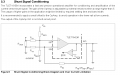
Remember that an ideal voltage source has zero output impedance at all frequencies. VDD is therefore "short circuited" to ground for analysis of this sort.
Operational amplifiers require input bias current. It may flow into or out of the inputs, depending on the internal circuit. When this current flows through a resistor a voltage drop is produced. [edit - added following sentence] The voltage drop is effectively in series with the signal voltage, either adding to it or subtracting from it. By making the feedback resistor equal to the parallel combination of the the bias resistors on the non-inverting input the resistance through which the inverting input bias current can flow is equal to that for the NII. The voltage drops due to bias current therefore cancel each other. Because the signal across the shunt resistor is, I presume, in the range of millivolts, care is required not to introduce unwanted small offset voltage that can translate to a large percentage of error.
How important this sort of balancing is depends on the amplifier. If an amp has very low bias current the error can sometimes be ignored if the resistor values are moderate. Fast bipolar amps typically have relatively high input bias current, so even with low-value resistors uncompensated bias current error can be a problem.
If you have simulation software such as LTSpice, this is a good circuit to experiment with to gain understanding.
Use an ideal op amp if there is one in the library.
Make a circuit consisting of just the op amp, the feedback resistor and the two bias resistors. I suggest using 100k for all resistors. Power your op amp with positive and negative supplies. Connect the resistor that is shown as going to Vdd to 0.2 volts relative to ground. To model the input bias current, but a current source between the non-inverting input and ground and another identical one between the inverting input and ground. I suggest setting the magnitude of the current sources to 1 µA (either polarity, just be sure both are the same) to start with. What we have no is an amplifier with a gain of 1 for the signal at the NII. Put some names on your signals.
Do a simulation run (this is a DC analysis). Look carefully at the voltages. I picked 0.2 volts because it should make it easy to see differences due to the bias current. Look at where currents are flowing.
Now change the feedback resistor to 50k and see what happens.
Play around with the magnitude of current sources and/or the values of the resistors (try 10k for all, 1Meg for all).
You can do all this the hard way with manual calc's, but the sim software makes it easy and you get to spend more time on thinking about the circuit instead of arithmetic.
Real op amps have input bias current offset, just as they have input offset voltage.
There is someone on AAC much better qualified than I to talk at length about this stuff. Ron M, where are you?
thank you ebp. I really appreciate your reply. I will do exactly as you said and try to grasp this concept as better as possible.
ps. do you have any resource to indicate me to read about this topic ?

 Facebook
 Google
 GitHub
 Linkedin