I don't really care, they work for me!
Generally speaking, bamboo has a higher compressive strength than wood, brick or concrete. It also has a slightly lower tensile strength than steel. This is around 10 times the tensile strength of a softwood such as pine.
Max.
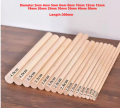
I went to reorder and I just noticed they only go up to 5mm, before it was 6.5mm (1/4") also you could add 9mm which were handy.
There may be other sites now for the larger sizes.
Max.
What about the bamboo flooring that I recently installed? While bamboo is technically a grass, its woody stem certainly has more in common with a tree than the grass on your lawn.
They are mostly at the mercy of the airlines, since most of the stuff is shipped airmail via space-available. Sometimes it sits for weeks waiting for a flight and other times it gets right on one. If they provided a tracking number, you can get a feeling of exactly when you will receive your package. The last couple of packages I received from mainland China got to me in under two weeks (but YMMV).
I once made a lift table that was used when the witch melted in the Wizard of Oz for an elementary school production. It had a hydraulic cylinder which gave a slow descent of the witch. It was held up by a stick until the scene where it was used. Of course, I forgot to remove the stick opening night and the parents got a chuckle as I crab walked across the pit to pull it!
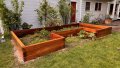
Woodworking doesn't seem to be a hot topic here. Understandable. But I've just completed the most ambitious wood project I've ever done and so thought I should share it here. I'll start with the last picture first: Here is the completed woodworking. I still need to kill the weeds and fill the bed.
The idea was to make a raised bed garden to replace the half-assed one I threw together over 30 years ago. That was just 6x6s or maybe 8x8s laid on the ground in a rectangle and there's not much left of them anymore. I wanted to raise the bed higher and make something to hopefully last even longer. The indentation in the front is to increase easy access to the full surface. It adds complexity and is a less efficient use of wood, but such is the cost of design. Overall the garden is roughly 16' x 8', less the indentation.
I studied a wide number of options and decided I preferred the look of wood over the corrugated metal bins/tubs that are popular now for this application. If you're not in the mood for a big project, stop reading now and go find one of those. One of my daughters has some upper-tier versions of those and loves them. Very slick but not as big as I wanted or the right look.
Further research revealed that Douglas fir is a decent choice with good longevity. And importantly, you can buy it at the big box stores, and the price is not absurd. If I recall, it's quite a bit cheaper than cedar if you can even find it. Every plank was 4"x6" (nominal, 3.5 x 5.5 actual). The long ones in back are 16' long and super awkward to move around. One person can do it but it's sooo much easier to have two people to handle those beasts. All the others were standard 8' lengths.
My original plan was to use naked wood, but exposed wood turns grey and looks weathered very soon. So once I got the boards cleaned and bleached, I decided to seal them with marine epoxy to give them that "wet" look. I'm hoping it dramatically extends the life of the wood.
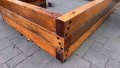
I thought a lot about the corner joinery and decided to not use any method that required cutting the wood. That meant I needed to use metal fasteners and in this case it was Spax lag screws. Using them involved drilling 104 holes for the lag screws to pass through, plus another 104 smaller pilot holes. The Spax screws are advertised as not needing pilot holes and I suppose that might work, but I very much did not want to risk splitting my wood. The Douglas fir is prone to end cracking as it is. Here is a bit of detail on the corner construction. Each of the 8 corners used 9 lag screws oriented horizontally and 4 longer ones to tack the three layers together. The two attaching the middle layer to the bottom are countersunk and not visible in the picture.
There's a ton more I could say about the long and arduous process for anyone that's interested. It's been a long time coming and it sure feels good to be done.
Woodworking doesn't seem to be a hot topic here. Understandable. But I've just completed the most ambitious wood project I've ever done and so thought I should share it here. I'll start with the last picture first: Here is the completed woodworking. I still need to kill the weeds and fill the bed. View attachment 367569
The idea was to make a raised bed garden to replace the half-assed one I threw together over 30 years ago. That was just 6x6s or maybe 8x8s laid on the ground in a rectangle and there's not much left of them anymore. I wanted to raise the bed higher and make something to hopefully last even longer. The indentation in the front is to increase easy access to the full surface. It adds complexity and is a less efficient use of wood, but such is the cost of design. Overall the garden is roughly 16' x 8', less the indentation.
I studied a wide number of options and decided I preferred the look of wood over the corrugated metal bins/tubs that are popular now for this application. If you're not in the mood for a big project, stop reading now and go find one of those. One of my daughters has some upper-tier versions of those and loves them. Very slick but not as big as I wanted or the right look.
Further research revealed that Douglas fir is a decent choice with good longevity. And importantly, you can buy it at the big box stores, and the price is not absurd. If I recall, it's quite a bit cheaper than cedar if you can even find it. Every plank was 4"x6" (nominal, 3.5 x 5.5 actual). The long ones in back are 16' long and super awkward to move around. One person can do it but it's sooo much easier to have two people to handle those beasts. All the others were standard 8' lengths.
My original plan was to use naked wood, but exposed wood turns grey and looks weathered very soon. So once I got the boards cleaned and bleached, I decided to seal them with marine epoxy to give them that "wet" look. I'm hoping it dramatically extends the life of the wood.
I thought a lot about the corner joinery and decided to not use any method that required cutting the wood. That meant I needed to use metal fasteners and in this case it was Spax lag screws. Using them involved drilling 104 holes for the lag screws to pass through, plus another 104 smaller pilot holes. The Spax screws are advertised as not needing pilot holes and I suppose that might work, but I very much did not want to risk splitting my wood. The Douglas fir is prone to end cracking as it is. Here is a bit of detail on the corner construction. Each of the 8 corners used 9 lag screws oriented horizontally and 4 longer ones to tack the three layers together. The two attaching the middle layer to the bottom are countersunk and not visible in the picture. View attachment 367571
There's a ton more I could say about the long and arduous process for anyone that's interested. It's been a long time coming and it sure feels good to be done.
Very impressive! What a nice diversion from electrical engineering and troubleshooting and related. I use that idea too as well as a friend of mine. We did various wood projects just to 'get away from it all' in everyday life.
I did a lot more in the past though, I built an entire 8 foot long entertainment system laminated with dark wood grain Formica. Also a 7 foot long 6 feet high bookshelf (I have a lot of books) out of dark stained 12 inch pine. That was years ago though.
Your mention of wood cracking reminded me of a much more recent fix I did on a small cherry wood table. The legs got really wobbly and that was because of the way the dowels were stuck into the legs and the leg wood started to crack. I had to take all the legs off and reglue. I had to use clamps to clamp the legs side to side so the cracks would fill up with glue and stay together until the glue dried. I used Titebond III which is maybe the best. I wanted to use the real furniture glue which is like a water based resin, but didn't like the price. The whole thing came out pretty sturdy and I still use it today even though the top needs refinishing.
Since I have been repairing wood stuff and creating new things with wood I am a little aware of the cost of these projects these days and I don't like it. I can't imagine what you paid for all that lumber. I bought a 1x2 maple hardwood 4 feet long about a year ago and it was like $12 USD. That's nuts.
Very nice job though. One of my previous neighbors did several of those beds but she used metal walls purchased just for that purpose. I couldn't believe how big they were. They were kind of decorative looking too. Not as nice as real wood though.
Coating the wood before using outdoors works really well. I had to redo a swinging lawn chair (the kind with chains so the seat could swing back and forth) and before I placed the new wood seat on the frame (about 2x4 feet) I spray painted it with Rustoleum paint. Amazingly, it lasted more then 30 years when with bare wood it would have probably been gone in less than 3 years. And that was with a simple spray-painted surface (a few coats). The key point I think is that I only painted the top surface, not the bottom. That allowed the moisture cycle to complete properly after a rain.
With an epoxy coating I can't imagine how long the wood would last. I was thinking 50 years, but the problem with coating the ENTIRE wood surface is the coating actually traps moisture inside the wood which can accelerate the deterioration of the wood inside.
The biggest disadvantage is the bottom layer is in constant contact with the moisture, fungi, chemicals, and insects. Correcting that could allow a much longer life for the wood.
Another disadvantage is that there are wood layers with tight spaces in between each layer that traps moisture.
The epoxy coating itself can lead to problems also because it allows moisture to get in, but it has a hard time getting out (the moisture cycle). When the wood expands the rate is different than for the epoxy, so small cracks form in the coating which allows moisture to wick into the inside. It has a much harder time getting out so the moisture stays in there.
One fix would be to add a bottom layer. It would have to be staggered rather than a continuous layer like a plastic sheet. For example, crushed stone, maybe a 1 inch layer. There are also special woods made for ground contact. The stone and the special wood layer could add many years to the construction. There's also some kind of fabric (called landscape fabric) that can be used to prevent dirt from working its way up into the stone layer. This is not used on the inside bottom of the bed however, just under the wood.
Another fix for the bottom might be patio stones on the bottom, with a top layer of crushed stone with the bottom wood layer on top of that. Anything to get the wood off the ground and allow airflow underneath.
It could also be used on the vertical inside of the bed so it prevents direct contact of the wood sides with the soil inside.
Another fix would be to add spacers between the wood layers, like 1/8 inch or something. That prevents them from actually touching each other and trapping moisture.
The whole key to getting longevity is the moisture cycle. If moisture can get in during the wet cycle, it has to be able to get out during the drying cycle. If that can be accomplished, the wood should last for years and years.
Maybe keep us updated on the future of this interesting and beautiful construction.
As Per post #100 . I tend to use hardwood dowel pins for securing some jobs, especially outside where metal tends to rust.
This was used for marine vessels for centuries .
As Per post #100 . I tend to use hardwood dowel pins for securing some jobs, especially outside where metal tends to rust.
This was used for marine vessels for centuries .
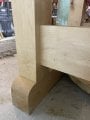
Dowels and glue are still one of the best techniques for hidden joinery. My workbench is held together by them, giving a nice, clean appearance. The uprights and base are 3 1/2 x 3 1/2 solid maple glue-ups. The dowels are, of course invisible because they are inside!
I went ahead and looked it up: $913.22 delivered by Menard's in 2024. Three at 16' and 15 at 8'. Labeled "4 x 6 #1 & Better S4S Douglas Fir Timber". The quality as delivered was quite good. I was fearing warped pieces but that was not really a problem. I had about three extra feet to work with and used that to strategically cut out cracks.
As long as I'm looking up numbers, here's the epoxy I used. https://www.amazon.com/dp/B01K7WP1NG
It wasn't cheap, nearly $200 and, being a noob at first in my application skills, I had to buy a second one. Most of it is leftover! But it may easily double the life of the wood and keep it looking nicer throughout its life.
The biggest disadvantage is the bottom layer is in constant contact with the moisture, fungi, chemicals, and insects. Correcting that could allow a much longer life for the wood.
Some of the prep I did was to lay a one foot wide, roughly two inch thick path of river rocks covered with another inch or so of leveling sand. At least for a while there is no direct contact with the soil below. That should help a little.
I've already started to see that. My epoxy project was finished last fall and so the sealed wood already has a full winter of weathering. The imperfections make me crazy but I have to keep telling myself "it's just a garden" and keep moving. Maybe someday this fall I'll touch up what I can.
Being a garden, my options were limited. I made sure the epoxy was food safe, and the only compromise I made was all the screw holes. I applied this stuff to all of them. https://www.rustoleum.com/product-catalog/consumer-brands/wolman/woodlife-coppercoat
I had a bunch leftover from other projects and I've been VERY impressed with it. Nothing I've applied it to has shown up rotten later. To apply it inside the drill holes, I used a swab you'd use for cleaning a 38 caliber gun barrel. Perfect!
There's also some kind of fabric (called landscape fabric) that can be used to prevent dirt from working its way up into the stone layer. This is not used on the inside bottom of the bed however, just under the wood.
The only fabric I'm going to use is around the inside perimeter. I've put sand there and plan to cover the sand with fabric before layering in the dirt. The idea is to keep the dirt from ever flowing out the bottom.
I was planning to do that all along but recently ruled it out mostly because I'm so desperate to get this all done. Hmmm... It might just about as easy to use the same length of fabric to cover the wall and the sand along the bottom of the wall. Just need a way to fasten it. Maybe stainless steel screws.
Nice indeed. I've used pocket holes for a number of projects - they're great in the right applications - but have often considered adding a doweling jig to my repertoire.

 Facebook
 Google
 GitHub
 Linkedin