Any woodworkers here?

SLK001

Joined Nov 29, 2011
1,549
I don’t, but I want one and I’ve spent quite a bit of time to measure and design one. Trouble is I can’t find the right thickness of stock and have no way to cut it if I did. I could use an old blade for the stock but again, I don’t have anything to cut it. I’ve used a water jet cutter to do similar things for me but it’s not cheap.
Another thing to consider, is can you actually MOUNT a riving knife behind your blade? I have a cabinet saw that I obtained prior to the nanny state's requirement for a riving knife. Since they do serve a purpose, I've been trying to retrofit one to my saw, but, alas, it just wasn't built for one.
 

Thread Starter

wayneh

Joined Sep 9, 2010
18,110
Another thing to consider, is can you actually MOUNT a riving knife behind your blade? I have a cabinet saw that I obtained prior to the nanny state's requirement for a riving knife. Since they do serve a purpose, I've been trying to retrofit one to my saw, but, alas, it just wasn't built for one.
Not easily, no, but I think it can be done, at least for straight cuts.
 

jpanhalt

Joined Jan 18, 2008
11,087
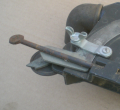
If your table has an insert like Delta Unisaw and so many others have, e.g., https://www.zoro.com/bosch-zero-clearance-plate-for-gts1031-ts1012/i/G0779199/ , you may be able to connect to the back of it. In case you haven't seen how it is attached to the back of a radial arm saw, here's how Craftsman did it (photo:ebay). (I got my Craftsman 10" radial arm saw in the Winter of 1974/75 during a typical "sale." I am surprised at what junk parts are selling for on eBay.)


upload_2019-4-5_3-36-5.png
 

Thread Starter

wayneh

Joined Sep 9, 2010
18,110
If your table has an insert like Delta Unisaw and so many others have, e.g., https://www.zoro.com/bosch-zero-clearance-plate-for-gts1031-ts1012/i/G0779199/ , you may be able to connect to the back of it. In case you haven't seen how it is attached to the back of a radial arm saw, here's how Craftsman did it (photo:ebay). (I got my Craftsman 10" radial arm saw in the Winter of 1974/75 during a typical "sale." I am surprised at what junk parts are selling for on eBay.)


View attachment 174186
I wish. My saw has an odd design. The rear of the blade is 2" in front of the back of the table. The insert reaches to the back edge. I haven't built myself an outfeed table yet and it's a challenge to handle the wood dropping off the back. I think it was built this way because it is better overall IF you add the outfeed table but it's goofy without one.

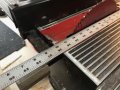
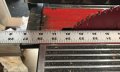
One design that might be relatively easy to implement is to add a splitter to a zero-clearance insert. This will only work for straight up cuts of thin (3/4" to 1") but that's probably 95% of my cuts.

IMG_1067.jpg IMG_1066.jpg
 
Last edited:

Thread Starter

wayneh

Joined Sep 9, 2010
18,110
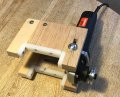
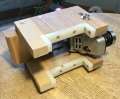
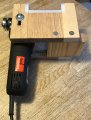
Here’s my latest project: A jig for making a straight cut in concrete landscaping blocks with an angle grinder. I need to lay a board into a rock face and anchor it for attaching a railing. I’ve got a diamond blade for the grinder, a $10 beauty from Harbor Freight. And yeah, I got yet another multimeter free with a coupon.

The jig is designed to slide along a 2x4. I’m hoping it’ll help make a nice straight line and increase safety.

upload_2019-4-15_20-3-47.jpeg

upload_2019-4-15_20-4-19.jpeg

upload_2019-4-15_20-1-22.jpeg
 
Last edited:

jpanhalt

Joined Jan 18, 2008
11,087
If you need to cut a longer distance (like across a driveway) one way is to snap a chalk line, then spray with a cheap, clear lacquer. That will keep the water coolant from destroying your line. And of course, your first cut should not be very deep as that is your guide cut. You may want to use a little water with your HF saw too.
 

killivolt

Joined Jan 10, 2010
836
Here’s my latest project: A jig for making a straight cut in concrete landscaping blocks with an angle grinder. I need to lay a board into a rock face and anchor it for attaching a railing. I’ve got a diamond blade for the grinder, a $10 beauty from Harbor Freight. And yeah, I got yet another multimeter free with a coupon.

The jig is designed to slide along a 2x4. I’m hoping it’ll help make a nice straight line and increase safety.

View attachment 175042

View attachment 175043

View attachment 175041
But why the cut is my question? Just curious?

kv
 

shortbus

Joined Sep 30, 2009
10,050
A jig for making a straight cut in concrete landscaping blocks with an angle grinder.
Instead of an angle grinder (from Harbor Freight) I bought their set of 3 diamond saw blades and used an old circular saw. The saw has more power and already has a base plate that can be used against a piece of wood or in my case a 1/4" x 2" cold roll metal bar. After using the 4" blades in the 3 piece set, I went and bought the 7" one, no water needed for cutting https://www.harborfreight.com/7-in-segmented-dry-cut-diamond-blade-for-masonry-68883.html
 

Thread Starter

wayneh

Joined Sep 9, 2010
18,110
You may want to use a little water with your HF saw too.
I will if I have a helper to dribble the water on the cut as I go. The grinder is not suitable for being near water, so this would have to be done with care. I'm planning to direct the dust downward in the direction of the cut, so a dribble of water would hopefully not be thrown back at the tool.
 

Thread Starter

wayneh

Joined Sep 9, 2010
18,110
But why the cut is my question? Just curious?
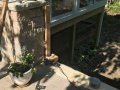
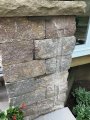
I'm installing a railing (about 8') between two pillars sitting atop a retaining wall made of concrete landscape blocks. The hardware for installing the railing is not suitable for direct anchoring to concrete, so I'm adding a small strip of cedar to each pillar. These will be anchored with normal concrete anchors and the railing will attach easily to the wood.

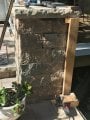
The concrete landscape blocks are not flat – they're highly textured to resemble hewn stone. I plan to cut a vertical slot about 2" wide into each pillar and create a more-or-less flat bottom where the cedar strip can rest. To do that I need to knock down the high spots. I'll use the angle grinder to make the two nice vertical cuts on either side of the slot and maybe one or two in the middle. Then I'll remove the bulk of the concrete by hand with a hammer and chisel.
 

Thread Starter

wayneh

Joined Sep 9, 2010
18,110
Instead of an angle grinder (from Harbor Freight) I bought their set of 3 diamond saw blades and used an old circular saw. The saw has more power and already has a base plate that can be used against a piece of wood or in my case a 1/4" x 2" cold roll metal bar. After using the 4" blades in the 3 piece set, I went and bought the 7" one, no water needed for cutting https://www.harborfreight.com/7-in-segmented-dry-cut-diamond-blade-for-masonry-68883.html
I have a circular saw, so I considered using that for quite a while. One problem I recognized was that it would be hard to cut the vertical slot down to the floor. That'll still be an issue with a 4-1/2" grinder also but it certainly will get closer. My circular saw is also a lot heavier than the angle grinder, even with the jig attached. I'm less confident I could keep it straight long enough to get the job done. (That's what she said. :p Badoomp.)
 

jpanhalt

Joined Jan 18, 2008
11,087
I will if I have a helper to dribble the water on the cut as I go. The grinder is not suitable for being near water, so this would have to be done with care. I'm planning to direct the dust downward in the direction of the cut, so a dribble of water would hopefully not be thrown back at the tool.
I routinely cut glass and glass-like things (e.g., ferrite) by cutting through a wet sponge using an abrasive disk in my Dremel. Position the sponge on the down going edge of the cutter, which also reduces the amount of up-going spray. Of course, that method is for cutting inches, not feet.

Bricks are far less prone to cracking with a dry abrasive than ferrite or glass is, but the same principle should work. In this case, it is to preserve the blade rather than prevent cracking of the item being cut, and good wetting is probably less critical.
 

cmartinez

Joined Jan 17, 2007
8,768
I routinely cut glass and glass-like things (e.g., ferrite) by cutting through a wet sponge using an abrasive disk in my Dremel. Position the sponge on the down going edge of the cutter, which also reduces the amount of up-going spray. Of course, that method is for cutting inches, not feet.

Bricks are far less prone to cracking with a dry abrasive than ferrite or glass is, but the same principle should work. In this case, it is to preserve the blade rather than prevent cracking of the item being cut, and good wetting is probably less critical.
What kind of sponge do you use? Doesn't it get tangled on the disk while you're doing the cut?
 

jpanhalt

Joined Jan 18, 2008
11,087
Unfortunately, I just buy what feels "right" and don't have any packaging to show me the brand. My sponge looks like this (pic is about 1"x 1/2"):
upload_2019-4-16_11-26-42.png

They are synthetic but don't have the plastic, uniform hole texture of some others. They wet very well, and when dry and compressed , they will hold that shape. They are not "springy." It is the only type of sponge I use for soldering, washing floors, etc. There is an "Ocelo" brand by 3M that looks similar and would probably work, but the Ocelo brand is usually not that color. They do not noticeably melt when used dry with a soldering iron, but you will see charing.

I have never had problems with them gumming up the abrasive disk. As for the disk, I use the thin, carborundum type without fiber reinforcement. A wider kerf probably contributes to more cracking of fragile substrates.

If I were closer to a big box store, I could probably give you an actual brand, but I am not. I will be going into Cleveland tomorrow and will look then.

EDIT: I feel silly that I didn't connect the 3M brand name with its composition and properties. Getting too old. After a little shopping, the sponge I use is 100% cellulose composition. I suspect any sponge of that composition will work. Sherwin-Williams carries a 100% cellulose sponge that is even the same color. :)
 
Last edited:

Thread Starter

wayneh

Joined Sep 9, 2010
18,110
In between thunderstorms I was able to get started. Here you can see my cutting jig in position. It's working nicely and the blade is making short work of it. The hard part is the setup, getting the 2x4 held steady in a perfectly vertical position.

IMG_1326.jpg
IMG_1327.jpg
 

Thread Starter

wayneh

Joined Sep 9, 2010
18,110
@wayneh
You can't hide "Talent":
I'm Amazed
Well thanks but talent would be doing it by hand without stressing over it. If I did this 20 times I might get there. I'm only doing it maybe 6 times (3 vertical cuts on each side). I'll be stressing the whole way.
 
Last edited:

MrAl

Joined Jun 17, 2014
13,709
BTW, here's a photo of a recent project, a nightstand. By far the nicest piece I've done so far.

View attachment 96332
Hi,

Thanks nice, I actually used to build all my own furniture too. I built a real nice entertainment center once with beautiful walnut woodgrain formica finish.
Also a huge bookcase for all my books. Stained 1x12 pine boards.
 
Top