As others have said, buying used parts of questionable functionality is a nonstarter for most; particularly SMT. Things that are "like new" would be an exception.
They'll likely have more value to you if you can use them. Otherwise, not a good investment of your resources.
Unless you have a means of testing a capacitor to determine its value - they're not worth the time. Even then, they're not much more useful than "in a pinch" situations. I have a drawer full of boards that were pulled from various things. I rarely pull a through hole component off one of them. With SMT you are just about shot down trying to determine the value of transistors (small ones). Large ones - perhaps you have a chance of determining what one is - but by the time you get it off, it's just far more efficient and reliable to buy new. The old one might work. But being exposed to heat to desolder it - puts stress on the component.
Like I said, I have some stuff in a drawer for those moments when I need something "in a pinch". Otherwise, I don't know why I bother to even keep them.
If you had a yard sale and had those boards laying around for sale I'd give you a nickel and nothing more. At best, those coils are worth a little; very little, but have some value. Maybe a penny or two. The aluminum heat sinks? Yeah, they have scrap value OR use as heat sinks in a project.
The plugs? They MIGHT come in useful, but I already have so many of those things laying around - I just don't need another. And the ones I have - they lay dormant (un used).
There MIGHT be some value in scrap metals if you have the means to remove any gold plating (should there be any), but unless you are doing it "Large Scale", chances of turning a profit are at best a fleeting hope. You'd be better off panning for gold.
I used to take stuff apart to see how it worked, and scavenge the "useful" stuff. That started at a young age, so over the years I've accumulated quite a pile of junk.
Now that I've built several projects, I've come to realize how useless most of that junk is, and how cheap many of those parts are. When I design a circuit, I design for function, not to use up existing parts. So I find myself ordering mostly new parts anyway. My pile of junk sits idle.
Building something is a lot of work, so it makes no sense to risk a failure by using questionable parts. I just ordered a bunch of resistors and I think they were 8¢ each in small quantities. Small capacitors and diodes are similar. Even most IC's are under $1. Why make smoke and burn my fingers to just to pull stuff like that off a PCB? It's not worth it. (I still do some, because I can't help myself!)
There are a few exceptions. Pots, relays, larger ICs, and anything mechanical are not as cheap as those other components. If I can grab one easily, I do. I've noticed in my project builds that a single $3 pot may cost as much as everything else put together. I'm also a sucker for big power MOSFETs if I see them, or voltage regulators. I might be reluctant to build a large project using some of these used parts, but they can be handy for small, quick and dirty stuff.
I mostly scavenge heat sinks, high value caps,high power resistors,high power transistors, pots, transformers,coils and speakers. Generally I never use those parts except heat sinks..
Some of the larger SMD parts can add rigidity to dead bug construction.
The bigger SMD ceramic chip capacitors can have impressive values, I've found as big as 47uF once or twice. You can add them on the solder side to improve ESR performance of SMPSU secondary side electrolytics.
On scrap boards with dense SMD population; I sometimes heat-gun the smooth side and rap the edge of the PCB on the bench when the parts start to loosen. Usually I sweep the shakings in a tobacco tin, when it starts to get full, I discard the less useful larger items - that tin is a last resort component source, but those parts aren't wasted (yet).
Most of the ICs on boards like that are specific to what the board does - but look carefully before aiming them at the trash can, you might find the occasional flash MPU.
My strategy is to keep a pile of scrap boards to search for components - usually; if I take one part off a board, I finish "cleaning" is so the bare board can be discarded.
The last example was a VCR board - my DVD player needed the 400V reservoir electrolytic, so I took that and also harvested anything else worth having.
Some of the larger SMD parts can add rigidity to dead bug construction.
The bigger SMD ceramic chip capacitors can have impressive values, I've found as big as 47uF once or twice. You can add them on the solder side to improve ESR performance of SMPSU secondary side electrolytics.
On scrap boards with dense SMD population; I sometimes heat-gun the smooth side and rap the edge of the PCB on the bench when the parts start to loosen. Usually I sweep the shakings in a tobacco tin, when it starts to get full, I discard the less useful larger items - that tin is a last resort component source, but those parts aren't wasted (yet).
Most of the ICs on boards like that are specific to what the board does - but look carefully before aiming them at the trash can, you might find the occasional flash MPU.
47µf SMT is pretty impressive. You're comparing it to THT (Through Hole Technology).
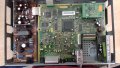
Regarding the photo - I'd keep the whole power supply section in tact. That is - IF - I don't already have several laying around. In fact, I have a couple power supplies now just gathering dust.
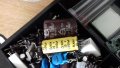
Your parts collection is fairly nice. The larger capacitors can be used in power amplifiers to drive smaller speakers with some potentially impressive sound. But if you're not pursuing amplifiers - those large caps can serve well enough as power filters. However, keep in mind that an oversized capacitor can actually drag down the performance of a power supply. The bigger the cap the longer it takes to charge it up. So start up voltage might not be so square an edge.
Other things on your board - IF you're pursuing RF - would be the RF modules. I think I have one or two laying around but I'm not chasing any RF projects now, nor do I think I might in the near (or even distant) future.
Keep what you have a use for. If your goal is to sell this stuff - play the lottery. Potentially the lottery might pay off in some small way. Selling scrap PCB components won't likely pay off anything worth the effort unless you come across a rare and truly valuable component. Don't ask me what that might be though. Perhaps a rare and valuable TV Tube or amplifier tube.
I have a stash of transformers from scrapped items. Bridge rectifiers can be useful. Those large caps are worth saving. But would I buy any of them from you? Probably not. At best, they're worth saving if YOU have a use for them.
It's been my experience that whenever I say "I haven't needed that stuff for 10 years, so in the trash it goes..." six months or so later, I need EXACTLY what was trashed.

 Facebook
 Google
 GitHub
 Linkedin