Analog DC Reverse Loop Controller for Model Railway — Design Request

MisterBill2

Joined Jan 23, 2018
27,557
Consider that a lot of other folks in the model train hobby have solved the problem, there must be somewhat simple schemes can work. The scheme that I described inadequately would work, but i doubt that it is being used very much. It is probably not the simplest.
 

crutschow

Joined Mar 14, 2008
38,525
Here's a critical question after thinking about a solution to your problem.
Is the main track polarity always the same when the train enters the loop?
If so, then only the main track polarity would have to be reversed when leaving the loop.
 
Last edited:

Thread Starter

oslosl

Joined Jan 13, 2023
270
Hi all,
I agree with you that intuitively you would think that there should be a simple scheme that would work, but both with DCC (with a polarity rectifier in the locomotive) and without you have to solve the short curcuit problem from the wheel at every isolation point).

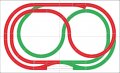
My track includes two reverse loops, meeting at the turnout section in front, but to keep it simple you could just consider one simple reverse loop from a single turnout. It must include minimum 2 isolation points to make two sections. Every time you cross an isolation point you must ensure that the polarity in the two sections is the same, and you can not change the polarity in a section when the train is in that section.

It seems like a simple logic problem, but then the solution complexity suddenly explodes when you want to make it automatic and seamless. This seems to be the reason why most commercial solutions are actually manual, where you have to stop the train and press a button to reverse the polarity.
 

Attachments

Last edited:

AnalogKid

Joined Aug 1, 2013
12,142
1. It looks like a portion of the green track is directly below a red tract. Any way to spread out the drawing so every inch of every track is visible?

2. In the upper right quad there is a Y track that is missing one connection. What is that?

3. Can you add a black stripe across the track where the short circuits happen?

ak
 

crutschow

Joined Mar 14, 2008
38,525
I do not see an answer to my post#22 question.
Is the polarity of the track always the same for the main track when the train enters a loop?
 

Thread Starter

oslosl

Joined Jan 13, 2023
270
1. It looks like a portion of the green track is directly below a red tract. Any way to spread out the drawing so every inch of every track is visible?

2. In the upper right quad there is a Y track that is missing one connection. What is that?

3. Can you add a black stripe across the track where the short circuits happen?

ak
1. I can do this (but it provides no new info)
2. Just an optional train parking track
3. Already marked with X's
 

Thread Starter

oslosl

Joined Jan 13, 2023
270
I understand that.
So the train can move forward into the loop with either polarity of the main track?
That I don't understand.
Not quite sure I understand, but the train can run in the loop independent of the polarity in the main track, untill it exits the loop where the main track must switch to the same polarity of the loop.
 
Last edited:

crutschow

Joined Mar 14, 2008
38,525
Not quite sure I understand, but the train can run in the loop independent of the polarity in the main track, untill it exits the loop where the main track must switch to the same polarity of the loop.
My question is: does the polarity of the track determine the train direction?
I think that's true, but want to make sure I understand.
 

KeithWalker

Joined Jul 10, 2017
3,607
The track polarity determines the direction of the train. The usual convention is that if the rail on the right side of the locomotive is positive, it will move forward. The polarity can be used to indicate the direction the train is travelling. Detecting that the train is approaching the turnout block can be done using photo detectors. The polarity of the track blocks can be set using relays or double bridge switches.
Using that information, a truth table must be drawn up, showing all possible states. Then it is an applied logic problem. With a double continuous loop and double crossovers, it will be a complicated problem to solve.
I avoid that problem by using double rail lines - one dedicated for each direction. The reversal loops change which rail line the train will travel on. The only switching I need is for the turnouts. I can run two trains at the same time, at different speeds, using two analog controllers.
 
Last edited:

eetech00

Joined Jun 8, 2013
4,705
Analog DC Reverse Loop Controller for Model Railway — Design Request

Background:
I am building a Z-scale analog DC model railway layout with 2 reverse loops. I need a controller circuit that automatically handles track polarity switching without DCC. The solution must work purely on analog DC track power.
Clarify "purely analog DC track power".
Do you mean there is "steady energy DC" voltage on the track rails?
And is this voltage to be used for occupancy detection if necessary?
-Or-
Is DCC actually on the rails and is used to control train speed and direction?
So the solution needs to be isolated from the rails.

The Problem:
A reverse loop on a 2-rail DC layout creates a polarity conflict at the isolation gap. The controller must resolve this by switching polarity in the correct section — either the reverse loop section or the main section — depending on whether the train is entering or exiting the loop.
This strongly suggests the solution needs to detect train direction.
 

eetech00

Joined Jun 8, 2013
4,705
Analog DC Reverse Loop Controller for Model Railway — Design Request

Critical Design Constraints:
Short circuit detector must trip faster than power supply protection
After trigger, lockout must be long enough for all locomotive axles to clear the isolation gap at minimum running speed
Flip-flop state must be preserved during brief power fluctuations caused by the short circuit event itself.
What is the "minimum speed"?
What is the distance (length) of the "Isolation gap"?
This info can be used to calculate the max time it will take for all locomotive axles to clear "the isolation gap".
 

Thread Starter

oslosl

Joined Jan 13, 2023
270
After analyzing the hardware requirements for a truly "seamless" analog reverse loop again and again, including considering incorporating bridge sensors, polarity flip-flops and more, I’ve decided to move the project to DCC and close this thread.

Sometimes the best hardware solution is a change in protocol. Thanks for the input during the analog phase.
 

MisterBill2

Joined Jan 23, 2018
27,557
I explained the sequence to achieve the goal back in post #8!! I did not give the details, only told what must be done. No need to see the track layout, really. AND, You are certainly welcome to ignore my suggestion. The difficult portion will be the scheme to determine which polarity the engine requires to move forward. That will require sensing the poarity of the voltage generated while the engine is coasting immediately after crossing the reversal point. So the circuit must respond within a couple of seconds. So it will take hardware logic, software will not be fast enough.
 

KeithWalker

Joined Jul 10, 2017
3,607
That would seem to be the best, considering the complexity of any analog approach.
If you plan on using DCC to control the speed and direction of the locomotives, in your layout, you will still have polarity reversal of the basic power between blocks. The insulators between blocks must be a little longer than the locomotive wheelbase to avoid short circuits that will damage the delicate power pick-ups on the wheels.
I hope you can find suitable DCC components that will fit inside a tiny Z-scale locomotive. Z-scale track has a 6.5mm gauge and a typical large locomotive is a little over 4cm long.
 

MisterBill2

Joined Jan 23, 2018
27,557
I had not hought about how tiny those trains are. Fortunately nothing inside the train needs to be changed. But it probably means that the coasting engine will not produce much voltage. So polarity sensing may be a challenge. The alternative scheme is more complicated.
 
Top