Amplifier design for an inductive load

Thread Starter

Farai01

Joined Aug 23, 2023
5
Good day team,

I need to design an AC amplifier for an inductive load (coil). Here are the specifications:
  1. Frequency: 35-55KHz
  2. Current 1,5A
  3. Inductance of coil: 100mH

I have done some research, I need to factor in the impedance of the inductor at this frequency. Xl = 2*pi*F*L. Even knowing this value, how best can I design a circuit that pumps 1,5A through this coil at this frequency?
 

LowQCab

Joined Nov 6, 2012
5,101
Providing a Circuit-Schematic will get You much more useful answers.
It depends a lot on why and how the Coil is being used.
What is the purpose of the Coil ?
Why does the Frequency change ?
What is the Power-Supply-Voltage ?
What is the DC-Resistance of the Coil ?
Does the Inductance of the Coil change because of other "moving-parts" near it ?

Why do You want an "Amplifier" and not a "Driver" ?
What is the "Wave-Form" that You intend to use, and why.
.
.
.
 

ronsimpson

Joined Oct 7, 2019
4,664
100mH at 55khz? Have you looked to see how much voltage you need to apply to get 1.5A at 55khz? I think you cannot do this.

35hz to 55khz or 35khz to 55khz?

What wave form? Square, triangle??
 

Thread Starter

Farai01

Joined Aug 23, 2023
5
Providing a Circuit-Schematic will get You much more useful answers.
It depends a lot on why and how the Coil is being used.
What is the purpose of the Coil ?
Why does the Frequency change ?
What is the Power-Supply-Voltage ?
What is the DC-Resistance of the Coil ?
Does the Inductance of the Coil change because of other "moving-parts" near it ?

Why do You want an "Amplifier" and not a "Driver" ?
What is the "Wave-Form" that You intend to use, and why.
.
.
.
Thank you for your response, here is some additional information.
What is the purpose of the Coil? I am an educator at undergraduate level, so I want to set up a practical that demonstrates to my students the principles of electromagnetic induction using two coils (transmit coil and receive coil). The AC passing through the transmitter coil creates an electromagnetic field. When this electromagnetic field encounters a conductive metal object, it induces eddy currents in the object. These eddy currents, in turn, generate their own magnetic field, which is picked by the receiving coil.
Why does the Frequency change? To determine the response of different targets at different frequencies (one of the main objectives of the practical).
What is the Power-Supply-Voltage ? 12 VDC
What is the DC-Resistance of the Coil ? 1.2 Ohms
Why do You want an "Amplifier" and not a "Driver" ? To amplify an AC signal from the synthesizer.
What is the "Wave-Form" that You intend to use, and why? I will be using an AC signal so as to produce an alternating magnetic field.
 

Thread Starter

Farai01

Joined Aug 23, 2023
5
100mH at 55khz? Have you looked to see how much voltage you need to apply to get 1.5A at 55khz? I think you cannot do this.

35hz to 55khz or 35khz to 55khz?

What wave form? Square, triangle??
35KHz - 55KHz Sine wave.

That's the help I am looking for, to do the necessary calculations, and see where I can compromise to build something that works.
 

LowQCab

Joined Nov 6, 2012
5,101
"" When this electromagnetic field encounters a conductive metal object,
it induces eddy currents in the object.
These eddy currents, in turn, generate their own magnetic field,

which is picked by the receiving coil. ""

This is not really correct,
yes, Eddy-Currents will be developed, but they are largely an unavoidable "loss".

The "Ferrous-Metal-Object" concentrates the Magnetic-Field into a
more useful, and concentrated shape.

The Eddy-Currents that are generated are to be completely avoided, if at all practical,
that's why Transformers have a "Laminated-Magnetic-Core", instead of a Solid-Iron-Core.

Ferrite-Cores achieve this Eddy-Current reduction by
suspending Magnetic-Particles in a Non-Conductive-Binder, ( some sort of special Epoxy Glue ).
This makes the Ferrite material into a very poor Conductor, reducing the Eddy-Currents significantly.
.
.
.
 

BobTPH

Joined Jun 5, 2013
11,488
Everyone is hinting at the fact that 1.5A into 100mH is, to say the least, difficult.

So I did the calculation.

The impedance of a 100mH coil at 55KHz is 34540Ω.

So the voltage at 1.5A is 51810V.
 

LowQCab

Joined Nov 6, 2012
5,101
~5Khz would be a much more practical Frequency-range,
and with an Amplifier after the "Receiving-Coil",
this Frequency-range could even power a Loudspeaker that everyone could easily hear.
.
.
.
 

BobTPH

Joined Jun 5, 2013
11,488
You can get that kind of current in a 100mH inductor, you just need to make it series resonant circuit so the capacitive and inductive reactances cancel out.
 

ronsimpson

Joined Oct 7, 2019
4,664
The impedance of a 100mH coil at 55KHz is 34540Ω.
I thought this was 20x more than a hard project. I have used 2000V transistors and have gone to 7kv using tubes.
I think you are 1000x from something that can be built. I am not certain you can get this much power from a wall outlet.

Have you thought about reducing the voltage to 1/100 and increasing the current to 100X. (that means a different coil) I have transistors that will run at 1200 volts and 500 amps. (or 600V) A LC resonant circuit like the output of a broad cast transmitter will work with low power loss.
 

WBahn

Joined Mar 31, 2012
32,776
You can get that kind of current in a 100mH inductor, you just need to make it series resonant circuit so the capacitive and inductive reactances cancel out.
Though the inductor (and the capacitor) are still going to have 51 kV peak voltages across it at 55 kHz. Good luck keeping that out of the receiving system, not to mention the safety considerations involved.

That's what, something like an 84 pF capacitor rated at somewhere around 100 kV and that can handle 1.5 A? Do they make such a thing?

And then there's the need to change the series capacitance to match the frequency as it's varied.

How careful is the whole thing going to have to be designed to keep parasitics from totally dominating things?

How likely are they to stay within limits that don't require the blessings of their equivalent of the FCC?

I think it's time for the TS to get someone experienced and qualified involved if they intend on pursuing this.
 

LowQCab

Joined Nov 6, 2012
5,101
Wire for Coils, Get 2
This is 2-100ft Spools, of 22-Gauge, Stranded-Wire, ~$4.oo each.
Hopefully, the beginning end of the Wire will be accessible through the hole in the center of the plastic-Spool,
if not, you'll have to take it outside and tie the Wire to a Bush, or a Fence-Post, and unwind it.
When You get to the end, pull ~2-feet of additional Wire out from the center-hole in the Spool,
and then re-wind all of the Wire back on to the plastic-Spool.
A Battery-Drill will make the re-winding procedure much faster.
Use a 4-inch long piece of 1/4" "All-Thread", along with 2-"Fender-Washers", and 2-1/4" nuts so that
You have a convenient shaft to put in the Battery-Drill.

Now You have 2-crude "Inductors".

100-Feet of 22-Gauge-Wire has roughly ~1.6-Ohms of DC-Resistance.
The Inductance can be roughly calculated, or measured,
but the exact Inductance value is not particularly important for this project.

Next, You need a Square-Wave-Oscillator with somewhat serious Current capabilities.
This is a particularly easy Circuit to make with only 4-Components.
The main component is a "FET-Driver" Chip, it comes in a TO-220-5 Package,
the DigiKey p/n is IXDI630MCI-ND ~$10.oo each.
It is capable of a continuous ~8-Amps of Current when attached to a good Heat-Sink,
but it will be used at substantially less than 8-Amps.
A ~3" x ~4" X ~2" Aluminum-Project-Box will serve as an adequate, and cheap, Heat-Sink.
The FET-Driver's Output-Current will be limited by a ~10-Ohm, ~20-Watt, Power-Resistor.
DigiKey Power-Resistor ~$4.oo each.
The Power-Resistor comes in a TO-220-2 Transistor-Package,
and should also be mounted to the Heat-Sink-Box.

The other 2 remaining parts make up the R/C Timing part of the Oscillator.
This consists of a Capacitor, and a Resistor,
The Resistor may be replaced with a Potentiometer if Frequency adjustability is needed,
or, the Size of the Capacitor may be altered to the same effect.

Since your Power-Supply is ~12-Volts, 2 additional Components will be necessary,
an additional Resistor, and a 5-Volt Zener-Diode.
These extra components, and including the 20-Watt-Power-Resistor,
would not be necessary if You have access to a High-Current 5-Volt Power-Supply capable of ~5-Amps.
( A used Computer-Power-Supply would be perfect for making this into a 5-Volt application )
( Most "Bench-Power-Supplies" will also be able to provide 5-Volts @ 5-Amps )

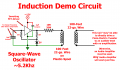
Here is the Schematic for the ~5Khz Square-Wave-Oscillator ..............
.
FET Gate Driver Oscillator .PNG
.
The receiving-Coil "may" have enough Output,
( when close to, or well coupled to, the Driving-Coil ),
to drive a Piezo-Electric-Tweeter at a reasonably audible level.
Piezo-Electric-Tweeter
If the Output is too low to directly drive the Tweeter adequately,
then use any Audio-Amplifier and Speaker available.
A "Microphone-Pre-Amplifier", or "Mic-Mixer",
driving an Audio-Amplifier and Speaker, is guaranteed to make some serious noise.

.............. DO NOT OPERATE WITHOUT A HEAT-SINK ............
.
.
.
 

Attachments

Last edited:

BobTPH

Joined Jun 5, 2013
11,488
Though the inductor (and the capacitor) are still going to have 51 kV peak voltages across it at 55 kHz. Good luck keeping that out of the receiving system, not to mention the safety considerations involved.

That's what, something like an 84 pF capacitor rated at somewhere around 100 kV and that can handle 1.5 A? Do they make such a thing?

And then there's the need to change the series capacitance to match the frequency as it's varied.

How careful is the whole thing going to have to be designed to keep parasitics from totally dominating things?

How likely are they to stay within limits that don't require the blessings of their equivalent of the FCC?

I think it's time for the TS to get someone experienced and qualified involved if they intend on pursuing this.
I wasn’t suggesting it as a practical solution! I was merely trying to clear up the theory.

That said, this is actually how wireless charging works, but at much lower frequencies.
 
Top