Amplifier configurations (setup)

WBahn

Joined Mar 31, 2012
32,836
Hi,

there is no practical use for now. Its for a halloween thing if you must know.
I dont know what that has to do with helping to build an amplifier . So many people here ask question In what occasion is it used for, when why how.... It has nothing to do with electronics
regards
In addition to what DickCappels said, a big reason why the details are asked for is because the specifications given by the person asking for help are so frequently simply inadequate to provide good advice. More often than not that's because the person asking the question really has no idea what things need to be specified or what factors are important. That's fine -- most customers engaging an engineer to design something for them are in a similar situation. Heck, if they knew what the issues were, there's a good chance they wouldn't need the engineer in the first place. By asking for details about what the underlying problem is that the circuit is trying to address, we can help discover what issues are important, what things might be non-issues, and what things haven't been considered that need to be.

For instance, because of the questions that have already been asked, I see some of the following concerns:

You have a 35 VAC power source, which means that it has about 49.5 V peak voltage. So how do you plan to deliver a 50 V sinusoid to a load? Is that 50 V the amplitude of the sine wave, or the RMS value? Or what?

You want to be able to drive a 40 mH coil at DC. What's going to limit the current? What will that max current be?

What do you expect to happen when you are driving this 40 mH coil at 10 Hz with a 1 V input signal? That's going to be around 500 VA, but your said your transformer is only rated at 200 VA.

At the end of the day, the electronics are almost always solving a problem that has little or nothing to do with electronics. It's the problem that is being solved that drives what the electronics really need to do, and it's only by exploring what is and is not important about the problem solution that we can determine what is and is not important about the electronics that will be used as part of that solution.
 

Thread Starter

captoro

Joined Jun 21, 2009
207
In addition to what DickCappels said, a big reason why the details are asked for is because the specifications given by the person asking for help are so frequently simply inadequate to provide good advice. More often than not that's because the person asking the question really has no idea what things need to be specified or what factors are important. That's fine -- most customers engaging an engineer to design something for them are in a similar situation. Heck, if they knew what the issues were, there's a good chance they wouldn't need the engineer in the first place. By asking for details about what the underlying problem is that the circuit is trying to address, we can help discover what issues are important, what things might be non-issues, and what things haven't been considered that need to be.

For instance, because of the questions that have already been asked, I see some of the following concerns:

You have a 35 VAC power source, which means that it has about 49.5 V peak voltage. So how do you plan to deliver a 50 V sinusoid to a load? Is that 50 V the amplitude of the sine wave, or the RMS value? Or what?

You want to be able to drive a 40 mH coil at DC. What's going to limit the current? What will that max current be?

What do you expect to happen when you are driving this 40 mH coil at 10 Hz with a 1 V input signal? That's going to be around 500 VA, but your said your transformer is only rated at 200 VA.

At the end of the day, the electronics are almost always solving a problem that has little or nothing to do with electronics. It's the problem that is being solved that drives what the electronics really need to do, and it's only by exploring what is and is not important about the problem solution that we can determine what is and is not important about the electronics that will be used as part of that solution.
Hello,

I understand that more information might be needed for some cases. But if you refer to my initial post, my question is very general and do not ask for specifics. I did not intend for anyone to make a schematic of what I needed. I have beed doing power electronics for many years, but this is the first time I need to amplify a signal that much.
I will reword my questions :
1) If the transconductance is not specified on a MOSFET datasheet, does that mean the MOSFET is for switching puposes only, How do I determine if a MOSFET is suitable for amplifying sinewave ?
2) Which setup has the greatest bandwidth output for sinewave ampifier? CE, CS , cascode CE ? another ?

thanks
Ken
 

DickCappels

Joined Aug 21, 2008
10,661
Probably a cascode amplifier, but if you are intent on using a MOSFET it would probably be best to use ones designed for use in RF amplifiers. Bipolars would probably be less of a problem.
 

WBahn

Joined Mar 31, 2012
32,836
I understand that more information might be needed for some cases. But if you refer to my initial post, my question is very general and do not ask for specifics. I did not intend for anyone to make a schematic of what I needed. I have beed doing power electronics for many years, but this is the first time I need to amplify a signal that much.
I will reword my questions :
1) If the transconductance is not specified on a MOSFET datasheet, does that mean the MOSFET is for switching puposes only, How do I determine if a MOSFET is suitable for amplifying sinewave ?
2) Which setup has the greatest bandwidth output for sinewave ampifier? CE, CS , cascode CE ? another ?
Without some specifics, the best we can answer most questions is going to be, "It depends on the specifics."

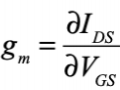
For a MOSFET used as an amplifier, the transconductance that (usually) matters is the small-signal transconductance. This is not a device parameter that can be put in a datasheet because, since the MOSFET is a square-law device in saturation, the small-signal transconductance is equal to the bias drain current divided by half the effective voltage.

As far as which setup has the greatest bandwidth. Well, that depends on the specifics. In particular, which capacitances are establishing the upper and lower cutoff frequencies and this, in turn, will depend on the component values chosen in the circuit, which in turn depend on what the frequency range is that you are trying to center around.
 

DickCappels

Joined Aug 21, 2008
10,661
Since there is a threshold voltage involved, this formula may provide more a satisfactory solution, at least for small signals:
1663055291320.png

We still do not really understand what you are trying to accomplish. The more specific you can be, the more detailed our advice can be.
 

Danko

Joined Nov 22, 2017
2,169
So far I only had to use simple ON-OFF mosfet.
I have a project that needs to make amplify a 1v signal to 50v
My load is a 0.04mH coil.
See diagram below and attachment:
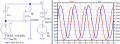
1663106265403.png
= = = = = = = = = = = = = = = = = = = = = = = = = = = = = = = = = = = = = = = = = = = = = = = = = = = = =

I am trying to avoid the negative pulse.
It is easy to obtain pulsed magnetic field, using AC voltage.
See this thread about similar problem:

"Coil, directly feeding from amplifier, requires 275Vp for current 4.3A, so power of amplifier should be about 1 kW.
However using circuit below, power, provided by amplifier, may be decreased to few watts:
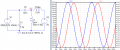
1663053227762.png"
 

Attachments

Last edited:
Top