Amplifier circuit for portable speaker project

Thread Starter

Eyebrows

Joined Aug 14, 2018
6
Evening all,

I've been doing some research and searching for this project to find a suitable circuit and have succeeded in getting myself confused and bogged down so am now looking for some advice!

I'm converting an old 4ohm 40w (RMS) speaker and housing into a portable speaker project. Now, I'll deal with the energy storage and power source later once I know what the requirements are. Anyway, what I'm mainly looking for is a suitable amplifier board for this.

Could anyone recommend a circuit that would produce suitable power, preferably not too high voltage requirement (as powered by li ion battery) and have decent sound quality. Now I know the speaker is 40w RMS but although I don't know much about what power is required, I'm pretty sure 40W isn't necessary especially from a decent circuit. I don't however know what power is recommended (it will be an outdoor portable speaker and Id like it to be fairly loud). Sound quality wise I'd like it to be as decent as possible but obviously not audiophile quality just decent sound.

Finally, it needs to be mono!

Could anyone suggest a circuit for not too much money (I'm in the UK)? Either a kit or prebuilt would be nice. But if needed I have the skill and most of the equipment to make my own one up I guess.

Hope someone can help, apologies if I've posted this in the wrong section. If I've failed to mention anything or you have any questions, please shout.

Cheers
 

AnalogKid

Joined Aug 1, 2013
12,055
If you want the possibility of running the speaker at its rated limit, you'll need 40 W of power out of the amplifier. Depending on the amp, the power supply required to produce this could be anywhere from 50 W to 100 W (linear power amps are not very efficient). For voltage and current numbers, look to Ohm, Watt, and Joule laws.

Joule: power = current squared times resistance. Rearranging, current = sqrt ( power / resistance ) = sqrt ( 40 / 4 ) = 3.16 ARMS (more on RMS later)
Watt: power = voltage squared divided by resistance. Rearranging, voltage = sqrt ( power x resistance ) = sqrt ( 40 x 4 ) = 12.65 V RMS
Ohm: voltage = current times resistance. 12.65 should equal 3.16 x 4. 3.16 x 4 = 12.64. Close enough, the difference is due to rounding errors.

The DC power supply numbers needed to produce the full 40 W output are larger because the supply has to supply the peak speaker current at the peak output voltage. The conversion from RMS to the full peak-to-peak voltage and current swing is 2 x sqrt(2), or 2.828 x. That's a lot. You need a minimum of a single +37.5 V (call it +38 V) or dual +/-19 V output voltage(s), able to supply a peak current of 9 A (or +/- 4.5 A). Again, that's a lot.

Battery capacity is given in amp-hours. A 12 V, 5 A-h battery has a nominal capacity of 60 watt-hours. Because of inefficiencies in the power supply and the amplifier, as well as the amplifier operating voltage "headroom", this is probably not enough battery to run the amp at full volume for 1 hour. It would run the amp at 4 W for a few hours.
I'm pretty sure 40W isn't necessary especially from a decent circuit.
The quality of the circuit has nothing to do with the loudness. For any given speaker and power level, a crappy amp with 10% distortion and a super quality amp with 0.1% distortion will be exactly the same loudness.

Bottom line, until you have a better handle on the amplifier output power requirements, it is difficult to recommend an amplifier circuit or module that will work.

ak
 

Audioguru

Joined Dec 20, 2007
11,248
You cannot buy or design an amplifier unless you know how much power you want.

What is the maximum battery voltage (number of Li-Ion cells)? 2 cells average only 7.4V (8.4V when fully charged). A single amplifier will produce only about 0.6W into a 4 ohm speaker. 4 cells will produce about 2.1W. 8 cells will produce about 7.4W.

A bridged amplifier produces about 3.5 times more power (8 cells will produce about 26W).

You also need to know how much current the amplifier draws to determine how long a certain battery charge will last or how big its battery cells must be.
 

Thread Starter

Eyebrows

Joined Aug 14, 2018
6
Firstly, thanks for the replies, really appreciate it.

Sorry, I don't think I made myself very clear the first time round! I'm more than happy calculating powers, currents and voltages. I was trying to sort the circuit out first then I'll spec the voltage and capacity of the power supply later myself, I have no issue doing that. Where my lack of knowledge comes in is the audio part of this circuit. The main thing is I have no idea what power I should look for to drive this speaker. Does anyone have any recommendations? Obviously the speaker caps this at 40w or so but I have a feeling that's way more than I'd want from the amplifier. Now, after the power rating has been sorted, what would be a suitable chip and circuit to use for it that has known decent sound quality? It's only a single speaker so mono is fine or bridged stereo I guess would work. I don't know much about bridging so I wouldn't exactly know what circuits could take it and which couldn't.

From there I'll deal with the power supply, I'm not too worried about that. If I know what it needs to provide I can spec it to that.

Thanks for the help, hope that clears things up a bit! Let me know if not

Cheers
 

Thread Starter

Eyebrows

Joined Aug 14, 2018
6
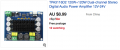
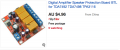
Wow, those all look very cheap! What's the sound quality on them like? I kind of want this to sound pretty good as a speaker if possible, would those circuits be suitable?
 

KJ6EAD

Joined Apr 30, 2011
1,581
Unless you're playing music in an otherwise quiet environment, the class D amplifier will be adequate and the most power efficient. To minimize distortion, it's best to avoid delivering more than about 60% of the speaker's RMS rating to it so if you get a 100W amplifier, look into setting a hard limit in the hardware behind the panel.

Driving less than 20W into a 32W RMS speaker, I've been able to get over 100 dB SPL (A weighted) at 1m distance.

If this is a busking cart project, you might try searching the forum for "busking" references as there probably have been prior threads on the topic.
 
Last edited:

dendad

Joined Feb 20, 2016
4,635
While this is bigger that your speaker, I made a PA amp with a couple of those class D Ebay modules and it runs very well.
Amp.png
And added a speaker protector too.
SpkrProtector.png
So it is worth while having a look at them.
Running at the lower voltage will limit the power.

My setup was built into an old stereo equalizer as it had loads of room.
2 stereo modules were used to drive 4 speakers.
I did swap the input coupling capacitors on the amplifiers around as I was driving them from a pot to 0V as the volume control, and these amps are expecting a +ve volts on the input it appears. The amps sounded very noisy, but it was the input electrolytic capacitors reversed biased.
Changing that fixed the noise.
This amp is used for outside music performances with great success.
 

Audioguru

Joined Dec 20, 2007
11,248
Of course the ebay amplifiers are cheap. They are no-name-brand and first two use obsolete ICs that are not made anymore. Defective old ICs or Chinese copies? Their heatsinks are much too small.

The ebay ads lie. They say the TDA2030A amplifier uses a 6V to 12V supply but the datasheet says 12V is the minimum. Ebay says 18W but the datasheet says only when the supply is a little higher than 40V with an 8 ohm speaker and only when the supply is 32V with a 4 ohm speaker but the heatsink is way too small for 18W.

The ebay ad for the TDA2050 amplifier says DC 12-24V 5W-120W but the datasheet says with a 12V supply the power is about 2W into a 4 ohm or 8 ohm load and with a 24V supply the power is 7W into 8 ohms or 20W into 4 ohms. The 8 ohm graph stops at 22V and 25W. the 4 ohm graph stops at 44V and 40W. The heatsink is too small for power more than 7W.

I did not look at the TPA3116 class-D amplifier because the ebay ad has no spec's for it.
 

Thread Starter

Eyebrows

Joined Aug 14, 2018
6
Sorry for the delay in reply, thank you very much for all the advice.

So a bit of thinking, I reckon I'd love to aim for about 30W RMS going into a mini speaker. (don't mind doing it via bridged stereo). Voltage wise I'd rather keep it below 24V or so if possible, 12v would be ideal but I realise that may be a bit difficult.

I'll sort a power supply to the correct voltage and current requirements, I'm not too worried about that as that can be fairly flexible.

Chances are this speaker would be used indoors in quiet rooms so I'd really appreciate a decent sounding circuit if possivle
 
Top