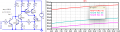
ambient temperature problem

Thread Starter

hhsting

Joined Apr 25, 2024
395
Thanks buddy. Sorry to piss you off but this time cant use ICs micro controller. I dont have money left and those are expensive now that inflation going up gotta save every penny. However thank you for helping me see the alternative. I just dig up something that does discrete components only. I have alot of discrete components transistors resistors diodes capacitors, inductors lying around.
 

wayneh

Joined Sep 9, 2010
18,104
Buck converter are not bound by temperature changes wither and they might do the same 0.1V drop as ambient temp changes.
That's not relevant to a constant current control scheme. A typical approach is to use a voltage reference and compare that voltage to the drop across a shunt resistor in series with the load under control. Both the reference and the shunt resistor can be specified to minimal temperature effect. If greater precision is required (it isn't, for driving an LED), a circuit can be used to compensate for temperature effects.
 

WBahn

Joined Mar 31, 2012
32,852
Thanks buddy. Sorry to piss you off but this time cant use ICs micro controller. I dont have money left and those are expensive now that inflation going up gotta save every penny. However thank you for helping me see the alternative. I just dig up something that does discrete components only. I have alot of discrete components transistors resistors diodes capacitors, inductors lying around.
Given that you can get microcontrollers for as little as three cents these days....

Now, you do need a means of programming it, but those can be had for very little, too. I've seen basic ones for under $10. The needed software is often free. Once you have the programmer, think of how much you can save down the road if you can replace a half-a-dozen five cent parts with a single MCU that cost you five to ten cents.
 

Thread Starter

hhsting

Joined Apr 25, 2024
395
Given that you can get microcontrollers for as little as three cents these days....

Now, you do need a means of programming it, but those can be had for very little, too. I've seen basic ones for under $10. The needed software is often free. Once you have the programmer, think of how much you can save down the road if you can replace a half-a-dozen five cent parts with a single MCU that cost you five to ten cents.
Those days are gone where we csn just go in store and buy. I have none so shipping handling traiffs etc much for than $10.
 

Thread Starter

hhsting

Joined Apr 25, 2024
395
Replace it by another NPN transistor and change R8 to 6.2Ω.
It will no longer be temperature compensated, but as light intensity of an LED varies with temperature, does it matter?
How did you get 6.2 ohms for R8? I am getting 13-0.75-3=9.25V. With 100mA current I am getting 92.5 ohms. What am I doing wrong?
 

WBahn

Joined Mar 31, 2012
32,852
How did you get 6.2 ohms for R8? I am getting 13-0.75-3=9.25V. With 100mA current I am getting 92.5 ohms. What am I doing wrong?
R8 is sized to provide the voltage that the TL421 is looking for, which is 2.5 V. So, at 100 mA, that means that R8 needs to be 25 Ω. But, if it is replaced with an NPN transistor, then R8 needs to be sized to produce Vbe at 100 mA. Since Vbe is around 0.6 V to 0.7 V, that means that you need something between 6 Ω and 7 Ω.
 

Ian0

Joined Aug 7, 2020
13,132
There's a Bob Pease circuit, where he replaced R6 with a Schottky diode (cathode to R8), and put a bias resistor from Q5 base to somewhere positive, and the transistor and Schottky temperature coefficients cancelled out.
Unfortunately, you then have two not-very-well-known values Vbe and Vf(schottky) setting the current, but it's stable with temperature.
 

Thread Starter

hhsting

Joined Apr 25, 2024
395
There's a Bob Pease circuit, where he replaced R6 with a Schottky diode (cathode to R8), and put a bias resistor from Q5 base to somewhere positive, and the transistor and Schottky temperature coefficients cancelled out.
Unfortunately, you then have two not-very-well-known values Vbe and Vf(schottky) setting the current, but it's stable with temperature.
nice but how can that be applied to Danko’s circuit without part labeled UL?
 

WBahn

Joined Mar 31, 2012
32,852
nice but how can that be applied to Danko’s circuit without part labeled UL?
Do you have Schottky diodes in your pile of stuff? If not, does it really matter, given that you are insisting that solutions can only use parts you already have?
 

Thread Starter

hhsting

Joined Apr 25, 2024
395
There's a Bob Pease circuit, where he replaced R6 with a Schottky diode (cathode to R8), and put a bias resistor from Q5 base to somewhere positive, and the transistor and Schottky temperature coefficients cancelled out.
Unfortunately, you then have two not-very-well-known values Vbe and Vf(schottky) setting the current, but it's stable with temperature.
Using the circuit he posted in post #33
Yes of course post#33 but exact placement of the diodes and transistor in circuit so band gap is cancelled in the circuit while maintaining the 100mA current checking is the question
 

Ian0

Joined Aug 7, 2020
13,132
Yes of course post#33 but exact placement of the diodes and transistor in so that band gap is cancelled in the circuit while maintaining the 100mA current checking is the question
Instead of using the TL431 bandgap reference which has a very good temperature coefficient, you can use the base-emitter junction as the reference but it has a poor temperature coefficient. If you add a schottky diode to the circuit it cancels out the temperature coefficient of the base emitter junction. However, the forward-volt drops of both base-emitter junction and schottky are not well-defined, so the sense resistor (R8) would have to be determined by experimentation.

What are you doing about the LED forward voltage drop temperature coefficient? And the temperature variation of the light output?
 
Top