ambient temperature problem

Thread Starter

hhsting

Joined Apr 25, 2024
395
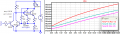
Instead of using the TL431 bandgap reference which has a very good temperature coefficient, you can use the base-emitter junction as the reference but it has a poor temperature coefficient. If you add a schottky diode to the circuit it cancels out the temperature coefficient of the base emitter junction. However, the forward-volt drops of both base-emitter junction and schottky are not well-defined, so the sense resistor (R8) would have to be determined by experimentation.

What are you doing about the LED forward voltage drop temperature coefficient? And the temperature variation of the light output?
Schokkty diodes i have has about 0.3V to 0.4V drop. Add the diodes where in the circuit base emitter of the transistor?

I am planing on doing nothing with diode forward voltage. It should be compensated by the 100mA current sensing no?
 

WBahn

Joined Mar 31, 2012
32,848
Schokkty diodes i have has about 0.3V to 0.4V drop. Add the diodes where in the circuit base emitter of the transistor?

I am planing on doing nothing with diode forward voltage. It should be compensated by the 100mA current sensing no?
Not if your current sensing is temperature sensitive.

You still haven't given an indication of what you really NEED this circuit to do.

It's one thing to keep the current within 10% over a wide temperature range. It's quite another to keep it within 1% and yet quite another to keep it within 0.1%.

What is the tolerance that you NEED this circuit to regulate the current to over your temperature range?

If this is just turning an LED light on and off over the course of the day, you'll probably not notice a difference of as much as 50% between summer and winter.

If you think you need to keep the current the same to keep the light output the same over that temperature range, you're wrong. The LED will put out a different amount of light at extreme versus the other.

So, again, what is the actual problem you are trying to solve?
 

Thread Starter

hhsting

Joined Apr 25, 2024
395
Not if your current sensing is temperature sensitive.

You still haven't given an indication of what you really NEED this circuit to do.

It's one thing to keep the current within 10% over a wide temperature range. It's quite another to keep it within 1% and yet quite another to keep it within 0.1%.

What is the tolerance that you NEED this circuit to regulate the current to over your temperature range?

If this is just turning an LED light on and off over the course of the day, you'll probably not notice a difference of as much as 50% between summer and winter.

If you think you need to keep the current the same to keep the light output the same over that temperature range, you're wrong. The LED will put out a different amount of light at extreme versus the other.

So, again, what is the actual problem you are trying to solve?
Two things:

1. I am trying to have full light output i.e full brightness from led regardless of temperature difference

2. I am also trying to have same full light output i.e full brightness from two sources whichever is on regardless of temperature difference: battery 9VDc lasting up-to 4VDC or plug outlet constant supply of 12.5VDC. The battery being backup when power is gone.

Now manufacturer just hasnt provided led I-V curves. Says he has none are. Maybe I can test the led at various points to get something
 

WBahn

Joined Mar 31, 2012
32,848
Two things:

1. I am trying to have full light output i.e full brightness from led regardless of temperature difference

2. I am also trying to have same full light output i.e full brightness from two sources whichever is on regardless of temperature difference: battery 9VDc lasting up-to 4VDC or plug outlet constant supply of 12.5VDC. The battery being backup when power is gone.

Now manufacturer just hasnt provided led I-V curves. Says he has none are. Maybe I can test the led at various points to get something
What are you defining as "full brightness"? If you want it brighter, force more current through it until just before it fails. Anything less isn't "full brightness".

Unless you specify as specific brightness, then "full brightness" at one temperature isn't going to be the same as "full brightness" at another temperature. Even using the "just before failure" definition of full brightness, since that failure point will be at a different brightness level.

Since the brightness of the LED varies with temperature, how do you expect your circuit maintain "full brightness"? To do that, you would need to monitor the actual brightness and use feedback to adjust the current to maintain that brightness. Even then, you would be maintaining a specific brightness, which is not going to be "full brightness" unless your definition of "full brightness" specifies a particular brightness.

To top it off, I doubt that having "full brightness" is the actual problem you are trying to solve, even if you were to clearly define what "full brightness" even means.

Why do you NEED "full brightness"? What bad thing happens if the actual brightness in the summer is 85% of some "full brightness" while it is 95% of that in the winter? What is it that you are doing that would even notice the difference?

Are you taking into account that the very nature of the light given off by the LED is going to be different at the different temperatures, due to the change in bandgap energy? The light will tend to be red-shifted at the higher temperatures?

What you are doing seems akin to me saying that I need to turn my car into a race car, but I want to do it using only tools and parts that I happen to have in my garage. Oh, and by the way, I don't even know what I mean by "race car" -- I can't say whether I want to race it at the drag strip, at Indianapolis, at Baja, or in the Pikes Peak Hill Climb. I just know I "need" a race car. But now I want people to tell me what modification I should make to my carburetor to achieve my goal.
 

Thread Starter

hhsting

Joined Apr 25, 2024
395
But you are doing nothing to mitigate the variation of brightness with temperature?
Now that you and WBahn made it clear constant current of 100ma thru led will not give me full brightness at various currents then i would need it.
 

Ian0

Joined Aug 7, 2020
13,132
Now that you and WBahn made it clear constant current of 100ma thru led will not give me full brightness at various currents then i would need it.
C
So, if you set it to "full" brightness at 25°C, then you would need to put more current into at 75°C to get the same light output.
Or do you set it to full brightness at 75°C, and have it run at a lower current at 0°C

By the way, do you realise just how sensitive the human eye is to changes in brightness? You would completely fail to notice variations of less than 1dB (about 12%)
 

WBahn

Joined Mar 31, 2012
32,848
Now that you and WBahn made it clear constant current of 100ma thru led will not give me full brightness at various currents then i would need it.
Need WHAT?

And WHY???

What is it that you are doing that you NEED "full brightness" and that you NEED the brightness to be exactly the same across the entire temperature range?

How are you even defining "brightness" given that the color of the light will be different at different temperatures?

Why do you think that whatever it is you are trying to achieve is even achievable using only what you happen to have lying around? This isn't Gilligan's Island and none of us are the Professor. Or MacGyver.
 

Thread Starter

hhsting

Joined Apr 25, 2024
395
Need WHAT?

And WHY???

What is it that you are doing that you NEED "full brightness" and that you NEED the brightness to be exactly the same across the entire temperature range?

How are you even defining "brightness" given that the color of the light will be different at different temperatures?

Why do you think that whatever it is you are trying to achieve is even achievable using only what you happen to have lying around? This isn't Gilligan's Island and none of us are the Professor. Or MacGyver.
Sorry buddy i understand. I appreciate all your help so far. Brightness would be the maximum luminance (LM) as defined in the spec of led it can achieve. Yes that LM should stay constant regardless of temperature changes outside. I will just shut up and work with what I have and Danko provided see i can tweak somethings if needed
 

Ian0

Joined Aug 7, 2020
13,132
Sorry buddy i understand. I appreciate all your help so far. Brightness would be the maximum luminance (LM) as defined in the spec of led it can achieve. Yes that LM should stay constant regardless of temperature changes outside. I will just shut up and work with what I have and Danko provided see i can tweak somethings if needed
How long do you want it to last? If you run it at a lower current that it's absolute maximum, it will last a lot longer. Look up "Arrhenius equation".
 

WBahn

Joined Mar 31, 2012
32,848
Sorry buddy i understand. I appreciate all your help so far. Brightness would be the maximum luminance (LM) as defined in the spec of led it can achieve. Yes that LM should stay constant regardless of temperature changes outside. I will just shut up and work with what I have and Danko provided see i can tweak somethings if needed
What spec?

Getting any kind of spec from the Warm and Happy company would be a near miracle. All I've seen is a marketing claim of 60 to 70 lumens/watt with zero information about what conditions that is for. One thing you can probably count on is that the "specs" in the ad are is based on running the LED at the absolute max current, which will ensure a relatively short lifespan.

So let's look at a roughly comparable LED from OSRAM that has much better specs to see what kind of changes can be expected.

1763506666567.png

Even if the lumens/watt were a constant, you would have to change your current as a function of temperature because the voltage across the device drops when increasing temperature, hence, for the same current, less power is delivered to the device. The Vf is typically about 125 mV less at 38°C than at -15°C, meaning that, at a constant current of 100 mA and a Vf of 3.0 V at 25°C, your power at 25°C is 300 mW, but at -15°C is it about 310 mW, but only about 294 mW at 38°C.

But a more direct measure is the second graph where we can see that, at -15°C, the luminous flux is about 15% higher than at 25°C and, at 38°C, it is about 2% lower. So if you need have the same light output that you get at max current at 25°C, you will need to overdrive the LED by 2% at the high temp (which will significantly shorten its life), but run it 15% below max at the low temps.
 

Thread Starter

hhsting

Joined Apr 25, 2024
395
What spec?

Getting any kind of spec from the Warm and Happy company would be a near miracle. All I've seen is a marketing claim of 60 to 70 lumens/watt with zero information about what conditions that is for. One thing you can probably count on is that the "specs" in the ad are is based on running the LED at the absolute max current, which will ensure a relatively short lifespan.

So let's look at a roughly comparable LED from OSRAM that has much better specs to see what kind of changes can be expected.

View attachment 359063

Even if the lumens/watt were a constant, you would have to change your current as a function of temperature because the voltage across the device drops when increasing temperature, hence, for the same current, less power is delivered to the device. The Vf is typically about 125 mV less at 38°C than at -15°C, meaning that, at a constant current of 100 mA and a Vf of 3.0 V at 25°C, your power at 25°C is 300 mW, but at -15°C is it about 310 mW, but only about 294 mW at 38°C.

But a more direct measure is the second graph where we can see that, at -15°C, the luminous flux is about 15% higher than at 25°C and, at 38°C, it is about 2% lower. So if you need have the same light output that you get at max current at 25°C, you will need to overdrive the LED by 2% at the high temp (which will significantly shorten its life), but run it 15% below max at the low temps.
lano did say what i am doing about forward voltage. Makes sense LED is light emitting diode and diode has forward voltage drop depended upon temperature.

Their is nothing that can be done. If luminous stay constant then life of led at stake temp changes. If current stay constant then luminous of led can vary when temp changes. You all are saying voltage cant stay constant for led wouldn't work. Their is not many variables to play with now
 
Last edited:

Thread Starter

hhsting

Joined Apr 25, 2024
395
How long do you want it to last? If you run it at a lower current that it's absolute maximum, it will last a lot longer. Look up "Arrhenius equation".
You mean run it anywhere between 90 ma to 100ma?
 
Last edited:

WBahn

Joined Mar 31, 2012
32,848
You mean run it anywhere between 90 ma to 100ma?
A general rule of thumb is that components should be run at no more than about 50% to 75% of their rated power to ensure long life. Since voltage is nearly constant for an LED, that translates directly to the same fraction of rated current.
 

Thread Starter

hhsting

Joined Apr 25, 2024
395
A general rule of thumb is that components should be run at no more than about 50% to 75% of their rated power to ensure long life. Since voltage is nearly constant for an LED, that translates directly to the same fraction of rated current.
In Dankos last circuit your not keeping the voltage led constant are you?
 

Ian0

Joined Aug 7, 2020
13,132
Would you mind explaining how this circuit temperature change is very little? I don't get it. I also don't get how this circuit work
The temperature coefficent of the schottky diode is the same as the temperature coefficient of Vbe of the transistor, so that they cancel out.
 
Top